Sima clan · Acting General-in-Chief
Gao Rou
courtesy name 文惠 · 174–263
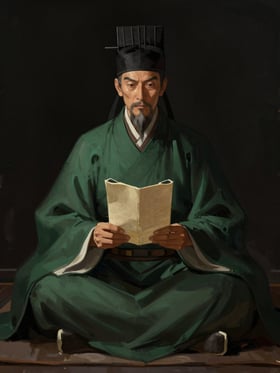
The Romance depicts Gao Rou, a noted Cao Wei official, holding camp on Sima Yi’s orders during the Cao Shuang case.

Life
In the novel: 1 chapter · In the Records: 4 volumes
Life174–263
220 CE (Huangchu 1)
254 CE (Zhengyuan 1)
Allegiance
Appearances
By chapter (5)
Novel
- 107
Records
- 4
- 11
- 12
- 24
List all 2 stops
- Chenliu174Birthplace
- Luoyang220–254Gao Rou's Administration of Criminal Law+1 more
On the boards
Compare with someone →Where this person ranks on each board.
Historical Record
Gao Rou, courtesy name Wenhui, was from Yu in Chenliu. His father, Gao Jing, once served as Commandant of Shu Commandery. As a young man, Gao Rou judged that the situation in Chenliu was unsettled and urged his fellow townsmen to avoid the disorder that Zhang Miao might provoke, but they did not believe him. Later, when Gao Gan summoned him to Hebei, he set out with his clan. On hearing that his father had died in Shu, he braved dangerous roads and rampant bandits to travel there and bring back the funeral cortege. It took him three years to return.
After Cao Cao Defeats the Yuan Clan, he appointed Gao Rou magistrate of Guan County. The county clerks heard of his reputation and left of their own accord, but Gao Rou cited Bing Ji’s example of leniency toward subordinates and summoned them back. From then on, they all applied themselves to their duties. Gao Rou later submitted to Cao Cao and served as an Investigating Censor, earning a reputation for fair enforcement of the law and for keeping cases moving without delay. He was gradually promoted to an official in the Chancellor’s Office. When Cao Cao prepared to send Zhong Yao to campaign against Zhang Lu, Gao Rou warned that Han Sui and Ma Chao in the west might take the opportunity to rebel, and urged that the Three Fu region be pacified first. After Zhong Yao entered the passes, Han Sui and Ma Chao did indeed raise troops.
Gao Rou’s views on criminal justice centered on lenient penalties, adherence to the law, and establishing the facts. When Song Jin and other soldiers deserted from Hefei, Cao Cao planned to extend collective punishment and execute Song Jin’s mother and younger brother. Gao Rou argued that harsh penalties might drive even more soldiers to flee in succession. Cao Cao heeded him, and Song Jin’s family was spared. During Cao Pi’s reign, Gao Rou opposed arbitrary killings and rewards for informers on charges of spreading rumors or slander. He also refused to obey an edict when Cao Pi wanted to execute Bao Xun unlawfully. Bao Xun was ultimately executed outright, and Gao Rou was not permitted to leave the Court of Judicial Review until after Bao Xun’s death. Under Cao Rui, Gao Rou invoked the principle that “the Court of Judicial Review is the standard of fairness for all under Heaven” to demand that the name of the person who had denounced Liu Gui be made public, allowing the case to be verified. He also pleaded on behalf of Xie Hong, who had feigned illness to mourn, prompting the emperor to pardon him.
Gao Rou served as Minister of Justice for twenty-three years, then held the posts of Grand Master of Ceremonies, Minister of Works, and Minister over the Masses. After Sima Yi submitted a memorial to remove Cao Shuang, the Empress Dowager ordered Gao Rou, bearing imperial authority, to act as General-in-Chief and take up position in Cao Shuang’s camp. Sima Yi said to him, “You are Zhou Bo now.” Gao Rou was later appointed Grand Commandant. He died in the fourth year of the Jingyuan era, aged ninety, and was posthumously named Marquis Yuan.
In the Novel
Chapter 107 of Romance of the Three Kingdoms places Gao Rou at the center of the Incident at the Gaoping Tombs. While Cao Shuang accompanied the Wei emperor Cao Fang out of the capital to pay respects at the tombs and hunt, Sima Yi seized the opportunity and ordered Gao Rou to “act as General-in-Chief, bearing the imperial axe and tally,” first taking control of Cao Shuang’s camp. The novel goes on to depict Sima Yi taking control of the armory, memorializing the Empress Dowager Guo to have Cao Shuang deposed, and deploying troops to guard strategic locations. Gao Rou, as an agent carrying out these orders, takes part in the Sima clan’s seizure of the initiative.
The historical account does record that after Sima Yi memorialized the court to remove Cao Shuang, the Empress Dowager issued an edict ordering Gao Rou to act as General-in-Chief with imperial authority and take up position in Cao Shuang’s camp; Sima Yi also compared him to Zhou Bo. Thus, the novel’s basic appointment and the episode of taking control of the camp have a historical basis. However, the novel elaborates on Cao Shuang’s departure from the capital, Sima Yi’s mobilization of troops while the opportunity presented itself, and a series of actions within the city. These details belong to the novel’s narrative and cannot all be treated as historical record.
Key Relationships
Gao Rou served under successive rulers of Cao Wei and was both a law-enforcement official and a courtier who repeatedly remonstrated with the sovereign. Cao Cao once accepted his advice about collective punishment for deserters and the order of military campaigns. In the face of Cao Pi, Gao Rou defied orders and upheld the law on Bao Xun’s behalf. Though he could not prevent Bao Xun’s execution, his actions showed that he would not readily bend the law in response to an angry ruler. In dealings with Cao Rui, he advocated careful handling of accusations, respect for judicial procedure, and leniency toward officials mourning family members. He also recommended improving the status of the Erudits and having the Three Excellencies participate in court affairs; some of his proposals were adopted.
Gao Rou’s relationship with Sima Yi became especially important in the case of Cao Shuang: he obeyed the edict to take control of Cao Shuang’s camp, and Sima Yi likened him to Zhou Bo, who had quelled the Lü clan’s rebellion. The novel retains this central relationship and portrays Gao Rou as one of the agents in Sima Yi’s plan to seize power.
Signature Scenes
The scene that best captures Gao Rou’s approach to law enforcement begins when Ying, the wife of Dou Li, is confiscated by the government as a deserter’s family member and eventually goes to the Court of Judicial Review to plead her case. Gao Rou probes for clues in her account of her husband’s character and associates, then notices that Jiao Ziwen, a fellow soldier from the same camp, looks uneasy. He questions him step by step until Jiao Ziwen confesses and reveals where Dou Li’s body is buried. An edict restores Ying and her child to commoner status and orders the case to be announced throughout the region as a warning.
Another scene shows how Gao Rou corrected a harsh prohibition in the interest of the people’s livelihood. Deer in a restricted area were eating the crops, yet anyone who caught one risked execution. Gao Rou submitted a memorial describing the damage to farming and the people’s inability to protect themselves, and requested that the public be allowed to hunt deer. The ban was then abolished. Meanwhile, his taking up position in Cao Shuang’s camp with imperial authority during the Incident at the Gaoping Tombs reveals the political role this long-serving elder statesman played amid a transfer of power. This action, recorded in the historical account, was also recast in the novel as an important part of Sima Yi’s opportunistic maneuvering.
- Family
- Friends
- Enemies
- Other
Who is Gao Rou connected to?
Pick someone to see how many steps lie between them and Gao Rou.
History vs. novel
7 points
| History | Novel |
|---|---|
| Gao Gan's FuneralHistory only | |
Gao Rou followed his clan in seeking refuge with Gao Gan. After Gao Gan died in the western region, he risked the journey to Shu to escort the coffin home. The journey was arduous, and he did not return for three years. vol. 24 | — |
| Appointing Officials in Jian CountyHistory only | |
Before Gao Rou took office as magistrate of Jian County, corrupt clerks left of their own accord after hearing of his reputation. He instead summoned them all back and treated them leniently; afterward, the clerks all urged themselves to become good officials. vol. 24 | — |
| Covering Him with a Fur Robe at NightHistory only | |
The Annals of the Wei Clan records that Gao Rou fell asleep holding some documents, and when Cao Cao made his rounds at night, he took off his fur robe and covered him with it. This incident appears in material cited in the Records of the Three Kingdoms, but not in the corresponding passage of the novel. vol. 24 | — |
| Advising Against Attacking Zhang LuHistory only | |
When Cao Cao was preparing to send Zhong Yao and others to attack Zhang Lu, Gao Rou urged him to pacify the Three Auxiliary Commanderies first, lest Han Sui and Ma Chao grow suspicious and rebel. After Zhong Yao entered the pass, Han Sui and Ma Chao did indeed rebel. vol. 24 | — |
| Sparing the Families of DesertersHistory only | |
After Song Jin and others fled, the officials in charge submitted a petition to execute their mothers, wives, and brothers. Gao Rou opposed punishing their families, and Cao Cao accepted his advice, stopping the killing of Song Jin's mother and brothers. vol. 24 | — |
| Defending Bao XunHistory only | |
Cao Pi wanted to have Bao Xun unlawfully executed, but Gao Rou refused to obey the edict. Cao Pi sent someone to the Court of廷尉 to deal with Bao Xun, and Gao Rou was not allowed to return to his office until after Bao Xun had died. vol. 24 | — |
| Appointment at the CampSources disagree | |
After Sima Yi submitted a request to remove Cao Shuang from office, the Empress Dowager issued an edict summoning Gao Rou, granting him a tally of authority and ordering him to act as General-in-Chief and take up position at Cao Shuang's camp. vol. 24 | When Sima Yi learned that Cao Shuang and the others had left the city with Cao Fang, he immediately ordered Gao Rou, granting him a tally and axe of authority, to act as General-in-Chief and first occupy Cao Shuang's camp. The novel depicts the appointment as a direct order from Sima Yi. ch. 107 |
- Gao Gan's FuneralHistory only
- History
Gao Rou followed his clan in seeking refuge with Gao Gan. After Gao Gan died in the western region, he risked the journey to Shu to escort the coffin home. The journey was arduous, and he did not return for three years.
vol. 24
- Appointing Officials in Jian CountyHistory only
- History
Before Gao Rou took office as magistrate of Jian County, corrupt clerks left of their own accord after hearing of his reputation. He instead summoned them all back and treated them leniently; afterward, the clerks all urged themselves to become good officials.
vol. 24
- Covering Him with a Fur Robe at NightHistory only
- History
The Annals of the Wei Clan records that Gao Rou fell asleep holding some documents, and when Cao Cao made his rounds at night, he took off his fur robe and covered him with it. This incident appears in material cited in the Records of the Three Kingdoms, but not in the corresponding passage of the novel.
vol. 24
- Advising Against Attacking Zhang LuHistory only
- History
When Cao Cao was preparing to send Zhong Yao and others to attack Zhang Lu, Gao Rou urged him to pacify the Three Auxiliary Commanderies first, lest Han Sui and Ma Chao grow suspicious and rebel. After Zhong Yao entered the pass, Han Sui and Ma Chao did indeed rebel.
vol. 24
- Sparing the Families of DesertersHistory only
- History
After Song Jin and others fled, the officials in charge submitted a petition to execute their mothers, wives, and brothers. Gao Rou opposed punishing their families, and Cao Cao accepted his advice, stopping the killing of Song Jin's mother and brothers.
vol. 24
- Defending Bao XunHistory only
- History
Cao Pi wanted to have Bao Xun unlawfully executed, but Gao Rou refused to obey the edict. Cao Pi sent someone to the Court of廷尉 to deal with Bao Xun, and Gao Rou was not allowed to return to his office until after Bao Xun had died.
vol. 24
- Appointment at the CampSources disagree
- History
After Sima Yi submitted a request to remove Cao Shuang from office, the Empress Dowager issued an edict summoning Gao Rou, granting him a tally of authority and ordering him to act as General-in-Chief and take up position at Cao Shuang's camp.
vol. 24
- Novel
When Sima Yi learned that Cao Shuang and the others had left the city with Cao Fang, he immediately ordered Gao Rou, granting him a tally and axe of authority, to act as General-in-Chief and first occupy Cao Shuang's camp. The novel depicts the appointment as a direct order from Sima Yi.
ch. 107
Combat
On the field
Duels, kills and executions as the texts tell them, counted separately for the Records and the Romance.
Stratagems
Plans this person devised or saw through, as the texts tell them.
- Records
- 1 carried out · 1 worked · 0 turned down · 0 seen through
- RecordsFalsely Claim to Be Questioning the CulpritDeceptionWorkedJuan 24「汝昔舉竇禮錢,何言不邪」
Events
Events (3)
Battles and events the texts place this person in, by date.
Other events
- 220Gao Rou's Administration of Criminal LawInstigator
- 249Incident at the Gaoping Tombs
- 254Deposition of Cao FangWitness
Places
Continue
Gao Rou's Administration of Criminal Law
Relationship timeline7 entries ▸
History · vol. 12
- Bao Xun§66
Witnessed
Memorialized a request that Bao Xun be punished
History · vol. 24
- Gao Jing§19
Kin
Father and son; Rou risked the journey to Shu to bring back his father’s funeral cortege
- Gao Gan§20
Kin
His elder male cousin Gao Gan (Yuan Shao’s nephew) summoned Rou; Rou followed him with his entire clan.
- Zhong Yao§21
Rival
urged Taizu not to send Zhong Yao and others to attack Zhang Lu
- Cao Pi§26
Rival
The emperor wished to execute Bao Xun in violation of the law, but Rou firmly refused to obey the imperial edict; the emperor angrily summoned Rou to the office
- Cao Rui§27
Advised
repeatedly submitted memorials urging Emperor Ming to accept remonstrance (on academicians, palaces, prohibiting hunts, and wrongful accusations)
- Sima Yi§34
Friend
The Grand Tutor submitted a memorial to remove Cao Shuang, and had Rou act as General-in-Chief with delegated authority and occupy Shuang’s camp; he called him “Zhou Bo”
Inner monologues · AI-generated3 monologues ▸
- When I was young and living in my native district, Chenliu was no place to sit at ease. The roads led in every direction
- I am Gao Rou, courtesy name Wenhui. Serving at the Wei court, I held to little more than a commitment to study the class
- I believe that governing the people is like untangling a mass of knotted thread; one cannot simply give it a sudden tug