Cao Wei · Grand Marshal
Cao Zhen
courtesy name 子丹 · –231
Not to be confused with Cao Zhen (曹珍) — Cao Zhen, a Wei general, was defeated at Gaoting by the Wu general Lü Ju in 256.
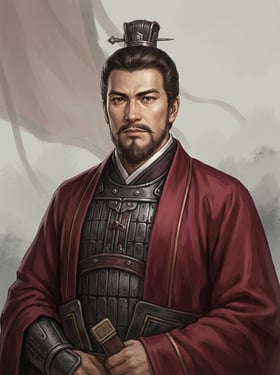
Cao Zhen shared hardships and comforts alike with his officers and men; when the army's rewards fell short he would often distribute his own family wealth among them, and so won the deep devotion of his soldiers. Steady and discerning, he could see through schemes of estrangement, acting with prudent gravity and relying on careful planning. Yet he once caused his vanguard's defeat by failing to vet the men he used, or, eager to win merit and wipe out disgrace, credulously trusted a feigned surrender, and in the end, grown arrogant, complacent, and contemptuous of the enemy, died of shame and rage.

Life
In the novel: 14 chapters · In the Records: 15 volumes
Life?–231
220 CE (Huangchu 1)
222 CE (Huangchu 3)
223 CE (Huangchu 4)
- Five-Route Invasion of ShuChengduCommander
4 more events
224 CE (Huangchu 5)
- Cao Pi's Guangling CampaignGuanglingCommander
228 CE (Taihe 2)
228 CE (Taihe 2)
- Battle for ChencangChencangCommander
230 CE (Taihe 4)
- Cao Zhen's Invasion of ShuHanzhongCommander
Allegiance
- Cao Wei
- Life event
List all 8 stops
- Luoyang220Cao Cao Dies and Emperor Wen of Wei Ascends the Throne
- Jiangling222Three-Pronged Campaign against Wu
- Chengdu223Five-Route Invasion of Shu
- Guangling224Cao Pi's Guangling Campaign
- Chencang228Battle for Chencang
- Mount Qi228Kongming Scolds Wang Lang to Death+2 more
- Hanzhong230Cao Zhen's Invasion of Shu
- Luoyang231Died here
On the boards
Compare with someone →Where this person ranks on each board.
Who they were
Character profile
- Character
- Cao Zhen shared hardships and comforts alike with his officers and men; when the army's rewards fell short he would often distribute his own family wealth among them, and so won the deep devotion of his soldiers. Steady and discerning, he could see through schemes of estrangement, acting with prudent gravity and relying on careful planning. Yet he once caused his vanguard's defeat by failing to vet the men he used, or, eager to win merit and wipe out disgrace, credulously trusted a feigned surrender, and in the end, grown arrogant, complacent, and contemptuous of the enemy, died of shame and rage.
- Life
- Cao Zhen was a clansman of Cao Cao, taken in and raised by him in his early years, and for his valor appointed a commander of the Tiger and Leopard Cavalry. He held in turn the offices of General Who Guards the West, Grand General of the Upper Army, Grand General of the Central Army, and Grand General, finally rising to Grand Marshal with authority over all military affairs within and without. Cao Zhen took part in many campaigns, including defeating a detached general of Liu Bei, campaigning against Sun Quan, quelling rebellions, and resisting Zhuge Liang's northern expeditions. He received Cao Pi's dying decree to assist in the government and correctly predicted Zhuge Liang's line of march, but during a campaign against Shu was forced by heavy rains to turn back.
- Anecdotes
- At Cao Pi's deathbed Cao Zhen was appointed one of the regent ministers, and later became commander of Wei's western front, with authority over the military affairs west of the passes. He held overall command of the troops of Yong and Liang, and yielded the seal of supreme command to Sima Yi. He was the father of Cao Shuang.
Historical Record
Cao Zhen, courtesy name Zidan, was a kinsman of Cao Cao. His father, Cao Shao, had followed Cao Cao when he raised an army in his early years, but was later killed by local authorities. Cao Cao took pity on the young Cao Zhen, who had lost his father, and adopted him, raising him alongside his own sons. In his youth, Cao Zhen once turned and shot a tiger while hunting. Cao Cao admired his courage and strength and put him in command of the Tiger and Leopard Cavalry. Later, Cao Zhen suppressed bandits at Lingqiu, took part in campaigns against Liu Bei’s generals, and, after Xiahou Yuan was killed in battle, was appointed Army Supervisor for the Campaign against Shu. He led Xu Huang and others in defeating Liu Bei’s general Gao Xiang. Cao Cao ordered him to meet the forces of Cao Hong and others as they returned to Chencang. After Cao Pi’s accession, Cao Zhen was appointed General Who Guards the West and given command of military affairs in Yong and Liang provinces. He was later appointed Senior General of the Upper Army, Senior General of the Central Army, and to other posts. When Cao Pi fell gravely ill, Cao Zhen, Chen Qun, Sima Yi, and others received his final edict to assist in governing. After Cao Rui’s accession, Cao Zhen was promoted to Marquis of Shaoling, appointed General-in-Chief, and subsequently made Grand Marshal.
Cao Zhen bore the main responsibility for resisting Shu forces on the western front. When Zhuge Liang advanced from Mount Qi and three commanderies rose in response, Cao Zhen stationed his troops at Mei. After Zhang He defeated Ma Su at Jieting, Cao Zhen advanced and besieged the people of Anding. Yang Tiao and others surrendered, and the three commanderies were pacified. Later, he judged that Zhuge Liang might next advance by way of Chencang, and ordered Hao Zhao and Wang Sheng in advance to repair and fortify the city. The following year, Zhuge Liang besieged Chencang, but could not take it because the Wei forces were prepared. Cao Zhen was rewarded with an increase in his fief. In countering Zhuge Liang’s offensives, he also dispatched Fei Yao and others to hold Chencang. As the Wei court’s General-in-Chief and commander of the forces in the Guanyou region, he was one of the central commanders responsible for Wei’s western defenses.
In the fourth year of the Taihe era, Cao Zhen was appointed Grand Marshal and advocated a multi-pronged campaign against Shu. The court accepted his proposal, and he set out from Chang'an, advancing south along the Ziwu Road, while Sima Yi and others provided support along separate routes. But heavy rain continued for more than thirty days, and the plank roads were cut off. Emperor Ming issued an edict ordering the troops to withdraw. Senior officials including Chen Qun, Wang Su, and Yang Fu had urged caution, citing the treacherous routes, grain transport, and the rainfall, and the army ultimately withdrew. Gravely ill, Cao Zhen returned to Luoyang, where Emperor Ming personally visited him at his residence. After his death, he was posthumously titled Marquis Yuan, and Cao Shuang inherited his title. Remembering his achievements, Emperor Ming enfeoffed his five sons as marquises. The historical account also records that Cao Zhen shared hardships with his soldiers and, when military rewards fell short, distributed his own family wealth among them; as a result, the troops were willing to serve him. He also once asked to set aside part of his fief to provide for the descendants of his kinsman Cao Zun and fellow townsman Zhu Zan, both of whom had died young.
In the Novel
Romance of the Three Kingdoms expands the western-front commander from the historical account into a major rival who repeatedly matches wits with Zhuge Liang. The novel first has Cao Zhen lead troops out of Nan Commandery when Cao Pi deploys the Three-Pronged Campaign against Wu. It then portrays him as a trusted regent to Cao Rui: when Sima Yi falls under suspicion amid rumors of a plot to sow discord, Cao Zhen urges Cao Rui not to believe them lightly and proposes that he imitate Emperor Gaozu of Han by making a false visit to Yunmeng, using the opportunity to observe Sima Yi. These specific words and actions are the novel’s elaborations; the Records of the Three Kingdoms only records that Cao Zhen received the final edict to assist in governing, and makes no mention of this episode involving false accusations or the feigned visit to Yunmeng.
The novel focuses on Cao Zhen’s campaigns to resist Zhuge Liang. He consults with Wang Lang and Guo Huai on how to repel the enemy. Wang Lang’s attempt to persuade the opposing forces to surrender before battle fails, and he dies of anger at the front; Cao Zhen has his body interred. Guo Huai then proposes a plan to raid the Shu camp in turn. Cao Zhen agrees that it accords with his own thinking, but Zhuge Liang has already laid a counter-ambush, which defeats them. Cao Zun, Zhu Zan, and the other vanguard commanders are thrown into confusion, and the Wei army suffers a crushing defeat. Cao Zhen later adopts Guo Huai’s suggestion to attack with Qiang troops on both flanks, but still fails to turn the tide. The novel then has him pursue the Shu army as it retreats, only to lose two more vanguard commanders. This portrayal highlights his poor judgment in choosing subordinates and his repeated setbacks. By contrast, the historical account records that although Cao Zhen repeatedly faced Zhuge Liang, he also anticipated the threat to Chencang and successfully prepared its defenses. The novel recasts this episode as a more dramatic battlefield contest centered on stratagems and their success or failure.
Key Relationships
- Cao Cao: Cao Zhen was a kinsman of Cao Cao. Cao Cao adopted him after he was orphaned, raised him alongside his own sons, and, impressed by his courage and strength, put him in command of the Tiger and Leopard Cavalry. This upbringing explains how Cao Zhen entered the Cao clan’s military inner circle at an early age.
- Cao Pi and Cao Rui: Cao Zhen received Cao Pi’s final edict to assist in governing as Cao Pi lay dying. After Cao Rui’s accession, he appointed Cao Zhen General-in-Chief and later promoted him to Grand Marshal; when Cao Zhen was gravely ill, Cao Rui visited him in person. This illustrates Cao Zhen’s role in the succession of power across the reigns of Cao Cao and Cao Pi.
- Zhuge Liang: The two were the principal opponents in the Wei–Shu struggle on the western front. Historical accounts say Cao Zhen led forces against Zhuge Liang and prepared Chencang’s defenses in advance; he also led a campaign against Shu but withdrew under imperial orders because of heavy rain. The novel intensifies their rivalry into a series of contests of stratagems and defeats.
- Cao Zun and Zhu Zan: The historical account says Cao Zhen pitied Cao Zun and Zhu Zan, who had died young, and asked to set aside part of his fief for their descendants. The novel instead makes Cao Zun and Zhu Zan vanguard commanders under Cao Zhen and has them die in the fighting at Mount Qi. (Unique to the novel)
- Soldiers: On campaign, Cao Zhen shared his soldiers’ hardships and made up any shortfall in rewards from his own wealth, showing that his command relied not only on rank and title but also on sharing hardships with his troops.
Signature Scenes
- Shooting a Tiger While Hunting: When the young Cao Zhen was chased by a tiger, he turned and felled it with a single arrow. Cao Cao admired his courage and strength and put him in command of the Tiger and Leopard Cavalry. This vivid scene in the historical account explains his bravery and his early rise.
- Preparing Chencang’s Defenses: Judging from Zhuge Liang’s previous setback at Mount Qi, Cao Zhen anticipated that he might attack Chencang on his next advance, and ordered Hao Zhao and Wang Sheng to repair the city and prepare its defenses. The following year, Zhuge Liang did besiege the city, but could not take it because its defenses were ready, demonstrating Cao Zhen’s judgment on the western front.
- The Campaign Against Shu Along the Ziwu Road and the Withdrawal in the Rain: Cao Zhen proposed a multi-pronged campaign against Shu and personally advanced from Chang'an along the Ziwu Road. Continuous heavy rain obstructed the roads and plank roads, and the court ultimately ordered the army to withdraw. The campaign shows both his initiative in proposing an offensive and the limits that terrain, weather, and transport conditions placed on military decisions.
- The Miscalculated Night Raid at Mount Qi: In the novel, Cao Zhen follows Guo Huai’s plan to raid the Shu camp, sending Cao Zun and Zhu Zan to attack it. They enter an empty camp and are then struck by an ambush, throwing the Wei forces into confusion. This is a representative scene in which the novel depicts Cao Zhen matching wits with Zhuge Liang, only to be outmaneuvered. (Unique to the novel)
Quotes
26 lines in the books · 3 featured
「不可。文皇帝托孤於臣等數人,是知司馬仲達無異志也。今事未知真假,遽爾加兵,乃逼之反耳。或者蜀、吳奸細行反間之計,使我君臣自亂,彼卻乘虛而擊,未可知也。陛下幸察之。」
These words show Cao Zhen's trust in Sima Yi and his political foresight, averting internal conflict.
「吾家人知我病重,不令我知。似此國家危急,何不拜仲達為都督,以退蜀兵耶?」
Recommending Sima Yi while gravely ill reflects his broad-mindedness in putting the greater cause first and his talent for judging and employing men.
「蜀兵數次侵界,屢犯中原,若不剿除,後必為患。今時值秋涼,人馬安閒,正當征伐。臣願與司馬懿同領大軍,逕入漢中,殄滅奸黨,以清邊境。」
This line shows Cao Zhen's aggressive, proactive military attitude in volunteering for the front, in keeping with his image as a general.
- Family
- Lord & vassal
- Friends
- Enemies
- Other
Who is Cao Zhen connected to?
Pick someone to see how many steps lie between them and Cao Zhen.
History vs. novel
7 points · 2 novel-only
| History | Novel |
|---|---|
| Campaign Against Wu After YilingNovel only | |
| — | After the Battle of Xiaoting, Cao Pi judged that the Wu army might advance westward, and ordered Cao Zhen to lead troops out through Nan Commandery and attack Wu along separate routes with Cao Ren and Cao Xiu; the novel also says he accompanied the army to the riverbank. ch. 84 |
| Cao Pi Entrusts His HeirNovel embellishes | |
When Cao Pi was gravely ill, he summoned Cao Zhen, Chen Qun, Cao Xiu, and Sima Yi to receive his final edict and assist Cao Rui. vol. 2 | The novel first depicts Cao Zhen, Chen Qun, and Sima Yi being entrusted with the task; Cao Xiu then enters the palace, and Cao Pi also instructs him to join them in assisting Cao Rui. ch. 91 |
| Orders for Mount QiNovel embellishes | |
After Zhuge Liang besieged Mount Qi and three commanderies responded, Cao Rui ordered Cao Zhen to oversee the army stationed at Mei; Zhang He defeated Ma Su decisively at Jieting, and the three commanderies were pacified. vol. 9 | The novel depicts Cao Rui appointing Cao Zhen as Grand Commander and sending him with an army of 200,000 to Mount Qi, with Wang Lang and Guo Huai accompanying him; Cao Zhen also clashes with Zhuge Liang. ch. 93 |
| Defense of ChencangNovel embellishes | |
Cao Zhen anticipated that Zhuge Liang would launch another campaign and advance by way of Chencang, so he ordered Hao Zhao and Wang Sheng to defend the city and build up its defenses in advance. The following year, Zhuge Liang besieged the city but failed to capture it because the Wei army was already prepared. vol. 9 | The novel depicts the raid on the camp at Mount Qi as an ambush set by Cao Zhen, which Zhuge Liang saw through and countered. Cao Zhen fell ill from shame after his defeat; this is not the account of the defense of Chencang found in the historical records. ch. 93 |
| Campaign Against Shu Through the Ziwu RoadNovel embellishes | |
Cao Zhen proposed attacking Shu along several routes, and Emperor Ming of Wei accepted his proposal. Cao Zhen advanced south from Chang'an by way of the Ziwu Road, but after more than thirty days of heavy rain and the destruction of the plank roads, he received an imperial order to withdraw. vol. 9 | The novel depicts Cao Zhen and Sima Yi discussing the matter, then withdrawing because of thirty days of continuous rain and the army's desire to return; the two also arranged for troops to ambush the enemy and cover the retreat. ch. 99 |
| Three-Pronged Attack on HanzhongHistory only | |
According to Shu Han records, the Wei army intended to attack Hanzhong, with Sima Yi advancing by way of Xicheng, Zhang He by the Ziwu Road, and Cao Zhen by the Xie Valley. After heavy rain blocked the routes, Cao Zhen and the others withdrew. vol. 33 | — |
| Surrendering Command After DefeatNovel only | |
| — | The novel depicts Cao Zhen falling ill after Zhuge Liang raided his camp and routed him. Sima Yi comes to visit him, and Cao Zhen voluntarily hands over the seal of command, after which Sima Yi takes control of the army. ch. 100 |
- Campaign Against Wu After YilingNovel only
- Novel
After the Battle of Xiaoting, Cao Pi judged that the Wu army might advance westward, and ordered Cao Zhen to lead troops out through Nan Commandery and attack Wu along separate routes with Cao Ren and Cao Xiu; the novel also says he accompanied the army to the riverbank.
ch. 84
- Cao Pi Entrusts His HeirNovel embellishes
- History
When Cao Pi was gravely ill, he summoned Cao Zhen, Chen Qun, Cao Xiu, and Sima Yi to receive his final edict and assist Cao Rui.
vol. 2
- Novel
The novel first depicts Cao Zhen, Chen Qun, and Sima Yi being entrusted with the task; Cao Xiu then enters the palace, and Cao Pi also instructs him to join them in assisting Cao Rui.
ch. 91
- Orders for Mount QiNovel embellishes
- History
After Zhuge Liang besieged Mount Qi and three commanderies responded, Cao Rui ordered Cao Zhen to oversee the army stationed at Mei; Zhang He defeated Ma Su decisively at Jieting, and the three commanderies were pacified.
vol. 9
- Novel
The novel depicts Cao Rui appointing Cao Zhen as Grand Commander and sending him with an army of 200,000 to Mount Qi, with Wang Lang and Guo Huai accompanying him; Cao Zhen also clashes with Zhuge Liang.
ch. 93
- Defense of ChencangNovel embellishes
- History
Cao Zhen anticipated that Zhuge Liang would launch another campaign and advance by way of Chencang, so he ordered Hao Zhao and Wang Sheng to defend the city and build up its defenses in advance. The following year, Zhuge Liang besieged the city but failed to capture it because the Wei army was already prepared.
vol. 9
- Novel
The novel depicts the raid on the camp at Mount Qi as an ambush set by Cao Zhen, which Zhuge Liang saw through and countered. Cao Zhen fell ill from shame after his defeat; this is not the account of the defense of Chencang found in the historical records.
ch. 93
- Campaign Against Shu Through the Ziwu RoadNovel embellishes
- History
Cao Zhen proposed attacking Shu along several routes, and Emperor Ming of Wei accepted his proposal. Cao Zhen advanced south from Chang'an by way of the Ziwu Road, but after more than thirty days of heavy rain and the destruction of the plank roads, he received an imperial order to withdraw.
vol. 9
- Novel
The novel depicts Cao Zhen and Sima Yi discussing the matter, then withdrawing because of thirty days of continuous rain and the army's desire to return; the two also arranged for troops to ambush the enemy and cover the retreat.
ch. 99
- Three-Pronged Attack on HanzhongHistory only
- History
According to Shu Han records, the Wei army intended to attack Hanzhong, with Sima Yi advancing by way of Xicheng, Zhang He by the Ziwu Road, and Cao Zhen by the Xie Valley. After heavy rain blocked the routes, Cao Zhen and the others withdrew.
vol. 33
- Surrendering Command After DefeatNovel only
- Novel
The novel depicts Cao Zhen falling ill after Zhuge Liang raided his camp and routed him. Sima Yi comes to visit him, and Cao Zhen voluntarily hands over the seal of command, after which Sima Yi takes control of the army.
ch. 100
Combat
On the field
Duels, kills and executions as the texts tell them, counted separately for the Records and the Romance.
Battles in command
Battles this person commanded in, with the outcome as each text tells it.
- Records
- 1W 0L 0D 3 undecided
- Romance
- 1W 3L 0D 2 undecided
- Records222Three-Pronged Campaign against WuUndecidedvs Wu forcesJuan 47「是月,魏軍皆退」
- Romance222Three-Pronged Campaign against WuLostvs Wu troopsCh. 85「丕聽知三路兵敗,乃喟然嘆曰」
- Romance223Five-Route Invasion of ShuLostvs Shu armyCh. 86「曹真屯兵於斜谷道,不能取勝而回」
- Romance223Zhuge Liang Repels the Five ArmiesLostvs Shu armyCh. 86「見了馬超,不戰自退;南蠻孟獲起兵攻四郡,皆被魏延用疑兵計殺退回洞去了」
- Records228First Northern ExpeditionWonvs Shu armyJuan 3「右將軍張郃擊亮於街亭,大破之。亮敗走,三郡平」
- Records228Zhuge Liang's Second Northern ExpeditionUndecidedvs Shu armyJuan 35「冬,亮復出散關,圍陳倉,曹真拒之,亮糧盡而還」
All battles (10)
Loading…
Stratagems
Plans this person devised or saw through, as the texts tell them.
- Records
- 1 carried out · 0 worked · 0 turned down · 0 seen through
- Romance
- 2 carried out · 0 worked · 0 turned down · 0 seen through
- RecordsEarthen Mound and TunnelSiegeFailedagainst JianglingJuan 56「真等起土山,鑿地道,立樓櫓臨城,弓矢雨注」
- RomanceFeign a Visit to YunmengDeceptionFailedCh. 91「可仿漢高僞遊雲夢之計」
- RomanceRaid the CampOtherSeen throughagainst Shu troopsCh. 98「看今夜山西火起,蜀兵必來救應」
Events
Events (14)
Battles and events the texts place this person in, by date.
Battles
- 222Three-Pronged Campaign against WuCommander
- 223Five-Route Invasion of ShuCommander
- 228First Northern ExpeditionCommander
- 228Zhuge Liang's Second Northern Expedition
- 228Battle of Jieting
- 228Zhuge Liang's Northern ExpeditionsCommander
- 230Cao Zhen's Invasion of ShuCommander
- 231Zhuge Liang's Fourth Northern Expedition
Other events
Places
- Was at
- Liang ProvinceRecords
- Died at
- LuoyangRecords
Continue
The Zhuge Liang's Northern Expeditions in 3D
Replay the Zhuge Liang's Northern Expeditions phase by phase on real terrain: troop strengths, movements and turning points at a glance, each marked as coming from the Records of the Three Kingdoms or the Romance.
Relationship timeline10 entries ▸
History · vol. 3
Fights
The General-in-Chief Cao Zhen was commander of the forces west of the Passes and advanced the troops.
History · vol. 9
- Cao Cao§46
Kin
A kinsman of Taizu; Taizu pitied him for being orphaned young, took him in, and raised him alongside his own sons
- Cao Rui§47
Lord
In the seventh year of Huangchu, Emperor Wen fell ill and received an edict entrusting him with assisting in government; when Emperor Ming ascended the throne, he was promoted and enfeoffed as Marquis of Shaoling and appointed General-in-Chief
- Zhuge Liang§48
Fights
Commanded the armies at Mei; predicted that Liang would later certainly advance through Chencang, ordered Hao Zhao and Wang Sheng to defend it, and Liang indeed could not take it
History · vol. 17
- Zhang He§23
Friend
Attacked the Lushui Hu of Anding and the Eastern Qiang; also paid court at the Xu palace
Novel · ch. 93
- Zhuge Liang§16
Enemy
discussed with Guo Huai a plan to raid the Shu camp; fell into Zhuge Liang’s counter-ambush and suffered a major defeat
Novel · ch. 97
- Jiang Wei§27
Betrayer
falsely submitted a letter saying, "The guilty general Jiang Wei bows a hundred times," feigning surrender and tricking Cao Zhen into mobilizing troops
Novel · ch. 98
- Sima Yi§25
Friend
while ill, handed the seal of command over all the troops to Sima Yi, saying, "If Zhongda does not take this post, the realm will be in peril"
All 10
Loading…
Inner monologues · AI-generated3 monologues ▸
- I am Cao Zhen, courtesy name Zidan. Looking back on my life, what I remember most is not the banners before my tent, but
- When I recall my youth, my family was caught up in the upheavals that shook the realm. Yet the records available to us n
- I am Cao Zhen, courtesy name Zidan. I lost my father while still young. Taizu took pity on me and brought me into his ho