Overview
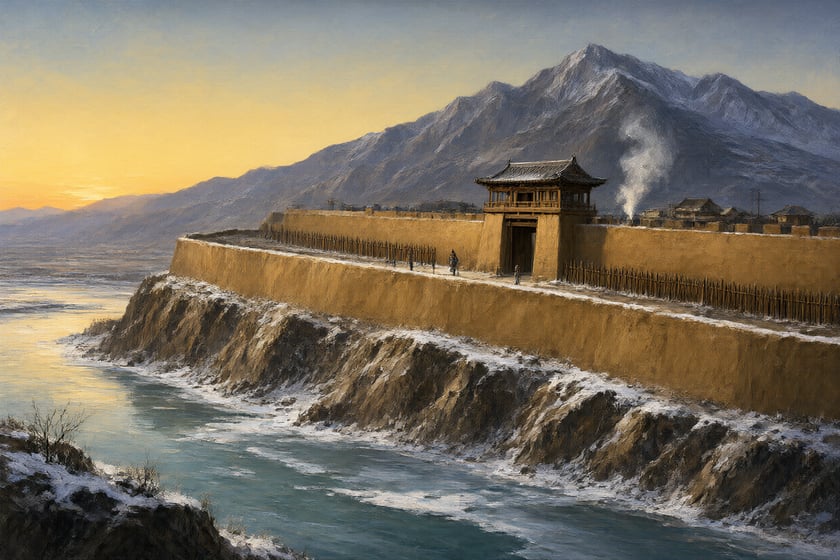
Chencang was a county seat under Fufeng Commandery in the Eastern Han, located east of present-day Chencang District, Baoji City, Shaanxi Province, on the north bank of the Wei River. Situated at the western end of the Guanzhong region, it provided access south through San Pass to Hanzhong and west through a narrow pass to Longyou, making it a gateway on Cao Wei’s western front. In the winter of the second year of Taihe (228), Zhuge Liang's Second Northern Expedition laid siege to Chencang, but was repelled by the steadfast defense of the Wei general Hao Zhao. Chencang became famous as a result.
History
In the first year of Xingping (194), after Ma Teng and Han Sui were defeated, Li Jue’s subordinate Fan Chou pursued them to Chencang. Han Sui and Fan Chou came from the same province; they rode side by side, clasped arms, and talked at length before parting. Li Jue consequently grew suspicious of Fan Chou and later had him killed at a banquet. In the nineteenth year of Jian’an (214), Ma Chao turned back and besieged Mount Qi. Xiahou Yuan sent Zhang He with five thousand infantry and cavalry in the vanguard through the Chencang Pass into Longyou. Ma Chao withdrew without fighting. In the third month of the twentieth year of Jian’an (215), Cao Cao marched west against Zhang Lu and reached Chencang. In the fourth month, he set out from Chencang through San Pass and advanced on Hedi. Lü Bing, a tenant farmer in a military colony, once proclaimed himself a general and gathered followers to occupy Chencang. Zhao Yan, the Protector of Guanzhong, led Yin Shu and other commanders in defeating him. In the twenty-fourth year of Jian’an (219), Cao Cao withdrew his forces from Hanzhong. Zhang He returned to garrison Chencang, while Cao Zhen was also ordered to Wudu to bring back Cao Hong and the others; they all garrisoned Chencang together.
After Zhuge Liang’s failed campaign from Mount Qi in the spring of the second year of Taihe (228), Cao Zhen predicted that his next attack would come from Chencang. He therefore sent the generals Hao Zhao and Wang Sheng to defend Chencang and repair its fortifications. In the twelfth month of that year, Zhuge Liang advanced from San Pass and besieged Chencang. Hao Zhao had only a little over a thousand men. Zhuge Liang first sent Jin Xiang, a fellow townsman of Hao Zhao, to urge him to surrender from outside the city walls twice, but Hao Zhao refused both times. The Shu army then raised scaling ladders and battering rams. Hao Zhao used fire arrows to burn the ladders and ropes to suspend millstones, crushing the rams. The Shu army built a hundred-foot siege tower and filled in the moat with earth, so Hao Zhao built another wall inside the city. When the Shu army dug tunnels, Hao Zhao dug crosswise trenches inside the city to cut them off. The two sides fought day and night for more than twenty days. Wei reinforcements arrived, and Zhuge Liang ran out of provisions, so he had no choice but to withdraw. The pursuing Wei general Wang Shuang was killed by Zhuge Liang’s forces. For his skillful defense, Hao Zhao was enfeoffed as a marquis.
Figures
- Hao Zhao: A native of Taiyuan, he began his career as a commander of retainers and guarded Hexi for more than ten years. With a little over a thousand troops, he held Chencang and became the city’s most famous defender.
- Wang Sheng: He was ordered by Cao Zhen to defend Chencang alongside Hao Zhao.
- Zhang He: He passed through Chencang twice: first, leading the vanguard through the Chencang Pass into Longyou, and later returning to garrison there after the withdrawal from Hanzhong.
- Cao Zhen: He anticipated Zhuge Liang’s route of advance and arranged Chencang’s defenses in advance.
- Zhao Yan: While serving as Protector of Guanzhong, he suppressed Lü Bing’s rebellion at Chencang.
Differences Between History and Fiction
In Romance of the Three Kingdoms, Sima Yi is the one who recommends Hao Zhao to defend Chencang, predicting that Zhuge Liang will imitate Han Xin’s “crossing Chencang by a hidden route”. In the Records of the Three Kingdoms, it is Cao Zhen who assigns Hao Zhao to defend the city. In the novel, the man sent to urge Hao Zhao to surrender is his fellow townsman Yin Xiang, whereas Pei Songzhi’s annotation to the Records of the Three Kingdoms, citing the Weilue, gives the name as Jin Xiang. The novel portrays Wang Shuang as the vanguard of reinforcements arriving during the siege, while the Records of the Three Kingdoms says he was killed while pursuing Zhuge Liang’s troops with cavalry after they had withdrawn. The greatest difference is the outcome: in the novel, Hao Zhao falls gravely ill, and Zhuge Liang sends Wei Yan and Jiang Wei to launch a night attack, allowing the Shu army to capture Chencang. Later, when Cao Zhen and Sima Yi garrison Chencang, the city’s houses have all been burned by the Shu army during its retreat. In the Records of the Three Kingdoms, Zhuge Liang never captures Chencang.
Today
Chencang District in present-day Baoji City retains this ancient place name.