Overview
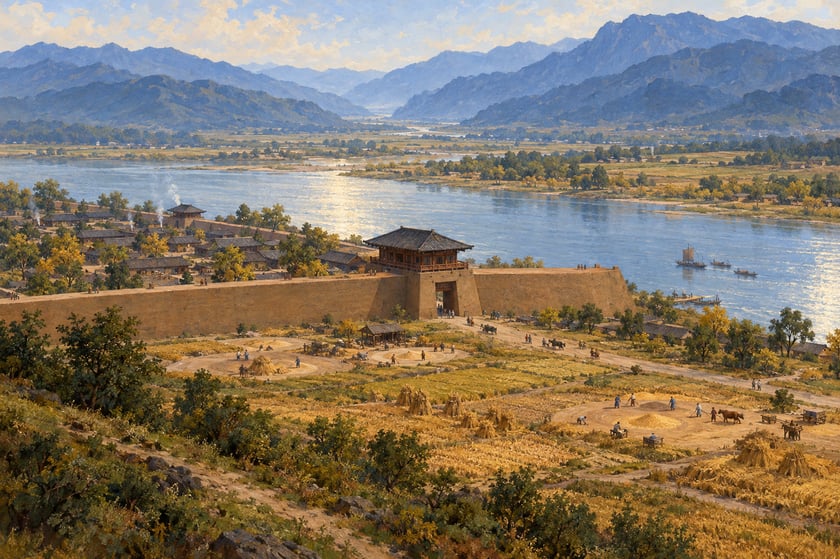
Mei was a county of Youfufeng in the Eastern Han. Under Cao Wei, it belonged to Fufeng Commandery. The county seat stood on the north bank of the Wei River, about seven kilometers east of present-day Mei County, Baoji, Shaanxi. It lay west of Chang'an, facing the mouth of Xie Valley to the south, and was often used to station troops when trouble arose in the Guanzhong region. The Romance of the Three Kingdoms usually calls it “Mei City.” Dong Zhuo’s Mei Fortress was built within the county; it is covered in a separate entry.
History
When Dong Zhuo was promoted to Chancellor, he was enfeoffed as Marquis of Mei. Pei Songzhi’s commentary quotes the Records of Heroes, which says that his granddaughter Dong Bai was made Lady Weiyang before she had reached adulthood. An altar was built east of Mei City, where she was invested with her seal. At the time, all officials in Mei holding ranks of 2,000 bushels—including commandants, palace attendants, and provincial inspectors—had to attend and escort her. After Dong Zhuo was killed, his younger brother Dong Min, nephew Dong Huang, and other elderly and young members of his clan were all in Mei. They were cut down or shot dead by Dong Zhuo’s subordinates. His ninety-year-old mother fled to the gate of the fortress, but was beheaded there as well. Later, Dong Zhuo’s former followers gathered up his ashes after the cremation, placed them together in a single coffin, and buried him in Mei. The main text of the Biography of Dong Zhuo also says that Li Jue and the others buried Dong Zhuo in Mei, but a violent storm damaged the tomb, and floodwater entered the burial chamber and swept away the coffin.
In the third year of Chuping (192), Han Sui and Ma Teng led their forces to Chang'an. The court appointed Ma Teng General Who Conquers the West and ordered him to garrison Mei. Later, Ma Teng raised troops in Mei, while Liu Yan and his son Liu Fan conspired with him to attack Chang'an. Their plot was exposed, and Liu Fan fled to Huaili, where he was killed. After Emperor Xian left Chang'an, Guo Si again tried to force the emperor to turn back and establish his capital at Mei. The emperor fled into Yang Feng’s camp, and Yang Feng defeated Guo Si. Guo Si was later attacked by his subordinate Wu Xi and died in Mei.
Under Cao Wei, Mei was one link in the defensive line against Shu. When Zhuge Liang besieged Mount Qi and the three commanderies of Nan'an, Tianshui, and Anding responded to him, Emperor Ming of Wei sent Cao Zhen to command the armies stationed at Mei, and separately dispatched Zhang He to defeat Ma Su. Later, when Sima Yi marched west to relieve Mount Qi, Zhang He proposed dividing the forces to garrison Yong and Mei. Sima Yi did not accept his proposal; this account appears in Pei Songzhi’s commentary, which quotes the Annals of Han and Jin.
Notable Figures
Fa Zheng was from Mei County in Fufeng. Two of Cao Cao’s sons, Cao Jun and Cao Zheng, were successively enfeoffed as Marquis of Mei. Cao Jun received the title in the twenty-first year of Jian’an (216), and the following year his fief was changed to Xiangyi. Cao Zheng received the title in the twenty-second year of Jian’an (217) and died the following year. After entering the Jin dynasty, Zhuge Liang’s grandson Zhuge Jing served as magistrate of Mei. In a memorial, Shan Tao praised his reputation for governing Mei well.
Differences in Historical and Literary Accounts
The Romance of the Three Kingdoms depicts Mei City as one of the targets of Zhuge Liang's Northern Expeditions. Sima Yi was certain that Zhuge Liang would come through Xie Valley to seize Mei City, and ordered Cao Zhen to hold it. When Zhuge Liang again advanced from Mount Qi, Guo Huai left Zhang He to defend Chang'an and led troops to Mei City overnight to guard it.