Overview
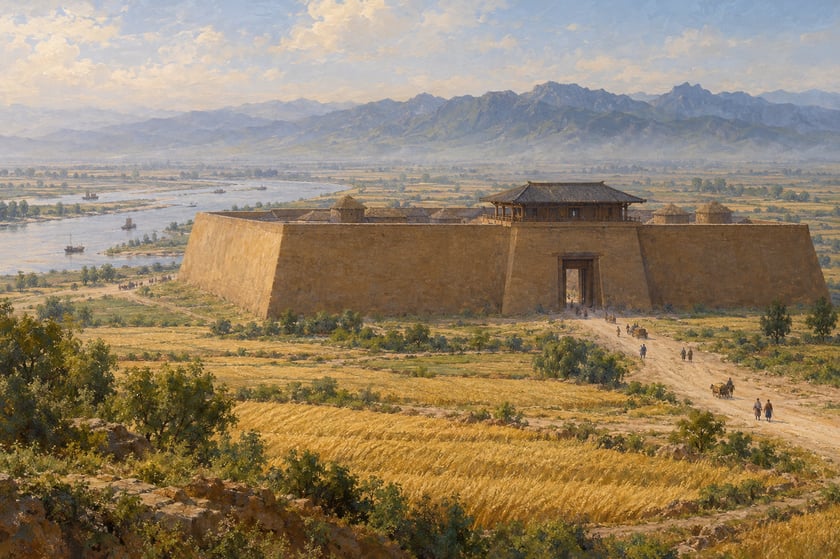
Mei Fortress was a fortified compound built by Dong Zhuo in Mei County, Youfufeng. It stood along the Wei River in the area of present-day Mei County, Baoji, Shaanxi Province. Dong Zhuo regarded it as a base from which he could either advance to contend for the realm or retreat to live out his days. After his death, his clan and accumulated wealth were also lost there.
History
After taking power, Dong Zhuo built a fortress at Mei and claimed it as his own. Its walls were as high as those of Chang'an, and the grain stored inside would have lasted thirty years. He said that if his great enterprise succeeded, he would rule the realm; if it failed, he could remain there until the end of his life. Pei Songzhi’s commentary quotes the Records of Heroes as saying that Mei was 260 li from Chang'an. Dong Zhuo once personally visited the fortress at Mei, and officials of every rank down to the ministers all saw him off outside Chang'an’s Heng Gate. The fortress also had a prison: after Liu Yan became governor of Yi Province, he refused Dong Zhuo’s summons to serve. Dong Zhuo then seized Liu Yan’s three sons, including Liu Fan, put them in shackles, and confined them in the underground prison at Mei Fortress. This account appears in the Records of Heroes, as quoted in Pei’s commentary.
Differences Between the Novel and History
The Romance of the Three Kingdoms portrays Mei Fortress as more opulent: it was 250 li from Chang'an and built by 250,000 laborers; its walls matched those of Chang'an in height and thickness. Inside were palaces and storehouses stocked with enough grain for twenty years. Eight hundred young women chosen from among the common people were brought in, and Dong Zhuo’s family all lived there. After the Fengyi Pavilion episode, Dong Zhuo returned to Mei Fortress with Diao Chan. The officials bowed as they saw him off, while Lü Bu watched the dust from the carriage from afar atop a mound. Li Su went to Mei Fortress and falsely announced an imperial edict, claiming that Emperor Xian intended to abdicate. Dong Zhuo left Li Jue, Guo Si, Zhang Ji, and Fan Chou to guard the fortress with three thousand Flying Bear troops, then set out for the capital himself. After Dong Zhuo was killed, the four men—Li Jue and the others—fled to Liang Province with the Flying Bear troops. Lü Bu and Huangfu Song went to Mei Fortress, freed the daughters of respectable families, executed Dong Zhuo’s relatives, and seized hundreds of thousands of gold.
The novel and the histories differ on two points. The first is Dong Zhuo’s burial place. The novel says that Li Jue and the others found fragments of his flesh and bones and reburied him at Mei Fortress, but each of the three times they buried him, thunder and rain burst open his coffin. The Biography of Dong Zhuo in the Records of the Three Kingdoms merely says, “Dong Zhuo was buried at Mei,” meaning in Mei County; Pei’s commentary also quotes the Records of Heroes as saying that he was buried at Mei. The second point concerns Emperor Xian. The novel says that when Li Jue and Guo Si fought one another, they moved the emperor and empress’s carriage to Mei Fortress and had Li Xian, Li Jue’s nephew, guard it. After Emperor Xian returned east, Guo Si also said that he had intended to seize the emperor and take him back to Mei Fortress. The Biography of Dong Zhuo in the Records of the Three Kingdoms only records that Guo Si wanted to force the emperor to return to the capital at Mei; he did not succeed.
Today
The precise location of Mei Fortress can no longer be determined. It is only known to have been within the boundaries of Mei County during the Han dynasty, in the area of present-day Mei County. The Book of the Later Han calls it “Longevity Fortress,” while neither the Records of the Three Kingdoms nor the Romance of the Three Kingdoms uses that name.