Overview
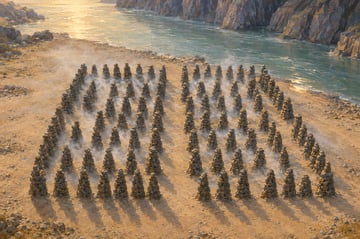
Mount Qi was a mountainous stronghold in Tianshui Commandery, Liang Province, during the Eastern Han. Its former site lies around present-day Qishan Town, east of Li County in Longnan, Gansu. It was a strategic position on Cao Wei’s western front. Emperor Ming of Wei ranked it alongside Hefei and Xiangyang as one of the three cities Wei was bound to contest. During Zhuge Liang’s Northern Expeditions, Shu Han twice surrounded Mount Qi with its forces, making it a focal point of the later struggle between Wei and Shu during the Three Kingdoms period.
History
During the Jian’an era, after Ma Chao captured Jicheng, Yang Fu, Jiang Xu, and others from Tianshui plotted to attack him, agreeing that Zhao Ang and Yin Feng would hold Mount Qi. In 214, the nineteenth year of Jian’an, Ma Chao sought refuge in Hanzhong, then returned with troops to besiege Mount Qi. Jiang Xu and the others urgently sought aid. Without waiting for Cao Cao’s orders, Xiahou Yuan sent Zhang He ahead with five thousand infantry and cavalry to relieve them. Zhao Ang and his wife Wang Yi held Mount Qi for thirty days under siege, until reinforcements arrived and lifted it.
In the spring of 228, the sixth year of Jianxing, Zhuge Liang announced that he would take Mei by way of the Xiegu Road, and sent Zhao Yun and Deng Zhi to occupy Jigu as a feint, while he personally led the main force to attack Mount Qi. Shu’s troops were orderly in formation and strict in their commands. The three commanderies of Nanan, Tianshui, and Anding rebelled against Wei and joined them, shaking Guanzhong. Ma Su was then soundly defeated by Zhang He at Jieting. Zhuge Liang failed to capture Mount Qi and withdrew to Hanzhong.
In the second month of 231, the ninth year of Jianxing, Zhuge Liang again sent out troops to surround Mount Qi, this time beginning to use wooden oxen to transport grain. Wei sent Sima Yi and Zhang He to relieve Mount Qi. During the siege, Wang Ping separately defended the encampment to the south. Zhang He attacked, but Wang Ping held firm, and Zhang He could not take the position. By the sixth month, Shu’s troops had run out of grain and withdrew. Zhang He pursued them as far as Qingfeng, where he was struck by an arrow and killed in battle with Shu’s army.
In 234, the second year of Qinglong, Sun Quan attacked Hefei Xincheng. Emperor Ming of Wei refused to abandon the city, saying that the late emperor had established Hefei in the east, guarded Xiangyang in the south, and secured Mount Qi in the west. Whenever enemies invaded, they were driven back beneath these three cities, because they were places both sides were bound to contest. After Wei’s great defeat at Taoxi, Deng Ai assessed the situation and concluded that troops had to be distributed to defend Didao, Longxi, Nanan, and Mount Qi. The area around Mount Qi had a thousand qing of ripe wheat, which could serve as bait to lure Shu’s army into attacking.
People
- Zhao Ang and Wang Yi: Zhao Ang was from Tianshui and joined Yang Fu and others in plotting against Ma Chao. His wife, Wang Yi, helped him defend the city, and the couple held Mount Qi together until the siege was lifted.
- Yin Feng: A native of Tianshui, he held Mount Qi alongside Zhao Ang.
- Wang Ping: A native of Dangqu, Baxi, he gathered the scattered remnants on his own after the defeat at Jieting, and later held off Zhang He during the siege of Mount Qi.
- Bao Su and Shi Zuan: In Romance of the Three Kingdoms, Jiang Wei has Bao Su garrison the entrance to the Mount Qi valley as a show of force; Chen Tai later captures the Mount Qi camp, and Bao Su is killed. Shi Zuan, meanwhile, guards the Mount Qi camp for Deng Ai.
Differences Between History and Romance
Romance of the Three Kingdoms uses Mount Qi as a byword for Zhuge Liang’s Northern Expeditions. It portrays him, while making offerings at the Temple of Zhao Lie, as saying, “I have marched on Mount Qi five times and gained not an inch of land,” before setting out for Mount Qi once again. The later saying “six campaigns against Mount Qi” derives from this. The Records of the Three Kingdoms records only two occasions when Zhuge Liang sent troops out by way of Mount Qi: in the sixth and ninth years of Jianxing. The novel also depicts the Wei and Shu armies drawn up before Mount Qi, with Wang Lang riding out to urge surrender. Zhuge Liang berates him at length, and Wang Lang falls from his horse and dies. This episode is not recorded in the Records of the Three Kingdoms. The novel further says that Deng Ai built nine camps at Mount Qi, each connected to the next, their formation like a giant serpent. Jiang Wei admires Deng Ai, saying that he is no less than Zhuge Liang. The two later face off before Mount Qi using the Eight Trigrams formation, and Jiang Wei changes the formation to encircle Deng Ai.
Today
The former site of Mount Qi lies in Qishan Town, Li County, Longnan, Gansu. Qishan Fort, on the north bank of the Western Han River, is an isolated earthen hill. A temple to the Marquis of Wu stands atop the fort, and local tradition holds that Zhuge Liang once garrisoned troops there.