Overview
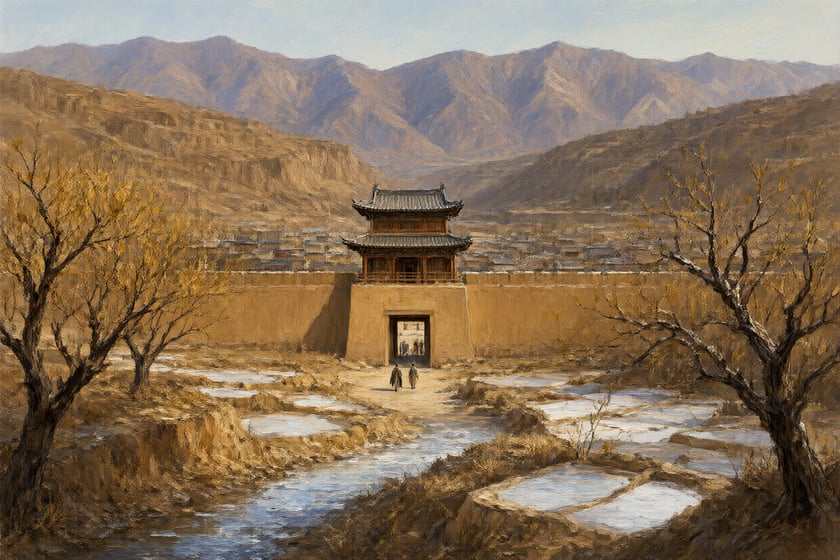
Lucheng was a walled town in Hanyang Commandery of Liang Province during the Eastern Han dynasty (renamed Tianshui Commandery by Wei). It lay in Longyou and is generally identified with the area around today’s Yanguan Town, northeast of Lixian County, Longnan, Gansu. In the late Han and Three Kingdoms period, it became a battlefield twice: first, when Yang Fu and Jiang Xu, former officials of Liang Province, raised troops at Lucheng to attack Ma Chao; and later, when Zhuge Liang marched out via Mount Qi in the ninth year of Jianxing (231), and Sima Yi led Wei forces in pursuit as far as Lucheng.
History
After Ma Chao was defeated by Cao Cao at Tong Pass, he led the Qiang and Hu peoples in attacks on the commanderies and counties of Longyou, killed Wei Kang, the Inspector of Liang Province, and seized Jicheng. Yang Fu, a former subordinate of Wei Kang, requested leave on the pretext of returning home to bury his deceased wife. He went to Licheng to see his cousin Jiang Xu and urged him to raise troops. Jiang Xu’s mother resolutely instructed her son to follow the plan, and the two then enlisted Zhao Ang, Yin Feng, Liang Kuan, Zhao Qu, and others to raise troops at Lucheng. The year of the uprising is given in the “Biography of Yang Fu” as the ninth month of the seventeenth year of Jian’an, while the “Biography of Xiahou Yuan” dates it to the nineteenth year of Jian’an. Ma Chao personally led troops to attack Lucheng but failed to take it. Liang Kuan and Zhao Qu then shut the gates of Jicheng, preventing Ma Chao from returning there. Ma Chao instead attacked and seized Licheng, where he captured Jiang Xu’s mother. She berated him, and he had her killed. Yang Fu fought Ma Chao and suffered five wounds; seven of his clansmen and brothers died in battle. In a desperate position, Ma Chao eventually fled south to Hanzhong and sought refuge with Zhang Lu.
In the ninth year of Jianxing (231; the fifth year of Taihe under Wei), Zhuge Liang again marched out via Mount Qi. He defeated Guo Huai and others in the area around Shanggui, reaped much of the local wheat, and then withdrew his forces after encountering Sima Yi east of Shanggui. Sima Yi pursued him all the way to Lucheng. Zhang He proposed that they remain in camp and not advance, while sending a force to circle around behind the Shu army. Sima Yi ignored the advice, but after catching up, he nevertheless camped on a mountain and refused to engage. His subordinates mocked him for “fearing Shu like a tiger”. On the xinsi day of the fifth month, Sima Yi sent Zhang He to attack the southern encampment defended by He Ping, while he himself advanced on Zhuge Liang from the center. Zhuge Liang sent Wei Yan, Gao Xiang, and Wu Ban to meet the attack. They routed the Wei army, beheaded three thousand men, and drove Sima Yi back to his camp. That same year, when Longyou faced a grain shortage, Guo Huai used a combination of kindness and authority to pacify the Qiang and Hu peoples and have each household contribute grain, thereby ensuring adequate provisions for the Wei army.
People
- Yang Fu: A former subordinate of Wei Kang, Inspector of Liang Province. When Ma Chao was fleeing to Anding after his defeat, Yang Fu urged Cao Cao to remain on his guard, saying Ma Chao had the courage of Han Xin and Ying Bu and had won the deep trust of the Qiang and Hu peoples.
- Jiang Xu: Yang Fu’s cousin. Yang Fu had grown up in his household, and at the time of the uprising, Jiang Xu was commanding troops stationed at Licheng.
Differences in Historical and Literary Accounts
Zhuge Liang’s reaping of wheat in the area around Shanggui during his march via Mount Qi is already recorded in Pei Songzhi’s commentary to the Records of the Three Kingdoms, which quotes the Spring and Autumn Annals of Han and Jin. Chapter 101 of the Romance of the Three Kingdoms, however, tells a different story: Zhuge Liang led his troops to Lucheng, whose governor opened the gates and surrendered. Zhuge Liang left Zhang Yi and Ma Zhong to defend the town while he led the army to reap wheat in Longyou. Sima Yi and Guo Huai surrounded Lucheng at night. Crossbow bolts rained down from the walls, and Shu forces lying in ambush at the four corners of the wheat fields attacked all at once. Troops inside the town also opened the gates and charged out, routing the Wei army. The surrender of Lucheng’s governor and the Wei army’s nighttime assault on the town are not recorded in the Records of the Three Kingdoms. In Pei Songzhi’s commentary, the standoff at Lucheng involved Sima Yi camping on a mountain and refusing battle; he later sent Zhang He and others to attack, but they were defeated by Wei Yan and the others.
Today
The Lixian area still preserves an ancient culture of salt wells, and local stories tell of Zhuge Liang “reaping wheat at Lucheng.”