Cao Wei · Senior Clerk of Pacifying the West; Inspector of Yong Province; General Who Displays Martial Prowess; General of the Front; General of Campaigning Against the West; General of Chariots and Cavalry
Guo Huai
courtesy name 伯济 · c. 185–255
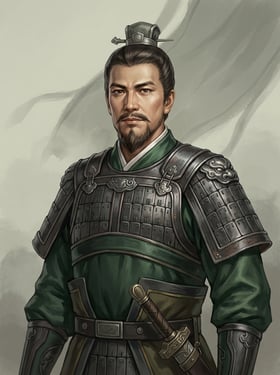
Guo Huai was precise and thorough in his plans, pacifying the barbarians abroad and settling the people's affairs at home. Adaptable and resourceful in strategy, he once foresaw that Kongming would surely take advantage of a mourning to launch a raid, and laid a counter-ambush against him.

Life
In the novel: 14 chapters · In the Records: 11 volumes
Life185–255
228 CE (Taihe 2)
229 CE (Taihe 3)
3 more events
231 CE (Taihe 5)
234 CE (Qinglong 2)
244 CE (Zhengshi 5)
- Battle of XingshiMount XingshiCommander
249 CE (Jiaping 1)
- Battle of QuchengMount QuCommander
255 CE (Zhengyuan 2)
Allegiance
- Cao Wei
- Hatched: dated by chapter
- Life event
- Death
List all 8 stops
- Taiyuan Commandery185Birthplace
- Mount Qi228Kongming Scolds Wang Lang to Death+1 more
- Wudu229Zhuge Liang's Third Northern Expedition
- Mount Qi231Zhuge Liang's Fourth Northern Expedition
- Wuzhang Plains234Battle of Wuzhang Plains
- Mount Xingshi244Battle of Xingshi
- Mount Qu249Battle of Qucheng
- Shouchun255Rebellion of Guanqiu Jian and Wen Qin
On the boards
Compare with someone →Where this person ranks on each board.
Who they were
Character profile
- Character
- Guo Huai was precise and thorough in his plans, pacifying the barbarians abroad and settling the people's affairs at home. Adaptable and resourceful in strategy, he once foresaw that Kongming would surely take advantage of a mourning to launch a raid, and laid a counter-ambush against him.
- Manner of speech
- Guo Huai was skilled at reading men and circumstances; he once smilingly remarked on "Sima Zhongda's insight," and could declare frankly that "Kongming far surpasses Zhongda."
- Life
- Guo Huai, styled Boji, was a native of Yangqu in Taiyuan. Recommended as a man of filial and incorrupt conduct during the Jian'an era, he served four reigns: Cao Cao, Cao Pi, Cao Rui, and Cao Fang. He garrisoned the region west of the passes for more than thirty years, campaigning against the Qiang and Hu abroad and pacifying the people and non-Han within. In the first year of Jiaping he was promoted to General Who Conquers the West and Commander of Yong and Liang; he died in the second year of Zhengyuan, with the posthumous title Marquis Zhen.
- Anecdotes
- Guo Huai served as Xiahou Yuan's marshal, and after Xiahou Yuan's death he nominated Zhang He to take command of the army. He served as Inspector of Yong Province and Commander of Yong and Liang Provinces. He was at odds with Xiahou Ba, and together with Chen Tai and Deng Ai he resisted Jiang Wei.
Historical Record
Guo Huai, courtesy name Boji, was from Yangqu, Taiyuan. During the Jian’an era, he was recommended as a Filial and Incorrupt official. He successively served as assistant administrator of Pingyuan, a bandit affairs officer in Cao Pi’s household, and an administrative clerk in the chancellor’s military office, and accompanied Cao Cao on Cao Cao's Campaign Against Hanzhong. He later served as Xiahou Yuan’s adjutant, beginning his involvement in military affairs west of the passes. When Xiahou Yuan was killed in battle in Hanzhong, the army fell into disorder. Guo Huai rallied the scattered troops and put Zhang He in command, bringing the various camps back under control. The next day, Liu Bei intended to cross the Han River and attack. Guo Huai advised against forming up along the water, proposing instead to fall back to a position some distance from it and lure the enemy halfway across before striking. Liu Bei hesitated and did not cross. Guo Huai held his position until reinforcements arrived, and Cao Cao praised his handling of the situation, reinstating him as an adjutant.
After Emperor Wen ascended the throne, Guo Huai was sent on a mission to offer congratulations, but fell ill on the way and arrived late. Emperor Wen reproached him, citing the execution of Fangfeng for arriving late. Guo Huai replied that the present age was one of Tang and Yu, pleasing the emperor, who promoted him to acting Inspector of Yongzhou. He subsequently used his authority and reputation to pacify the Qiang and Hu, arrange military provisions, and deal repeatedly with Shu army offensives. When Zhuge Liang advanced from Mount Qi, Guo Huai and Zhang He defeated Ma Su and Gao Xiang. When Zhuge Liang came out of Xie Valley, Guo Huai anticipated that the Shu army would contest Beiyuan and occupied it in advance. He also saw through a feint toward the western encampment, recognizing that the real attack would target Yangsui. When Jiang Wei advanced into Longxi, Guo Huai pursued him and pacified the Di and Qiang as well.
Guo Huai commanded troops for more than thirty years, combining campaigns against the Qiang and Hu with the pacification of the people within and beyond the frontier. When Jiang Wei attacked Xiahou Ba at Chishang, Guo Huai rushed to his aid in time, forcing Jiang Wei to withdraw. Later, he struck Liao Hua by surprise at Chengzhong Mountain, drawing Jiang Wei back to his rescue and thereby managing both fronts. In the first year of the Jia平 era, he was promoted to General Who Conquers the West and appointed Inspector of the armies of Yong and Liang. The following year, he was made General of Chariots and Cavalry and enfeoffed as Marquis of Yangqu. He died in the second year of the Zhengyuan era and was posthumously granted the title of Grand General, with the posthumous title Marquis Zhen.
In the Novel
Romance of the Three Kingdoms portrays Guo Huai as a Wei general well versed in military strategy and skilled at assessing the course of a battle, often involving him in campaigns against Shu as deputy commander, commander, or a leading frontier defender. The novel has Cao Zhen recommend him as deputy commander, then depicts him anticipating that Zhuge Liang will raid the Wei camp at night after Wang Lang’s death and proposing a plan to split the forces and counterattack the camps. Zhuge Liang sees through the plan, and the Wei army is instead ambushed. Guo Huai then proposes enlisting the Western Qiang to attack the Shu forces from both sides, but in the novel the Qiang troops are likewise defeated by Zhuge Liang. These specific episodes and stratagems are inventions of the novel; they are not explicitly recorded in the Records of the Three Kingdoms.
The novel also depicts him repeatedly serving under Sima Yi’s orders, defending Chang'an, Longxi, and other places, sometimes accompanying Sun Li in an attack to seize Wudu and Yinping, and sometimes being ordered to garrison various commanderies in Longxi. In one episode, he can openly say that Kongming is superior to Sima Yi, yet he is also repeatedly defeated by Zhuge Liang’s ambushes. Compared with the novel’s emphasis on stratagems devised on the battlefield, the historical record likewise shows Guo Huai’s skill at anticipating the enemy, but also focuses on his campaigns against the Qiang and Hu, his arrangements for provisions, and his efforts to pacify the people. These should not be conflated as facts of the same kind.
Key Relationships
Guo Huai’s relationship with Zhang He began amid the crisis in Hanzhong: after Xiahou Yuan was killed, Guo Huai put Zhang He in charge of military affairs, stabilizing the various camps. He later joined Zhang He in defending against the Shu army. For Cao Wei, he was a senior general who guarded the western passes for many years and oversaw both military and civil affairs. He served under Cao Cao, Cao Pi, Cao Rui, and Cao Fang, eventually rising to General of Chariots and Cavalry.
He and Chen Tai were both colleagues involved in planning the defenses, and one succeeded the other in office. When Jiang Wei built a fortress at Qushan, Guo Huai and Chen Tai discussed how to respond and adopted a plan to encircle it and cut off its supplies. When Jiang Wei came to its aid, Chen Tai devised a plan to block his retreat. Jiang Wei withdrew, and Ju An and the others surrendered. Xiahou Ba, meanwhile, was at odds with Guo Huai. After Guo Huai succeeded Xiahou Xuan as General Who Conquers the West, Xiahou Ba, fearing for his safety, defected to Shu.
Signature Scenes
The decision by the Han River best illustrates Guo Huai’s thinking in the midst of battle. The other generals feared that Liu Bei would cross the river while riding the momentum of victory. Guo Huai did not advocate showing weakness by resisting the enemy at the water’s edge; instead, he proposed retreating to a position farther from the water and drawing the enemy halfway across before striking. Liu Bei ultimately did not cross, and Cao Cao approved of Guo Huai’s decision to hold his position. This episode appears in the historical accounts. The source notes label the stratagem a “failure,” while the main text says that Liu Bei hesitated and did not cross; therefore, it would be inaccurate to present luring the enemy into a decisive defeat as an outcome that actually occurred.
Another notable episode concerns his two predictions about Beiyuan and Yangsui. When Zhuge Liang came out of Xie Valley, Guo Huai judged that Beiyuan was crucial to the route through Long and to the safety of the people within and beyond the frontier, and insisted on occupying it first. Later, when the Shu army feigned an advance westward, he judged that its real target was Yangsui and prepared in advance, preventing its night attack from succeeding. The historical Guo Huai was not a commander who relied on force alone; through his assessment of terrain, steadfast defense, and ability to adapt to circumstances, he maintained Wei’s defenses in the western passes for many years.
Quotes
28 lines in the books · 3 featured
「若亮跨渭登原,連兵北山,隔絕隴道,搖盪民、夷,此非國之利也。」
This line shows Guo Huai's precise judgment of Shu Han's strategic intentions, reflecting his military talent.
「此示弱而不足挫敵,非筭也。不如遠水爲陣,引而致之,半濟而後擊,備可破也。」
This stratagem embodies Guo Huai's military wisdom, skilled at luring the enemy in deep and striking after they have committed.
「此城山勢高阜,必然水少,須出城取水;若斷其上流,蜀兵皆渴死矣。」
This stratagem shows Guo Huai's battlefield insight, making skillful use of geographic advantage to defeat the enemy.
- Family
- Lord & vassal
- Friends
- Enemies
- Other
Who is Guo Huai connected to?
Pick someone to see how many steps lie between them and Guo Huai.
History vs. novel
7 points · 4 novel-only
| History | Novel |
|---|---|
| Recommending Zhang HeNovel embellishes | |
After Xiahou Yuan was killed in battle, Guo Huai rallied the scattered troops and recommended Zhang He as commander, bringing stability to the various camps; the Records of the Three Kingdoms does not describe any further dramatic scenes beyond Guo Huai’s absence from the fighting due to illness. vol. 26 | After Zhang He returned from defeat, Cao Hong wanted to execute him. Guo Huai remonstrated that “an army is easy to find,” and also suggested giving him another five thousand troops to attack Jiameng Pass, thereby saving Zhang He. ch. 70 |
| Night Raid on the Shu CampNovel only | |
| — | After Wang Lang’s death, Guo Huai judged that the Shu army might launch a night attack and proposed splitting the forces to lay an ambush and raid the Shu camp in turn; the novel says that Wei troops fell into Zhuge Liang’s trap, trampled one another, and suffered a crushing defeat. ch. 93 |
| Seeking a Qiang Flanking AttackNovel only | |
| — | Guo Huai suggested that Cao Zhen promise a marriage alliance and enlist Qiang troops to attack the Shu army’s rear, catching it in a pincer movement; the novel then says that the Shu army withdrew, while the Wei army pursued and fell into an ambush. ch. 94 |
| Jieting and LieliuchengNovel embellishes | |
When Zhuge Liang advanced from Mount Qi, Zhang He defeated Ma Su at Jieting, while Guo Huai routed Gao Xiang at Lieliucheng; the historical accounts record separate Wei victories at the two locations. vol. 26 | Guo Huai and Cao Zhen discussed splitting their forces and seizing Lieliucheng while the Shu general went to relieve Jieting; Sima Yi then entered the city, where Guo Huai praised his strategy, and was ordered to pursue the Shu army. ch. 95 |
| Repelling Shu at BeiyuanNovel embellishes | |
Guo Huai foresaw that Zhuge Liang would contest Beiyuan and insisted that it be occupied first; when the Shu army attacked, he led his troops out to meet it, later saw through a feint, and secured the area around Yangsui. vol. 26 | The novel says that Guo Huai warned Sima Yi that Beiyuan might become a key Shu army target, and was ordered to hold it with deep moats and high ramparts; later, while pursuing the Wooden Ox and Flowing Horse, he was ambushed and defeated by Wei Yan and Jiang Wei. ch. 102 |
| Defeat over the Wooden Ox and Flowing HorseNovel only | |
| — | Guo Huai pursued the Wooden Ox and Flowing Horse captured by Wang Ping, but was defeated and forced to retreat after Wei Yan and Jiang Wei attacked him from both sides; the novel also adds that the Shu army used “divine soldiers” to carry away the Wooden Ox and Flowing Horse. ch. 102 |
| Lifting the Siege with a Feigned SurrenderNovel only | |
| — | When Sima Zhao was trapped on Iron Cage Mountain, Guo Huai adopted Chen Tai’s plan to feign surrender to the Qiang, sowed discord among the Qiang forces, and captured Mi Dang; he then used the Qiang troops to lift the siege. ch. 109 |
- Recommending Zhang HeNovel embellishes
- History
After Xiahou Yuan was killed in battle, Guo Huai rallied the scattered troops and recommended Zhang He as commander, bringing stability to the various camps; the Records of the Three Kingdoms does not describe any further dramatic scenes beyond Guo Huai’s absence from the fighting due to illness.
vol. 26
- Novel
After Zhang He returned from defeat, Cao Hong wanted to execute him. Guo Huai remonstrated that “an army is easy to find,” and also suggested giving him another five thousand troops to attack Jiameng Pass, thereby saving Zhang He.
ch. 70
- Night Raid on the Shu CampNovel only
- Novel
After Wang Lang’s death, Guo Huai judged that the Shu army might launch a night attack and proposed splitting the forces to lay an ambush and raid the Shu camp in turn; the novel says that Wei troops fell into Zhuge Liang’s trap, trampled one another, and suffered a crushing defeat.
ch. 93
- Seeking a Qiang Flanking AttackNovel only
- Novel
Guo Huai suggested that Cao Zhen promise a marriage alliance and enlist Qiang troops to attack the Shu army’s rear, catching it in a pincer movement; the novel then says that the Shu army withdrew, while the Wei army pursued and fell into an ambush.
ch. 94
- Jieting and LieliuchengNovel embellishes
- History
When Zhuge Liang advanced from Mount Qi, Zhang He defeated Ma Su at Jieting, while Guo Huai routed Gao Xiang at Lieliucheng; the historical accounts record separate Wei victories at the two locations.
vol. 26
- Novel
Guo Huai and Cao Zhen discussed splitting their forces and seizing Lieliucheng while the Shu general went to relieve Jieting; Sima Yi then entered the city, where Guo Huai praised his strategy, and was ordered to pursue the Shu army.
ch. 95
- Repelling Shu at BeiyuanNovel embellishes
- History
Guo Huai foresaw that Zhuge Liang would contest Beiyuan and insisted that it be occupied first; when the Shu army attacked, he led his troops out to meet it, later saw through a feint, and secured the area around Yangsui.
vol. 26
- Novel
The novel says that Guo Huai warned Sima Yi that Beiyuan might become a key Shu army target, and was ordered to hold it with deep moats and high ramparts; later, while pursuing the Wooden Ox and Flowing Horse, he was ambushed and defeated by Wei Yan and Jiang Wei.
ch. 102
- Defeat over the Wooden Ox and Flowing HorseNovel only
- Novel
Guo Huai pursued the Wooden Ox and Flowing Horse captured by Wang Ping, but was defeated and forced to retreat after Wei Yan and Jiang Wei attacked him from both sides; the novel also adds that the Shu army used “divine soldiers” to carry away the Wooden Ox and Flowing Horse.
ch. 102
Combat
On the field
Duels, kills and executions as the texts tell them, counted separately for the Records and the Romance.
Battles in command
Battles this person commanded in, with the outcome as each text tells it.
- Records
- 1W 1L 0D 1 undecided
- Romance
- 1W 1L 0D 1 undecided
- Records229Zhuge Liang's Third Northern ExpeditionLostvs Shu armyJuan 35「亮自出至建威,淮退還,遂平二郡」
- Romance229Zhuge Liang's Third Northern ExpeditionLostvs Shu armyCh. 99「司馬懿大敗一陣」
- Records238Jiang Wei's Northern ExpeditionsUndecidedvs Shu armyJuan 44「維本羈旅托國,累年攻戰,功績不立」
- Romance238Jiang Wei's Northern ExpeditionsUndecidedvs Shu troopsCh. 115「維只得遵命,先令洮陽兵退,次後與張翼徐徐而退」
- Records249Battle of QuchengWonvs Shu armyJuan 22「维惧,遁走,安等孤县,遂皆降」
- Romance249Battle of QuchengWonvs Shu troopsCh. 108「句安見援兵不至,乃開門降魏。姜維折兵數萬,領敗兵回漢中屯紮」
Stratagems
Plans this person devised or saw through, as the texts tell them.
- Records
- 4 carried out · 3 worked · 0 turned down · 1 seen through
- Romance
- 6 carried out · 3 worked · 0 turned down · 0 seen through
- RecordsUse Distant Reinforcements to Lure the EnemyLureFailedagainst Liu BeiJuan 26「不如遠水爲陣,引而致之,半濟而後擊,備可破也」
- RecordsMake a Sound in the East, Strike in the WestFeintSaw throughagainst government troopsJuan 26「淮獨以爲此見形於西,欲使官兵重應之,必攻陽遂耳」
- RecordsMake a Sound in the East, Strike in the WestFeintWorkedagainst rebel QiangJuan 26「淮見形上流,密於下渡兵據白土城,擊,大破之」
- RecordsAttack Hua to Draw Out WeiLureWorkedagainst ShuJuan 26「維果馳還救化,皆如淮計」
- RecordsPersuade to SurrenderPersuasionWorkedagainst ShuJuan 26「與雍州刺史陳泰恊策,降蜀牙門將句安等於翅上」
- RomanceRaid the CampAmbushSeen throughagainst Shu troopsCh. 93「曹遵先殺入寨,卻是空寨,並無一人,料知中計」
All stratagems (11)
Loading…
Events
Events (16)
Battles and events the texts place this person in, by date.
Battles
- 228First Northern ExpeditionAdvisor
- 228Battle of Jieting
- 228Zhuge Liang's Northern Expeditions
- 229Zhuge Liang's Third Northern ExpeditionWarrior
- 230Cao Zhen's Invasion of Shu
- 231Zhuge Liang's Fourth Northern ExpeditionWarrior
- 234Battle of Wuzhang PlainsCommander
- 238Jiang Wei's Northern Expeditions
All 10
- 244Battle of XingshiCommander
- 249Battle of QuchengCommander
Famous objects
Places
- Native of
- Taiyuan CommanderyRecords
Continue
The Battle of Wuzhang Plains in 3D
Replay the Battle of Wuzhang Plains phase by phase on real terrain: troop strengths, movements and turning points at a glance, each marked as coming from the Records of the Three Kingdoms or the Romance.
Relationship timeline15 entries ▸
History · vol. 17
- Zhang He§22
Friend
Yuan's Sima; directed the troops to recommend Zhang He as commander, “and all the generals followed Zhang He's orders”
History · vol. 26
- Zhang He§36
Advised
After Xiahou Yuan was killed, Huai gathered the scattered troops and recommended General Who Sweeps Bandits Zhang He as their commander; the various camps were then settled
- Liu Bei§36
Enemy
Formed a line in the distant waters, lured them forward, and attacked after they had half-crossed; Bei was suspicious and did not cross, so Huai held his position firmly.
- Zhuge Liang§38
Enemy
In the second year of Taihe, attacked and destroyed all Gao Xiang’s camps; in the second year of Qinglong, predicted that Liang would certainly contest Beiyuan and that it should be occupied first, so he stationed troops at Beiyuan; he also anticipated Liang’s attack on Yang and prepared for it, as expected
- Sima Yi§38
Advised
Sima Xuanwang camped south of the Wei River; Huai judged that Liang would certainly contest the Northern Plain, and Xuanwang approved of his assessment
- Jiang Wei§39
Enemy
In the first year of Zhengshi, when Jiang Wei entered Longxi, Huai advanced in pursuit as far as Qiangzhong, and Wei withdrew; later, when Wei came out at Shiying and Qiangchuan, Huai detached troops to seize Liao Hua, forcing Wei to look back anxiously and rush back
- Chen Tai§41
Commands
In the first year of Jiaping, jointly devised a strategy with Chen Tai, Inspector of Yongzhou, and induced the Shu gate general Ju An and others to surrender
Novel · ch. 95
All 15
Loading…
Inner monologues · AI-generated3 monologues ▸
- I am Guo Huai, courtesy name Boji. Looking back on more than thirty years in the lands west of the Pass, what I defended
- I am Guo Huai, courtesy name Boji, from Yangqu in Taiyuan. I recall that in my youth, neither my family’s standing nor m
- In the first year of Huangchu, illness spread along the roads. I was sent to congratulate Emperor Wen on ascending the t