Cao Wei · General-in-Chief
Cao Shuang
courtesy name 昭伯 · –249
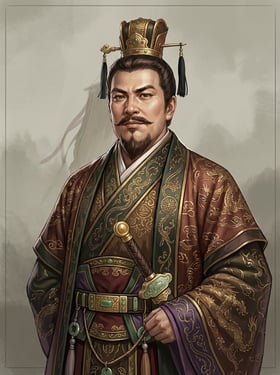
Cao Shuang did not accept Sima Yi's advice and monopolized power; at first he served Sima Yi carefully, but later, misled by He Yan, he seized authority. Domineering, arrogant, and extravagant, he prized rare treasures and filled his household with entertainers; he lightly trusted Li Sheng's report and would not heed the remonstrance of Huan Fan that he and his brother Cao Xi ought not all leave the city together. Irresolute and suspicious, greedy for ease and clinging to life, he in the end sought to live on as a "rich old commoner," unable to accept Cao Jiong's argument for imperial kinsmen as a protective screen for the throne.

Life
In the novel: 3 chapters · In the Records: 16 volumes
Life?–249
239 CE (Jingchu 3)
244 CE (Zhengshi 5)
- Battle of XingshiMount XingshiCommander
249 CE (Jiaping 1)
- Cao Wei· Undated
- Life event
- Death
On the boards
Compare with someone →Where this person ranks on each board.
Who they were
Character profile
- Character
- Cao Shuang did not accept Sima Yi's advice and monopolized power; at first he served Sima Yi carefully, but later, misled by He Yan, he seized authority. Domineering, arrogant, and extravagant, he prized rare treasures and filled his household with entertainers; he lightly trusted Li Sheng's report and would not heed the remonstrance of Huan Fan that he and his brother Cao Xi ought not all leave the city together. Irresolute and suspicious, greedy for ease and clinging to life, he in the end sought to live on as a "rich old commoner," unable to accept Cao Jiong's argument for imperial kinsmen as a protective screen for the throne.
- Manner of speech
- His manner of speech was arrogant and curtly dismissive, as in "Who dares to revolt! Speak no more nonsense!" and "The military authority is in my hands—what is there to fear?"
- Life
- Cao Shuang received Emperor Ming's final charge to jointly assist the sovereign with Sima Yi. In the fifth year of Zhengshi he led forces on a campaign against Shu without success. In the first year of Jiaping, during the Incident at the Gaoping Tombs, he was executed by Sima Yi, and his three kindreds were exterminated. He had served as Cavalier Attendant Gentleman, Colonel of the City Gates, Cavalier Regular Attendant, and General of the Martial Guard; when Emperor Ming lay ill, he was appointed Grand General, given the staff of authority, made Commander of All Military Affairs Within and Without, and Overseer of the Masters of Writing. Together with Sima Yi he received the testamentary edict to assist the young sovereign; after the Prince of Qi ascended the throne, he was additionally made Palace Attendant, re-enfeoffed as Marquis of Wu'an, and granted the right to wear sword and shoes in the hall, to enter court without hastening, and to be announced at audience without his name being called. Heeding Ding Mi's scheme, he had the Son of Heaven transfer Sima Yi to Grand Tutor—outwardly honoring him while inwardly stripping his power—and promoted He Yan, Deng Yang, Ding Mi, Bi Gui, and Li Sheng as his trusted confidants.
- Anecdotes
- Cao Shuang was the son of Cao Zhen, the Grand General entrusted with the last charge by Emperor Ming of Wei, who together with Sima Yi received the guardianship of the orphaned heir. His food, carriages, and robes rivaled those of the imperial carriage; his wives and concubines filled his rear halls, and he privately took the late emperor's palace ladies, gathering with He Yan and others in an underground chamber to drink and revel. He was once on bad terms with Sun Li, and once invited Wang Ji to serve as Attendant Officer.
Historical Record
Cao Shuang, courtesy name Zhaobo, was the son of Cao Zhen. In his youth, he was cautious and measured as a member of the imperial clan, and Cao Rui, then Crown Prince, was close to him. After Cao Rui ascended the throne, Cao Shuang successively served as Attendant Gentleman of the Palace Guard, Commandant of the City Gates, Regular Attendant, and General of the Palace Guard, and was treated with considerable favor. When the emperor became gravely ill, he summoned Cao Shuang to his bedchamber, appointed him General-in-Chief, and granted him a tally and axe, command over all military affairs inside and outside the capital, and authority over the Secretariat. Cao Shuang was to assist the young ruler, Cao Fang, alongside Grand Commandant Sima Yi, in accordance with the emperor’s final edict. After Cao Fang ascended the throne, Cao Shuang was additionally appointed Palace Attendant and enfeoffed as Marquis of Wu’an. He received the privileges of wearing a sword and shoes in the palace, walking without hurrying at court, and being announced at court without his name.
At first, Cao Shuang respected Sima Yi and did not dare act unilaterally. Ding Mi urged him to have Sima Yi reassigned as Grand Tutor: this would honor him in name, while in practice ensuring that memorials were first handled by Cao Shuang. Thereafter, He Yan, Deng Yang, Ding Mi, and others entered the core of power, while Sima Yi gradually withdrew from public life. Historical accounts describe Cao Shuang and his close associates as wielding power arbitrarily. They also record that his food, clothing, and carriages rivaled those of the emperor, that he amassed wives and concubines and musicians, and that he privately took talented women from the late emperor’s household. In the fifth year of the Zhengshi era, Cao Shuang followed Deng Yang and others’ advice and led an expedition against Shu, taking sixty or seventy thousand men through Luo Valley into Shu. After the army advanced deep into the region, it met resistance and supply transport became difficult; large numbers of oxen and horses died. Yang Wei urged an immediate retreat, and Cao Shuang eventually withdrew, having suffered heavy losses.
In the first year of the Jiaping era, Cao Shuang accompanied Cao Fang to the Gaoping Tombs. Sima Yi seized the opportunity to mobilize troops, take control of the armory and the pontoon bridge over the Luo River, and submit a memorial requesting that Cao Shuang and his brothers be stripped of their offices. Huan Fan urged Cao Shuang to take the emperor to Xu Chang and summon troops from elsewhere, but the Cao brothers hesitated. In the end, they believed the claim that they would merely lose their offices, surrendered their military authority, and were permitted to return home as marquises. Later, Zhang Dang’s testimony in prison implicated Cao Shuang, He Yan, and others in a plot to rebel. After the court ministers debated the case, Cao Shuang, Cao Xi, Cao Xun, He Yan, Deng Yang, and others were arrested and executed, and their three clans were exterminated.
In the Novel
The novel Romance of the Three Kingdoms portrays Cao Shuang as a tragic figure who gradually changes from a cautious subordinate of Sima Yi into an arrogant and overbearing ruler. In the novel, He Yan urges him to seize Sima Yi’s military authority, saying, “Power must not be entrusted to another.” Cao Shuang then pushes for Sima Yi’s promotion to Grand Tutor and has his brothers take charge of the imperial guards. He also relies on He Yan, Deng Yang, Li Sheng, Ding Mi, Bi Gui, and others, indulging in feasts and hunting and building grand residences. Historical accounts do record Sima Yi’s reassignment as Grand Tutor, the appointment of close associates, and extravagant displays that encroached on imperial prerogatives. The novel, however, develops the persuasion, dialogue, and various scenes with greater dramatic effect.
When Li Sheng visits Sima Yi while he is ill, the novel describes in detail how Sima Yi feigns sickness, mistakes the names of provinces and commanderies, and spills soup down the front of his robe. Cao Shuang believes Li Sheng’s report and concludes that Sima Yi is near death. During the Incident at the Gaoping Tombs, Cao Xi and Huan Fan warn Cao Shuang in turn, but he first takes confidence from his control of the troops, then hesitates because he worries about his family and yearns to become a “wealthy man at home.” At last, he surrenders his seals and returns home. By depicting him weeping through the night and relinquishing power with reluctance, the novel heightens his portrayal as indecisive and attached to comfort and life. The specific dialogue and descriptions of his thoughts are literary inventions and should not be regarded as the wording of the historical accounts.
Key Relationships
Cao Shuang’s relationship with Cao Rui was one of favor and trust: the emperor had been fond of Cao Shuang from early on and entrusted him with the regency on his deathbed. His relationship with Sima Yi shifted from jointly receiving the dying emperor’s charge and treating each other with courtesy to a struggle for power. Cao Shuang diminished Sima Yi’s practical influence, and Sima Yi ultimately launched a coup while Cao Shuang was away from the capital.
Ding Mi, He Yan, Deng Yang, Bi Gui, and Li Sheng were important associates in Cao Shuang’s regime; historical accounts say that they took up senior posts and participated in government affairs. Cao Xi, Cao Shuang’s brother, repeatedly tried to dissuade him from his course of action. During the coup, Huan Fan urged him to take the emperor to Xu Chang and command the forces throughout the realm, but Cao Shuang rejected his advice. The novel particularly emphasizes Huan Fan’s role as a “strategist” and Cao Shuang’s hesitation; this dialogue and characterization are unique to the novel.
Signature Scenes
The Campaign against Shu through Luo Valley: Cao Shuang led a large army deep into the mountain valleys, where Shu forces held the passes and resisted. The supply lines faltered, and the transport of provisions by oxen and horses suffered severe losses. Yang Wei argued for a swift retreat, while Deng Yang disputed him. Cao Shuang eventually led the army back. Though the campaign failed to achieve victory, it also caused considerable damage to the Guanyou region.
Surrendering Power at the Gaoping Tombs: The key turning point in the historical accounts is that Cao Shuang accompanied Cao Fang out of the capital to pay respects at the tombs. After Sima Yi secured the strategic locations, Huan Fan advised Cao Shuang to take the emperor to Xu Chang, but his advice went unheeded. Cao Shuang accepted the blame and asked to be executed, then returned to his residence as a marquis, only to be arrested and have his clan executed as a result of the Zhang Dang case. The novel, by contrast, presents the episode as a series of attempts to persuade Cao Shuang to surrender and struggles of conscience: Cao Shuang says he would rather be a “wealthy man at home,” surrenders his seals, and is sent back to his residence, after which Sima Yi sends him grain to put him at ease. These particular words, the episode involving the grain, and the detailed presentation are unique to the novel.
Quotes
13 lines in the books · 3 featured
「兵權在吾手中,何懼之有?」
A textbook display of Cao Shuang's domineering monopoly of power, sowing the seeds of his later destruction.
「我不起兵,請願棄官,但為富家翁足矣!」
Displays Cao Shuang's weakness and wishful thinking during the coup, which ultimately led to his defeat.
「司馬公本無害我之心也!」
Cao Shuang's misjudgment of Sima Yi directly led to his death and the annihilation of his clan.
- Family
- Lord & vassal
- Friends
- Enemies
- Other
Who is Cao Shuang connected to?
Pick someone to see how many steps lie between them and Cao Shuang.
History vs. novel
7 points · 1 novel-only
| History | Novel |
|---|---|
| Choice of RegentNovel embellishes | |
The histories record that Cao Rui initially appointed the Prince of Yan, Cao Yu, as General-in-Chief, but later replaced him with Cao Shuang and summoned Sima Yi to assist in governing; details of Liu Fang and Sun Zi persuading Cao Rui are found in Pei Songzhi’s annotations. vol. 3 | The novel says that when Cao Rui was gravely ill, Liu Fang and Sun Zi recommended Cao Shuang out of gratitude for Cao Zhen’s kindness, and persuaded Cao Yu to return to his fief; Cao Shuang then took charge of the court. ch. 106 |
| Stripping Military AuthorityNovel embellishes | |
Ding Mi advised Cao Shuang to petition for Sima Yi to be made Grand Tutor. Though this appeared to honor him, it meant that memorials to the throne from the Secretariat would first pass through Cao Shuang, allowing him to control government affairs. vol. 9 | The novel says He Yan warned Cao Shuang to guard against Sima Yi. Cao Shuang then petitioned to appoint Sima Yi Grand Tutor and took the military command into his own hands. ch. 106 |
| Withdrawal from the Campaign Against ShuNovel embellishes | |
Cao Shuang launched a major campaign against Shu, but was blocked after entering the Luo Valley. He withdrew on Yang Wei’s advice; Pei Songzhi’s annotations also record that Fei Yi intercepted the Wei forces at a strategic pass, forcing them to retreat with difficulty. vol. 9 | The novel merely says that Cao Shuang’s campaign against Shu ended in failure and a return, without elaborating on the difficulties of the march and the details of the retreat recorded in the historical accounts. ch. 106 |
| Sima Yi Feigns IllnessNovel only | |
| — | When Li Sheng came to visit, Sima Yi pretended to be deaf and befuddled, letting broth run down the front of his robe. Cao Shuang was led to believe that he was gravely ill and near death, and consequently relaxed his guard. ch. 106 |
| The Gaoping Tombs CoupNovel embellishes | |
When Cao Fang paid his respects at the Gaoping Tombs, Sima Yi petitioned to dismiss Cao Shuang and his brothers and ordered them to return home with the rank of marquis. The historical accounts record the case involving Zhang Dang and the plotting of Cao Shuang and his allies. vol. 4 | The novel says Sima Yi launched his move while Cao Shuang was accompanying the emperor outside the city, took control of the armory and the floating bridge over the Luo River, and asked Empress Dowager Guo to issue an order deposing Cao Shuang. ch. 107 |
| Huan Fan Urges Him to Xu ChangNovel embellishes | |
After making his way to Cao Shuang, Huan Fan urged him to escort the emperor to Xu Chang and rally troops from outside the capital. Cao Shuang and his brothers hesitated and ultimately did not take his advice. vol. 9 | The novel makes the appeal more impassioned: Huan Fan argues that Cao Shuang should take the Son of Heaven to Xu and campaign against Sima Yi, but Cao Shuang remains indecisive. ch. 107 |
| The Sigh of a Wealthy CommonerNovel embellishes | |
Pei Songzhi’s annotations record that after laying down his arms, Cao Shuang said he could still live as a wealthy commoner. They also recount Huan Fan berating Cao Shuang and his brothers in tears, and Sima Yi sending them a hundred hu of grain. vol. 9 | The novel expands the scene: Cao Shuang hesitates with his sword in hand and weeps through the night before giving up resistance, while Huan Fan weeps bitterly and calls him a “piglet.” Cao Shuang is then reassured when he receives the grain. ch. 107 |
- Choice of RegentNovel embellishes
- History
The histories record that Cao Rui initially appointed the Prince of Yan, Cao Yu, as General-in-Chief, but later replaced him with Cao Shuang and summoned Sima Yi to assist in governing; details of Liu Fang and Sun Zi persuading Cao Rui are found in Pei Songzhi’s annotations.
vol. 3
- Novel
The novel says that when Cao Rui was gravely ill, Liu Fang and Sun Zi recommended Cao Shuang out of gratitude for Cao Zhen’s kindness, and persuaded Cao Yu to return to his fief; Cao Shuang then took charge of the court.
ch. 106
- Stripping Military AuthorityNovel embellishes
- History
Ding Mi advised Cao Shuang to petition for Sima Yi to be made Grand Tutor. Though this appeared to honor him, it meant that memorials to the throne from the Secretariat would first pass through Cao Shuang, allowing him to control government affairs.
vol. 9
- Novel
The novel says He Yan warned Cao Shuang to guard against Sima Yi. Cao Shuang then petitioned to appoint Sima Yi Grand Tutor and took the military command into his own hands.
ch. 106
- Withdrawal from the Campaign Against ShuNovel embellishes
- History
Cao Shuang launched a major campaign against Shu, but was blocked after entering the Luo Valley. He withdrew on Yang Wei’s advice; Pei Songzhi’s annotations also record that Fei Yi intercepted the Wei forces at a strategic pass, forcing them to retreat with difficulty.
vol. 9
- Novel
The novel merely says that Cao Shuang’s campaign against Shu ended in failure and a return, without elaborating on the difficulties of the march and the details of the retreat recorded in the historical accounts.
ch. 106
- Sima Yi Feigns IllnessNovel only
- Novel
When Li Sheng came to visit, Sima Yi pretended to be deaf and befuddled, letting broth run down the front of his robe. Cao Shuang was led to believe that he was gravely ill and near death, and consequently relaxed his guard.
ch. 106
- The Gaoping Tombs CoupNovel embellishes
- History
When Cao Fang paid his respects at the Gaoping Tombs, Sima Yi petitioned to dismiss Cao Shuang and his brothers and ordered them to return home with the rank of marquis. The historical accounts record the case involving Zhang Dang and the plotting of Cao Shuang and his allies.
vol. 4
- Novel
The novel says Sima Yi launched his move while Cao Shuang was accompanying the emperor outside the city, took control of the armory and the floating bridge over the Luo River, and asked Empress Dowager Guo to issue an order deposing Cao Shuang.
ch. 107
- Huan Fan Urges Him to Xu ChangNovel embellishes
- History
After making his way to Cao Shuang, Huan Fan urged him to escort the emperor to Xu Chang and rally troops from outside the capital. Cao Shuang and his brothers hesitated and ultimately did not take his advice.
vol. 9
- Novel
The novel makes the appeal more impassioned: Huan Fan argues that Cao Shuang should take the Son of Heaven to Xu and campaign against Sima Yi, but Cao Shuang remains indecisive.
ch. 107
- The Sigh of a Wealthy CommonerNovel embellishes
- History
Pei Songzhi’s annotations record that after laying down his arms, Cao Shuang said he could still live as a wealthy commoner. They also recount Huan Fan berating Cao Shuang and his brothers in tears, and Sima Yi sending them a hundred hu of grain.
vol. 9
- Novel
The novel expands the scene: Cao Shuang hesitates with his sword in hand and weeps through the night before giving up resistance, while Huan Fan weeps bitterly and calls him a “piglet.” Cao Shuang is then reassured when he receives the grain.
ch. 107
Combat
On the field
Duels, kills and executions as the texts tell them, counted separately for the Records and the Romance.
- RecordsJuan 9ExecutionLost「於是收爽、羲、訓、晏、颺、謐、軌、勝、範、當等,皆伏誅,夷三族」
Battles in command
Battles this person commanded in, with the outcome as each text tells it.
- Records
- 0W 0L 0D 1 undecided
- Records244Battle of XingshiUndecidedvs Shu armyJuan 33「魏大將軍曹爽、夏侯玄等向漢中,鎮北大將軍王平拒興勢圍,大將軍費禕督諸軍往赴救,魏軍退」
Stratagems
Plans this person devised or saw through, as the texts tell them.
- Romance
- 1 carried out · 1 worked · 0 turned down · 0 seen through
- RomancePromote in Name, Demote in PracticeOtherWorkedagainst Sima YiCh. 106「司馬懿功高德重,可加為太傅」
Events
Events (6)
Battles and events the texts place this person in, by date.
Battles
- 244Battle of XingshiCommander
Other events
Continue
Incident at the Gaoping Tombs
Relationship timeline11 entries ▸
History · vol. 3
- Cao Rui§43
Advised
Emperor Ming entrusted the regency on his deathbed; together with Sima Yi, assisted the young son
History · vol. 4
- Zhang Dang§20
Betrayer
Was handed over to the Commandant of Justice for investigation; said that Shuang had conspired to commit treason
History · vol. 9
- Cao Zhen§52
Kin
was indeed his biological son
- Cao Rui§53
Lord
When Emperor Ming became gravely ill, he summoned him into his bedchamber and appointed him General-in-Chief, granting him the authority of a ceremonial axe and tally and command of all military affairs inside and outside the capital; together with Sima Yi, he received the dying emperor’s edict to assist the young ruler
- Sima Yi§53
Rival
At first, Heng served him as a father; later, following Ding Mi’s plan, honored him outwardly as Grand Tutor in order to seize power
- Sima Yi§56
Betrayer
In the first month of the first year of Jiaping, during the Incident at the Gaoping Tombs, was impeached by Sima Yi, dismissed, and sent home; later was executed and his three clans exterminated
History · vol. 22
- Wei Zhen§66
Rival
sent Xiahou Xuan to convey the intention to bring him in to serve as Director of the Secretariat, and also sought a marriage for his younger brother; both requests were refused
- Lu Yu§82
Rival
Held power and sought to build a faction; transferred Lu Yu to the post of Vice Director and appointed He Yan in his place
All 11
Loading…
Inner monologues · AI-generated3 monologues ▸
- I recall that when I was young, I often went in and out of the palace and was frequently at Emperor Ming’s side. The pal
- The oath by the Luo River still rang in my ears, yet the gates of my residence had been locked again. I, Cao Shuang, cou
- I am Cao Shuang, courtesy name Zhaobo. I remember that in my youth, as a member of the imperial clan, I conducted myself