Cao Wei · Assistant Lesser Treasurer
Guan Lu
courtesy name 公明 · 209–256
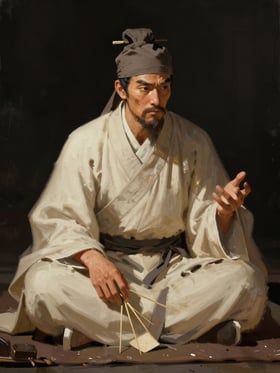
Guan Lu, a Cao Wei diviner from Pingyuan, was famed for Yi studies and omens; histories stress divination and frank remonstrance.
Life
In the novel: 4 chapters · In the Records: 1 volume
Life209–256
Allegiance
On the boards
Compare with someone →Where this person ranks on each board.
Historical Record
Guan Lu, courtesy name Gongming, was from Pingyuan. In Cao Wei, he was a practitioner of the occult arts renowned for his mastery of the Zhouyi, observing celestial phenomena, and divination through wind patterns. He was coarse and unattractive in appearance, lacked dignity, and loved wine and unrestrained conversation; yet he was generous in nature, treated people without regard to closeness or distance, and regarded loyalty, filial piety, trustworthiness, and righteousness as fundamental. From boyhood he delighted in gazing up at the stars. At fifteen, he accompanied his father to the government quarters to study the Book of Songs, the Analects, and the Changes, and his talent showed itself early. Dan Zichun, Administrator of Langya, once gathered guests to debate with him. Guan Lu first drank three sheng of wine, then spoke of the nature of the Five Phases and spirits, answering with ease. He was consequently called a child prodigy.
Guan Lu’s abilities went beyond identifying objects through divination. He could explain the meanings and principles of the hexagram lines, and also used observations of the wind and the cries of birds to predict events. Historical accounts record his divination of the illness of Liu Fenglin’s wife, his explanation to Wang Ji of strange phenomena at a guesthouse, and his discovery of buried human remains for the Magistrate of Xindu. Liu Fenglin’s wife was gravely ill, and her coffin had already been prepared. Guan Lu divined that her life would end at midday on the xīn-mǎo day of the eighth month; her condition did indeed worsen on the date he had named. The three strange things Wang Ji had witnessed, Guan Lu explained as unusual phenomena at an old guesthouse, and no misfortune followed. These accounts present both stories of divination and signs of Guan Lu’s skill in using the hexagrams to explain good and ill fortune, without pronouncing every strange occurrence an omen of disaster.
After being recommended, Guan Lu entered the service of Pei Hui, Inspector of Jizhou, successively serving as Literary Officer, Administrator, and Aide-de-Camp. In the ninth year of the Zhengshi era, he was recommended as a Xiucai; in the eighth month of the second year of the Zhengyuan era, he became Assistant Director of the Palace Treasury. When he met He Yan and Deng Yang, he used He Yan’s dream of a bluebottle fly landing on his nose to urge him to be modest. He pointed out that those who held high office and great power rarely possessed virtue, and offered counsel through the meanings of “modesty” and “vigor.” Deng Yang mocked him for repeating old platitudes, and Guan Lu answered with a sharp rejoinder. Later, after Cao Shuang and the others were executed, the strong winds on New Year’s Day recorded in Pei Songzhi’s annotation were seen as corresponding to these events, and only then did Guan Lu’s maternal uncle believe how pointed his words had been that day.
Knowing that his life would be short, Guan Lu once listed to his younger brother Guan Chen the signs in his face and birth date, saying he feared he would not live past forty-seven or forty-eight. He became Assistant Director of the Palace Treasury in the second year of the Zhengyuan era and died in the second month of the following year, aged forty-eight. A biography written by his younger brother says that although Guan Lu was skilled in divination, he used only such books as the Yilin, works on wind divination and bird calls, and texts on observing the stars; he had no other secret teachings. It also laments that his talent was great but his life short.
In the Novel
Romance of the Three Kingdoms builds on the historical image of the “diviner of Pingyuan,” portraying Guan Lu as an extraordinary man who could use hexagrams to foretell upheavals across the realm and who dared to speak frankly to the powerful. In Chapter 69, Cao Cao hears Xu Zhi mention Guan Lu while ill, then summons him to divine. The novel has Guan Lu predict that Eastern Wu will lose a great general, Shu in the west will invade its borders, and Xu will suffer a fire; he also uses cryptic words to foretell Xiahou Yuan’s death in the Battle of Mount Dingjun. Cao Cao does not believe him at first, but after the reports arrive, he connects the phrases “three and eight crisscrossing” and “a yellow boar meets a tiger” with Xiahou Yuan’s death. These prophecies and events are inventions of the novel and should not be treated as historical accounts of Cao Cao summoning Guan Lu or of divination concerning Mount Dingjun.
The novel also portrays Guan Lu as a compassionate and loyal man who uses his arts to save lives. He sees the aura of death between Zhao Yan’s brows, but cannot bear the father and son’s desperate pleas, so he directs Zhao Yan to take wine and meat to Mount Nan and ask for a longer life. The fantastical episode of a man gaining years of life from players in a game of go highlights Guan Lu’s willingness to intervene even though he knows Heaven’s decree. The Records of the Three Kingdoms contains no such story.
In the episode with He Yan and Deng Yang, the novel retains the historical account of the bluebottle fly dream, the admonition to be modest, and the sharp retort, “Those who call themselves old hands see what is not there; those who speak of old platitudes see nothing worth discussing.” It adds a scene in which Guan Lu, after returning home, declares that the two men will meet violent deaths, using the phrases “ghostly agitation” and “ghostly gloom.” Chapter 107 then confirms the prophecy with the unnatural deaths of He Yan and Deng Yang, making Guan Lu a prophet who sees calamity coming and dares to defy the powerful. The novel’s account of physiognomy and foretelling disaster is more dramatic than the historical record.
Key Relationships
As a youth, Guan Lu debated with Dan Zichun, Administrator of Langya, thereby revealing his talent for argument. Dan Zichun praised his ability and character, and Guan Lu consequently gained a reputation as a “child prodigy.” Later, Zhao Kongyao recommended him to Pei Hui, who brought him into his staff and repeatedly promoted him. Their relationship involved both patronage and intellectual discussions about the principles of the Changes and people’s talents and character.
He Yan and Deng Yang were the key figures to whom Guan Lu offered counsel based on the principles of the Changes. The historical account says that he urged He Yan to guard against complacency and remain modest; the novel goes further, portraying him as privately predicting that both men would die. Cao Cao’s summoning Guan Lu to divine the affairs of the realm, and Zhao Yan’s request that Guan Lu save his life, appear only in the novel; the Records of the Three Kingdoms contains no corresponding episodes.
Signature Scenes
As a young man, Guan Lu asked to drink three sheng of wine at a banquet where Dan Zichun’s hall was filled with guests, then spoke about the Five Phases and spirits. The guests questioned him in turn, and he answered them all, carrying on the discussion from daylight until dusk. With its striking “drink first, debate afterward” gesture and his sustained eloquence, the scene establishes him as both free-spirited and exceptionally gifted.
Another representative scene shows Guan Lu responding to He Yan’s dream of a bluebottle fly not merely by divining good or ill fortune, but by discussing rank, virtue, and modesty, warning that the height of He Yan’s power might bring a fall. The historical account records this admonition and the later executions of He Yan and Deng Yang. The novel links the men’s appearance, Guan Lu’s pronouncements about their ghostly aspects, and the subsequent fulfillment of his predictions, heightening the dramatic force of the tragic foreshadowing.
The novel’s Zhao Yan episode, in which he seeks a longer life, turns the diviner’s ability to communicate with the unseen into an act of rescue: Guan Lu arranges for Zhao Yan to plead with men playing go, and their father-and-son devotion wins him additional years. Compared with the historical accounts of Guan Lu predicting the course of an illness or explaining strange phenomena, this fictional story places greater emphasis on his compassion and sense of responsibility.
Quotes
47 lines in the books · 3 featured
「吾與死人語,何所畏耶?」
This line shows Guan Lu's extraordinary courage and his refusal to fear the powerful, a classic portrayal of his character.
「吾自知有分直耳,然天與我才明,不與我年壽,恐四十七八間,不見女嫁兒娶婦也。若得免此,欲作洛陽令,可使路不拾遣,枹鼓不鳴。但恐至太山治鬼,不得治生人,如何!」
This line foretells his own lifespan and voices his aspiration to bring order to the age, a footnote to his tragic fate.
「元、愷輔舜,周公佐周,皆以和惠謙恭,享有多福。今君侯位尊勢重,而懷德者鮮,畏威者眾,殆非小心求福之道。且鼻者,山也;山高而不危,所以長守貴也。今青蠅臭惡而集焉,位峻者顛,可不懼乎?願君侯裒多益寡,非禮勿履;然後三公可至,青蠅可驅也。」
This passage uses physiognomy as a pretext to in fact admonish He Yan, reflecting Guan Lu's political wisdom and moral stance.
- Family
- Friends
- Enemies
- Teacher & student
- Other
Who is Guan Lu connected to?
Pick someone to see how many steps lie between them and Guan Lu.
History vs. novel
7 points · 3 novel-only
| History | Novel |
|---|---|
| Zhao Yan's Extended LifespanNovel only | |
| — | Guan Lu saw that Zhao Yan had the aura of death between his brows, so he advised him to take wine and meat to Mount Nan and seek help from the Southern Dipper and Northern Dipper, who were playing go. As a result, Zhao Yan's lifespan was extended by twelve years. The Records of the Three Kingdoms does not record this incident. ch. 69 |
| Cao Cao Asks About His DreamNovel only | |
| — | Cao Cao suffered a recurrence of his head ailment and dreamed of three horses sharing a trough, so he summoned Guan Lu to divine its meaning. Guan Lu said it was merely an illusion. Reassured by this, Cao Cao felt better; the Records of the Three Kingdoms does not record this episode. ch. 69 |
| Cao Cao Divines the Fate of the RealmNovel only | |
| — | In the novel, Cao Cao orders Guan Lu to divine the fate of the realm and the duration of Cao Wei's rule. Using cryptic phrases such as “three and eight crisscrossing,” Guan Lu predicts the course of events. The Records of the Three Kingdoms contains no such scene of Cao Cao consulting him for a divination. ch. 69 |
| He Yan's Omen of DeathNovel embellishes | |
He Yan asks whether he will attain the rank of one of the Three Excellencies and what it means to dream of bluebottles gathering on his nose. Guan Lu urges him to be modest and reflect on himself, using the bluebottles as a metaphor for his circumstances. He and Deng Yang were later executed. vol. 29 | The novel retains the scene in which He Yan consults Guan Lu about divination, Deng Yang questions him, and Guan Lu speaks frankly. It also adds that the two mock him to his face, and has him explain their deaths with the phrases “ghostly restlessness” and “ghostly gloom.” ch. 106 |
| Foreknowing His Short LifeHistory only | |
Guan Lu tells his younger brother that he fears he will not live past the age of forty-seven or forty-eight, and lists signs of a short life in his forehead, eyes, nose, and feet. He died the following year, aged forty-eight. vol. 29 | — |
| Prophecy of Three CivetsHistory only | |
While traveling with his younger brother by carriage to Wucheng, Guan Lu divines his own fortune and predicts that they will see three civets at the old city. The prediction comes true. In the ninth year of the Zhengshi era, he was recommended as a xiucai. vol. 29 | — |
| Thirteen Objects in a Divination TestHistory only | |
Xu Jilong, the Magistrate of Qinghe, asks Guan Lu to divine what game they will hunt. Guan Lu predicts they will catch a civet, and is proved right. Xu then tests him with thirteen objects; Guan Lu identifies nearly all of them correctly, mistaking only a comb for a bi. vol. 29 | — |
- Zhao Yan's Extended LifespanNovel only
- Novel
Guan Lu saw that Zhao Yan had the aura of death between his brows, so he advised him to take wine and meat to Mount Nan and seek help from the Southern Dipper and Northern Dipper, who were playing go. As a result, Zhao Yan's lifespan was extended by twelve years. The Records of the Three Kingdoms does not record this incident.
ch. 69
- Cao Cao Asks About His DreamNovel only
- Novel
Cao Cao suffered a recurrence of his head ailment and dreamed of three horses sharing a trough, so he summoned Guan Lu to divine its meaning. Guan Lu said it was merely an illusion. Reassured by this, Cao Cao felt better; the Records of the Three Kingdoms does not record this episode.
ch. 69
- Cao Cao Divines the Fate of the RealmNovel only
- Novel
In the novel, Cao Cao orders Guan Lu to divine the fate of the realm and the duration of Cao Wei's rule. Using cryptic phrases such as “three and eight crisscrossing,” Guan Lu predicts the course of events. The Records of the Three Kingdoms contains no such scene of Cao Cao consulting him for a divination.
ch. 69
- He Yan's Omen of DeathNovel embellishes
- History
He Yan asks whether he will attain the rank of one of the Three Excellencies and what it means to dream of bluebottles gathering on his nose. Guan Lu urges him to be modest and reflect on himself, using the bluebottles as a metaphor for his circumstances. He and Deng Yang were later executed.
vol. 29
- Novel
The novel retains the scene in which He Yan consults Guan Lu about divination, Deng Yang questions him, and Guan Lu speaks frankly. It also adds that the two mock him to his face, and has him explain their deaths with the phrases “ghostly restlessness” and “ghostly gloom.”
ch. 106
- Foreknowing His Short LifeHistory only
- History
Guan Lu tells his younger brother that he fears he will not live past the age of forty-seven or forty-eight, and lists signs of a short life in his forehead, eyes, nose, and feet. He died the following year, aged forty-eight.
vol. 29
- Prophecy of Three CivetsHistory only
- History
While traveling with his younger brother by carriage to Wucheng, Guan Lu divines his own fortune and predicts that they will see three civets at the old city. The prediction comes true. In the ninth year of the Zhengshi era, he was recommended as a xiucai.
vol. 29
- Thirteen Objects in a Divination TestHistory only
- History
Xu Jilong, the Magistrate of Qinghe, asks Guan Lu to divine what game they will hunt. Guan Lu predicts they will catch a civet, and is proved right. Xu then tests him with thirteen objects; Guan Lu identifies nearly all of them correctly, mistaking only a comb for a bi.
vol. 29
Events
Events (2)
Battles and events the texts place this person in, by date.
Battles
Other events
Places
- Native of
- PingyuanRecords
- Was at
- Julu CommanderyRecords
Continue
Liu Bin
Friend
Relationship timeline8 entries ▸
History · vol. 29
- Guo En§51
Witnessed
Guan Lu divined the cause of the lameness afflicting the Guo En brothers
- Wang Ji§53
Crossed paths
Guan Lu went to see Wang Ji, the governor of Anping, and cast a hexagram
- He Yan§63
Witnessed
Minister of Personnel He Yan asked Guan Lu to cast a divination to inquire whether he would attain the rank of Three Excellencies
- Deng Yang§63
Rival
Deng Yang, at He Yan's place, discussed Guan Lu's hexagram pronouncements and mocked them as the stale talk of an old scholar
Novel · ch. 69
- Zhao Yan§12
Student
saw the aura of death between his brows and instructed him to serve the Southern and Northern Dippers at Nanshan to seek an extension of his life
- Cao Cao§15
Advised
Summoned to Ye, he divined Cao Cao's illness, the fate of the realm, and the transmission of the mandate; all his predictions came true
Novel · ch. 106
- He Yan§14
Advised
was invited to perform divination; judged his “soul not dwelling in its house, blood not lending color to his face” to be an omen of “ghostly gloom”
- Deng Yang§14
Advised
He later commented that his physiognomy—“his sinews did not bind his bones, and his veins did not control his flesh”—was the physiognomy of a “restless ghost.”
Inner monologues · AI-generated3 monologues ▸
- I am Guan Lu, courtesy name Gongming, a native of Pingyuan. Now that I have come to this point, looking back on my life,
- I am Guan Lu, courtesy name Gongming. As I reflect on these years of reading human affairs through the patterns of divin
- I recall that when I was young, there was a man in my home district named Guo Yibo, who was well versed in the *Book of