Shu Han · Five Great Tiger Generals
Ma Chao
courtesy name 孟起 · 176–222
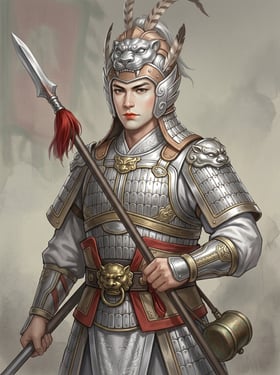
His face like capped jade, his eyes like shooting stars, a tiger's frame and an ape's arms, a leopard's belly and a wolf's waist; his face as if powdered, his lips as if smeared with cinnabar, slender at the waist and broad at the shoulders, his voice powerful and his strength fierce; in a lion helmet and beast-figured belt, silver armor and a white robe, extraordinary in array and outstanding in talent.

Life
In the novel: 21 chapters · In the Records: 22 volumes
Life176–222
202 CE (Jian'an 7)
211 CE (Jian'an 16)
8 more events
211 CE (Jian'an 16)
212 CE (Jian'an 17)
- Siege of JichengJichengCommander
213 CE (Jian'an 18)
214 CE (Jian'an 19)
218 CE (Jian'an 23)
- Peng Yang AffairChengduWitness
219 CE (Jian'an 24)
223 CE (Huangchu 4)
Allegiance
- Liu Bei's faction
- Way of the Five Pecks of Rice
- Shu Han
- Xiliang Army· Undated
- Cao Wei· Undated
- Hatched: dated by chapter
- Life event
- Death
List all 8 stops
- Youfufeng176Birthplace
- Pingyang202Zhong Yao Defeats Guo Yuan and Receives the Xiongnu Chanyu's Submission
- Tong Pass211Cao Cao Cuts His Beard and Discards His Robe+4 more
- Jicheng212Siege of Jicheng
- Lucheng213Yang Fu Raises Troops Against Ma Chao
- Chengdu214–218Liu Zhang's Surrender+2 more
- Mianyang219Liu Bei's Elevation to King of Hanzhong
- Chengdu223Zhuge Liang Repels the Five Armies
On the boards
Compare with someone →Where this person ranks on each board.
- Most Defections: #2Records
- Most Foes Defeated: #4Romance
- Stratagem Success Rate: #4Romance
- Best Duel Record: #4Both
- Most Duel Wins: #6Romance
- Saw Through the Most: #6Records
- Most Executions Ordered: #6Both
- Most Generals Slain: #7Romance
- Most Battles Won: #9Romance
- Most Battles Lost: #10Records
- Plans That Worked: #10Romance
- Best Connected: #13Records
- Master Strategists: #13Romance
- Most Betrayed: #14Romance
Who they were
Character profile
- Appearance
- His face like capped jade, his eyes like shooting stars, a tiger's frame and an ape's arms, a leopard's belly and a wolf's waist; his face as if powdered, his lips as if smeared with cinnabar, slender at the waist and broad at the shoulders, his voice powerful and his strength fierce; in a lion helmet and beast-figured belt, silver armor and a white robe, extraordinary in array and outstanding in talent.
- Character
- Relying on the frontier tribes and presuming on his valor, matchlessly brave, fierce and skilled in battle, staunch but lacking in strategy and prone to suspicion, conceited in his great strength.
- Manner of speech
- Sorrowful and indignant at his death.
- Life
- The son of Ma Teng, a native of Maoling in Youfufeng. He once rebelled against Cao Cao together with Han Sui and others, then fled in defeat to Hanzhong to attach himself to Zhang Lu, and at last submitted to Liu Bei, helping him besiege Chengdu. He was enfeoffed as General Who Pacifies the West, General of Agile Cavalry, Governor of Liang Province, and Marquis of Tai precinct. In the second year of Zhangwu he died of illness at the age of forty-seven, and was posthumously titled Marquis Wei.
- Weapons
- A long spear and a bronze mace.
- Anecdotes
- When the Xiliang Army retreated in defeat he covered the rear, fighting to the death and driving back Zhang Ji; after his army's defeat he entered the lands of the Qiang for more than two years, befriending the Qiang soldiers and taking commanderies in Longxi. Later, falling for Yang Fu's stratagem, he lost his wife, children, and kinsmen to slaughter; he himself took up a sword and killed the Mother of Jiang Xu, then fled in defeat to Hanzhong to join Zhang Lu. A sojourner returned to his country, he lived in constant fear and dread; hearing Peng Yang's words, he was greatly alarmed and made no reply, and then reported him. Ranked with Guan and Zhang as claws and fangs, his name was listed among those urging Liu Bei to become King of Hanzhong.
Historical Record
Ma Chao, courtesy name Mengqi, was from Maoling in Youfufeng and was the son of Ma Teng. After Ma Teng entered the imperial court to serve as Commandant of the Guards, Ma Chao took command of his troops and was enfeoffed as Marquis of Douting. Early in his career, he accompanied Zhong Yao on campaigns against Guo Yuan and Gao Gan, leading troops to join forces with Zhong Yao and decisively defeat the enemy. Guo Yuan was beheaded; Pang De, who served under Ma Chao, took part in the battle and personally killed Guo Yuan.
In the sixteenth year of Jian’an, Ma Chao and Han Sui, along with other generals in the Guanzhong region, rebelled against Cao Cao. Cao Cao led a campaign west, and the two sides fought at Tong Pass and in the Wei River region. Ma Chao and the others challenged Cao Cao several times, then requested territory in exchange for peace. Cao Cao followed Jia Xu’s strategy, pretending to agree while sowing discord between Ma Chao and Han Sui, and then defeated their allied forces. Ma Chao and Han Sui fled to Liang Province. Later, Ma Chao rose again in Hanyang, relying on Qiang and Hu forces, and the Di king Qianwan responded to his call. Zhao Qu, Yin Feng, and others raised troops against him. Ma Chao’s wife and children were killed, and he fled to Hanzhong to seek refuge with Zhang Lu.
Ma Chao later submitted to Liu Bei. When Liu Bei besieged Chengdu, the city was thrown into turmoil by the arrival of Ma Chao’s forces, and Liu Zhang surrendered. Ma Chao thereafter became an important general under Liu Bei, ranking alongside Guan Yu and Zhang Fei as one of his “claws and fangs.” After Liu Bei Proclaims Himself King of Hanzhong, he appointed Ma Chao General of the Left and granted him authority to act independently. In the first year of Zhangwu, Ma Chao was promoted to General of the Chariots and Cavalry, appointed governor of Liang Province, and elevated to Marquis of Taixiang. He died in the second year of Zhangwu at the age of forty-seven and was posthumously titled Marquis Wei.
In the Novel
The Romance of the Three Kingdoms portrays Ma Chao as a dashing, imposing, valiant, and fierce general from Xiliang. The novel has him make his first appearance at seventeen, when he kills Wang Fang with a spear and captures Li Meng alive, emphasizing his youthful heroism and quickness in battle. These specific encounters are fictional; they are not recorded in the Records of the Three Kingdoms.
The novel also presents his motive for opposing Cao Cao as a desire for revenge after Cao Cao killed his father, Ma Teng, and his younger brothers, and has Liu Bei send him a letter proposing an alliance, prompting Ma Chao to raise troops. In the episode at Tong Pass, Ma Chao pursues Cao Cao and forces him to cut off his beard and abandon his robe, then engages Xu Chu in a famous contest of strength. Historical accounts record that Ma Chao fought Cao Cao at Tong Pass and in the Wei River region, and that Cao Cao defeated the enemy, but they do not include the novel’s scenes of Cao Cao being pursued after cutting off his beard, or the duel of more than a hundred bouts with Xu Chu.
Key Relationships
Ma Teng was both Ma Chao’s father and the former master of the troops Ma Chao commanded early in his career. Han Sui, meanwhile, was an important ally of Ma Chao when he rebelled against Cao Cao. Historical accounts say Cao Cao used letters and meetings to deepen the mutual suspicion between the two, ultimately defeating their allied forces. Liu Bei was the ruler to whom Ma Chao later submitted. Ma Chao served as a general in Shu Han and was granted high office.
When Guan Yu asked Zhuge Liang about Ma Chao, Zhuge Liang praised him as “gifted in both Wen Wu, and outstanding in courage and strength,” comparing him to figures such as Ying Bu and Peng Yue. This account reflects Ma Chao’s reputation among Shu Han’s famous generals. The novel, by contrast, particularly emphasizes his confrontation with Xu Chu, portraying the two fierce generals as evenly matched. (Unique to the novel)
Signature Scenes
The Battle of Tong Pass was a turning point in Ma Chao’s career. He and Han Sui, along with others, held the pass against Cao Cao, who adapted the course of the battle through tactics including crossing the river, crossing the Wei, feigning weakness, and sowing discord. He ultimately defeated the allied forces. Ma Chao consequently fled to Liang Province and later sought refuge with Zhang Lu, illustrating the shifts in his fortunes after his power in Guanzhong was checked.
The Siege of Jicheng and Ma Chao’s subsequent defeat reflect his resurgence and loss of power in Liang Province. Ma Chao besieged Jicheng. Yan Wen slipped out to seek aid and was captured, but still called out to those inside the city that reinforcements were on their way; Ma Chao eventually had him killed. Yang Fu and others then raised troops, while Zhao Qu and Liang Kuan seized the opportunity to shut the city gates. Ma Chao’s wife and children were killed, and he fled south once more to Zhang Lu.
The novel’s most vivid dramatic scene has Ma Chao pursue Cao Cao along the Wei River, forcing Cao Cao to escape in panic. Ma Chao then fights Xu Chu on the battlefield, and the two battle for a long time without either gaining the upper hand. (Unique to the novel)
Quotes
45 lines in the books · 3 featured
「操賊欺君罔上,罪不容誅!害我父弟,不共戴天之讎!吾當活捉生啖汝肉!」
This line displays Ma Chao's deep and bitter hatred for Cao Cao, shaping his image as an 'avenger'.
「短髯者是曹操!」
'The one with the short beard is Cao Cao!' is a classic scene in Romance of the Three Kingdoms depicting Cao Cao's disgraceful flight, and is widely renowned.
「今遇明主,如撥雲霧而見青天!」
This line expresses Ma Chao's state of mind after submitting to Liu Bei, a pivotal line at a turning point in his life.
- Family
- Lord & vassal
- Friends
- Enemies
- Other
History vs. novel
8 points · 2 novel-only
| History | Novel |
|---|---|
| Ma Chao’s First Battle as a YouthNovel embellishes | |
Ma Chao accompanied Zhong Yao on a campaign against Guo Yuan and Gao Gan. Historical records say he took part in a major defeat of the enemy, while Pang De beheaded Guo Yuan; they do not mention Ma Chao winning a duel as a youth. vol. 36 | The novel portrays Ma Chao’s debut as that of a seventeen-year-old hero: he stabs Wang Fang to death and captures Li Meng alive, highlighting his youthful valor. ch. 10 |
| Reason for Raising an ArmySources disagree | |
Cao Cao's Campaign Against Zhang Lu passed through Guanzhong, arousing suspicions among Ma Chao and others. Ma Chao then rose in revolt with Han Sui and others; the Records of the Three Kingdoms does not say this was to avenge his father. vol. 1 | The novel says that after Cao Cao killed Ma Teng and his sons, Ma Chao raised an army to avenge his father and vowed to capture Cao Cao. ch. 58 |
| Pursuit of Cao Cao at Tong PassNovel embellishes | |
During the fighting at Tong Pass, Ma Chao and the others faced off against Cao Cao. Cao Cao used Jia Xu’s strategy to sow discord between Ma Chao and Han Sui, ultimately defeating their allied forces; the Records of the Three Kingdoms does not record Ma Chao pursuing Cao Cao. vol. 36 | The novel depicts Ma Chao chasing Cao Cao, who is so startled that he drops his riding crop. Cao Cao then cuts off his beard and abandons his robe as he flees, dramatizing Ma Chao’s valor. ch. 58 |
| Meeting at the Wei BridgeNovel embellishes | |
When Cao Cao met with Ma Chao and Han Sui on horseback, Ma Chao secretly considered rushing forward to seize Cao Cao. Xu Chu glared at him, and Ma Chao therefore dared not act rashly. vol. 36 | The novel also depicts Cao Cao meeting with Ma Chao, adding that Xu Chu glared at him and Ma Chao did not dare make a rash move, highlighting Xu Chu’s intimidating presence. ch. 58 |
| Wei Kang’s Death at JichengNovel embellishes | |
Ma Chao besieged Jicheng for several months, and Wei Kang opened the gates and surrendered. After Ma Chao entered the city, Yang Fu and others resisted; historical records say that Wei Kang was killed. vol. 36 | The novel says that after Wei Kang surrendered, Ma Chao suspected he was not sincere and executed Wei Kang and more than forty others. It also says that Yang Fu was spared because he upheld his principles. ch. 64 |
| Night Battle with Zhang FeiNovel only | |
| — | When Ma Chao attacked Jiameng Pass, he fought Zhang Fei in a fierce battle. They fought for more than a hundred bouts in broad daylight without a victor, then agreed to fight again at night, making this one of the novel’s most memorable scenes. ch. 65 |
| Surrender to Liu BeiNovel embellishes | |
Ma Chao was frustrated in his service to Zhang Lu in Hanzhong. When he heard that Liu Bei had surrounded Chengdu, he secretly sent a letter requesting to surrender. vol. 36 | The novel says that Li Hui persuaded Ma Chao, pointing out that he was surrounded on all sides and had nowhere to turn. After hearing this, Ma Chao killed Yang Bai and surrendered to Liu Bei. ch. 65 |
| Five Tiger GeneralsNovel only | |
| — | The novel says that after Liu Bei Proclaims Himself King of Hanzhong, he appoints Guan Yu, Zhang Fei, Zhao Yun, Ma Chao, and Huang Zhong as the Five Tiger Generals. This appointment is an arrangement found in the novel. ch. 73 |
- Ma Chao’s First Battle as a YouthNovel embellishes
- History
Ma Chao accompanied Zhong Yao on a campaign against Guo Yuan and Gao Gan. Historical records say he took part in a major defeat of the enemy, while Pang De beheaded Guo Yuan; they do not mention Ma Chao winning a duel as a youth.
vol. 36
- Novel
The novel portrays Ma Chao’s debut as that of a seventeen-year-old hero: he stabs Wang Fang to death and captures Li Meng alive, highlighting his youthful valor.
ch. 10
- Reason for Raising an ArmySources disagree
- History
Cao Cao's Campaign Against Zhang Lu passed through Guanzhong, arousing suspicions among Ma Chao and others. Ma Chao then rose in revolt with Han Sui and others; the Records of the Three Kingdoms does not say this was to avenge his father.
vol. 1
- Novel
The novel says that after Cao Cao killed Ma Teng and his sons, Ma Chao raised an army to avenge his father and vowed to capture Cao Cao.
ch. 58
- Pursuit of Cao Cao at Tong PassNovel embellishes
- History
During the fighting at Tong Pass, Ma Chao and the others faced off against Cao Cao. Cao Cao used Jia Xu’s strategy to sow discord between Ma Chao and Han Sui, ultimately defeating their allied forces; the Records of the Three Kingdoms does not record Ma Chao pursuing Cao Cao.
vol. 36
- Novel
The novel depicts Ma Chao chasing Cao Cao, who is so startled that he drops his riding crop. Cao Cao then cuts off his beard and abandons his robe as he flees, dramatizing Ma Chao’s valor.
ch. 58
- Meeting at the Wei BridgeNovel embellishes
- History
When Cao Cao met with Ma Chao and Han Sui on horseback, Ma Chao secretly considered rushing forward to seize Cao Cao. Xu Chu glared at him, and Ma Chao therefore dared not act rashly.
vol. 36
- Novel
The novel also depicts Cao Cao meeting with Ma Chao, adding that Xu Chu glared at him and Ma Chao did not dare make a rash move, highlighting Xu Chu’s intimidating presence.
ch. 58
- Wei Kang’s Death at JichengNovel embellishes
- History
Ma Chao besieged Jicheng for several months, and Wei Kang opened the gates and surrendered. After Ma Chao entered the city, Yang Fu and others resisted; historical records say that Wei Kang was killed.
vol. 36
- Novel
The novel says that after Wei Kang surrendered, Ma Chao suspected he was not sincere and executed Wei Kang and more than forty others. It also says that Yang Fu was spared because he upheld his principles.
ch. 64
- Night Battle with Zhang FeiNovel only
- Novel
When Ma Chao attacked Jiameng Pass, he fought Zhang Fei in a fierce battle. They fought for more than a hundred bouts in broad daylight without a victor, then agreed to fight again at night, making this one of the novel’s most memorable scenes.
ch. 65
- Surrender to Liu BeiNovel embellishes
- History
Ma Chao was frustrated in his service to Zhang Lu in Hanzhong. When he heard that Liu Bei had surrounded Chengdu, he secretly sent a letter requesting to surrender.
vol. 36
- Novel
The novel says that Li Hui persuaded Ma Chao, pointing out that he was surrounded on all sides and had nowhere to turn. After hearing this, Ma Chao killed Yang Bai and surrendered to Liu Bei.
ch. 65
- Five Tiger GeneralsNovel only
- Novel
The novel says that after Liu Bei Proclaims Himself King of Hanzhong, he appoints Guan Yu, Zhang Fei, Zhao Yun, Ma Chao, and Huang Zhong as the Five Tiger Generals. This appointment is an arrangement found in the novel.
ch. 73
Combat
On the field
Duels, kills and executions as the texts tell them, counted separately for the Records and the Romance.
Duel them- RecordsJuan 18ExecutionYan WenWon「超遂殺之」
- RecordsJuan 25ExecutionorderedWei Kang「使楊昂殺刺史、太守」
- RecordsJuan 25ExecutionMother of Jiang XuWon「超怒,殺之」
- RomanceCh. 10DuelWang FangWon「早被馬超一槍刺於馬下」
- RomanceCh. 10DuelLi MengWon「被馬超輕舒猿臂,生擒過去」
- RomanceCh. 58DuelYu JinWon8 bouts「兩馬交戰,鬥得八九合,于禁敗走」
All encounters (19)
Loading…
Battles in command
Battles this person commanded in, with the outcome as each text tells it.
- Records
- 0W 1L 0D 0 undecided
- Romance
- 2W 1L 0D 0 undecided
- Records211Battle of Tong PassLostvs Cao forcesJuan 1「乃縱虎騎夾擊,大破之,斬成宜、李堪等」
- Romance211Battle of Tong PassLostvs Cao troopsCh. 59「止剩得三十餘騎,與龐德、馬岱望隴西、臨洮而去」
- Romance223Five-Route Invasion of ShuWonvs Wei's five armiesCh. 86「曹真屯兵於斜谷道,不能取勝而回」
- Romance223Zhuge Liang Repels the Five ArmiesWonvs Wei's five armiesCh. 86「見了馬超,不戰自退;南蠻孟獲起兵攻四郡,皆被魏延用疑兵計殺退回洞去了」
Stratagems
Plans this person devised or saw through, as the texts tell them.
- Records
- 3 carried out · 0 worked · 0 turned down · 1 seen through
- Romance
- 7 carried out · 6 worked · 0 turned down · 1 seen through
- RecordsLaunch a Surprise Attack During a MeetingOtherFailedJuan 18「超負其力,陰欲前突太祖,素聞褚勇,疑從騎是褚」
- RecordsForce Wen to Deceive the CityDeceptionFailedagainst JichengJuan 18「若從吾言,反謂城中,東方無救,此轉禍為福之計也」
- RecordsMeet Cao on Horseback and Capture HimDeceptionSeen throughagainst Cao CaoJuan 36「超負其多力,陰欲突前捉曹公,曹公左右將許褚瞋目盻之,超乃不敢動」
- RecordsCoordinate Inside and OutsideOtherSaw throughagainst ShuJuan 40「又謂超曰:「卿為其外,我為其內,天下不足定也。」」
- RomancePretend Not to KnowDeceptionWorkedagainst Li Meng's armyCh. 10「原來馬超明知李蒙追趕,卻故意俄延」
- RomanceGoading into ActionLureWorkedCh. 58「此是馬超要激將軍廝殺,切不可與戰」
All stratagems (13)
Loading…
Events
Events (16)
Battles and events the texts place this person in, by date.
Battles
- 211Battle of Tong PassCommander
- 218Hanzhong Campaign
- 222Battle of Xiaoting
- 223Zhuge Liang Repels the Five ArmiesCommander
Other events
- 192Turmoil of Li Jue and Guo Si
- 202Zhong Yao Defeats Guo Yuan and Receives the Xiongnu Chanyu's SubmissionWarrior
- 211Zhang Ji Defeats Ma Chao at HuayinKilled in action
- 211Cao Cao Cuts His Beard and Discards His RobeWarrior
- 211Xu Chu Fights Ma Chao Bare-ChestedWarrior
- 211Jia Xu Sows Discord Between Ma Chao and Han SuiWarrior
- 212Siege of JichengCommander
- 213Yang Fu Raises Troops Against Ma ChaoVictim
All 12
- 214Liu Zhang's SurrenderWarrior
- 214Ma Chao's Surrender to Liu BeiWarrior
- 218Peng Yang AffairWitness
- 219Liu Bei's Elevation to King of HanzhongWitness
Places
- Native of
- YoufufengRecords
- Was at
- Tong PassRecords
- Yangping PassRomance
- Governed
- Liang ProvinceRecords
- JichengRecords
- TianshuiRecords
- Moved to
- HanzhongRecords
Continue
The Battle of Tong Pass in 3D
Replay the Battle of Tong Pass phase by phase on real terrain: troop strengths, movements and turning points at a glance, each marked as coming from the Records of the Three Kingdoms or the Romance.
Relationship timeline26 entries ▸
History · vol. 1
- Han Sui§77
Friend
Rebelled with Han Sui and others
History · vol. 15
History · vol. 25
- Wei Kang§15
Enemy
detained Yue in Ji and had Yang Ang kill the provincial governor and commandery governor
History · vol. 36
- Pang De§18
Commands
Chao’s general Pang De personally cut off Guo Yuan’s head
- Han Sui§19
Friend
Chao allied with Han Sui to rebel against Cao Cao
- Wei Kang§19
Fights
killed Wei Kang, the Inspector of Liang Province, and occupied Jicheng
- Ma Dai§22
Kin
younger paternal cousin Dai, whom he deeply entrusted to Your Majesty
- Ma Cheng§22
Child
His son Cheng succeeded him
All 26
Loading…
Inner monologues · AI-generated3 monologues ▸
- I was styled Mengqi and was from Maoling in Fufeng. In my youth, I saw my father, Ma Teng, establish himself in the west
- I am about to die. Looking back on my life, what weighs most heavily on me is not my defeat at Tong Pass, nor my flight
- I am Ma Chao, courtesy name Mengqi. The height of my fortunes came when I raised troops south of the Wei River and the v