Cao Wei · Commandant
Xu Chu
courtesy name 仲康 · –c. 230
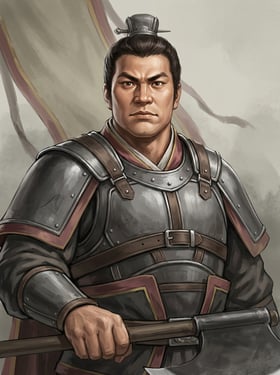
Xu Chu stood over eight chi tall, with a waist ten spans around, a fierce and majestic countenance, and strength beyond that of ordinary men. At times he wore heavy armor with arrows lodged in the plates, his round eyes glaring wide and his gaze flashing with a divine light.

Life
In the novel: 31 chapters · In the Records: 3 volumes
Life?–230
195 CE (Xingping 2)
201 CE (Jian'an 6)
- Battle of CangtingCangtingWarrior
- Cao Cao Pacifies HebeiYeWarrior
5 more events
201 CE (Jian'an 6)
- Battle of RangshanMount RangWarrior
207 CE (Jian'an 12)
208 CE (Jian'an 13)
210 CE (Jian'an 15)
211 CE (Jian'an 16)
211 CE (Jian'an 16)
215 CE (Jian'an 20)
Allegiance
- Cao Wei
- Life event
List all 10 stops
- QiaoBirthplace
- Dingtao195Defeat of Lü Bu at Dingtao
- Mount Rang201Battle of Rangshan
- Ye201Cao Cao Pacifies Hebei
- Cangting201Battle of Cangting
- White Wolf Mountain207Cao Cao's Campaign Against the Wuhuan
- Jing Province208Cao Cao's Southern Campaign Against Jing Province
- Ye210Bronze Bird Terrace Inauguration Ceremony
- Tong Pass211Cao Cao Cuts His Beard and Discards His Robe+1 more
- Nanzheng215Zhang Lu Surrenders to Cao Cao
On the boards
Compare with someone →Where this person ranks on each board.
Who they were
Character profile
- Appearance
- Xu Chu stood over eight chi tall, with a waist ten spans around, a fierce and majestic countenance, and strength beyond that of ordinary men. At times he wore heavy armor with arrows lodged in the plates, his round eyes glaring wide and his gaze flashing with a divine light.
- Character
- Xu Chu was cautious and law-abiding by nature, solid and sparing of words, and utterly loyal. His strength surpassed all others and earned him the nickname 'the Tiger Fool'; at times fierce and unyielding, he could also err by growing careless of the enemy when emboldened by drink.
- Manner of speech
- Xu Chu's speech was terse and weighted with a sense of duty. He once said, 'Though he is a close and trusted kinsman, he is still an external lord; I serve as an inner minister, and the counsel of the assembly is enough—why should I confer with him in private?', thus showing his sense of the proper bounds between inner and outer.
- Life
- Xu Chu stood over eight chi tall with a waist ten spans around. At the end of the Han he gathered several thousand households of young men and clansmen to fortify a stronghold against marauders, and with hurled stones and by dragging an ox backward by its tail he made the tens of thousands of Ge Bei bandits of Runan fear him. After submitting to the Grand Progenitor he was that very day appointed Commandant and drawn into the bodyguard; following the campaign against Zhang Xiu he was first to scale the walls and beheaded foes by the myriad; in the campaign against Yuan Shao at Guandu he slew the traitor Xu Ta and others who plotted rebellion; and at the siege of Ye he fought hard and was granted the rank of Marquis Within the Passes. At the Battle of Tong Pass he helped the Grand Progenitor onto the boat, cut down those who clutched at it, sculled the vessel with his right hand while raising a saddle with his left to shield the Grand Progenitor, and glared at Ma Chao until he dared not stir. Afterward, having routed Ma Chao and the others, he was promoted to General of the Martial Guard of the Household; when Cao Ren came to court, Xu Chu declined his request to sit at ease. When the Grand Progenitor died, Xu Chu wept aloud until he vomited blood. Emperor Wen advanced him to Marquis of Wansui Pavilion, Emperor Ming to Marquis of Mou District, and at his death he was given the posthumous title Zhuang (the Valiant).
- Weapons
- Xu Chu wielded a great axe, a great blade, twin halberds, weapons for meeting the foe head-on, a sword, and a steel saber.
- Anecdotes
- Xu Chu, styled Zhongkang, once struck down bandits with hurled stones and dragged two oxen backward by their tails with his bare hands. Cao Cao likened him to Fan Kuai and praised, 'Xu Chu is truly a loyal minister!' He was the father of Xu Yi, and his son Yi succeeded him; his elder brother Ding served as General Who Rouses Valor and commanded the Tiger Guards patrolling the roads, and in the Taihe era two of his sons and grandsons were again granted the rank of Marquis Within the Passes.
Historical Record
Xu Chu, courtesy name Zhongkang, was from Qiao County in the state of Qiao. When Cao Cao campaigned in the Huai and Ru regions, Xu Chu led his followers in submitting to him. Seeing Xu Chu’s imposing physique, Cao Cao praised him, saying, “This is my Fan Kuai!” He immediately appointed him Commandant and assigned him to the palace guard. Xu Chu’s knight-errant followers were also appointed by Cao Cao as “Tiger Warriors.” Xu Chu once followed Cao Cao on campaign against Zhang Xiu, fighting at the front and taking countless heads. He was therefore promoted to Colonel. Xu Chu also accompanied the army in the Battle of Guandu. At the time, Xu Ta and other attendants who regularly accompanied Cao Cao plotted a rebellion, but dared not act because Xu Chu was always at Cao Cao’s side. When Xu Chu took leave, Xu Ta and the others entered with knives hidden on them. While lodging, Xu Chu sensed that something was amiss and immediately returned to his post as guard. Xu Ta and the others did not know this; when they entered the tent and saw Xu Chu, they were greatly alarmed. Xu Chu noticed their unusual expressions and promptly killed Xu Ta and the others. Cao Cao consequently grew even closer to Xu Chu and trusted him more, taking him along wherever he went and keeping him constantly at his side.
Xu Chu fought bravely during the siege of Ye and distinguished himself in battle, earning the title of Marquis Within the Passes. In the Battle of Tong Pass, he accompanied Cao Cao on campaign against Han Sui and Ma Chao. As Cao Cao prepared to cross the Wei River northward, he first sent the bulk of his forces across, while he and Xu Chu remained on the south bank with more than a hundred Tiger Warriors to cover the retreat. Ma Chao led over ten thousand infantry and cavalry in a surprise attack on Cao Cao’s forces, loosing arrows like rain. Xu Chu advised Cao Cao, “The enemy are numerous, and our army has finished crossing. We should withdraw at once.” He then helped Cao Cao aboard a boat. The enemy pressed their attack fiercely, and the soldiers crowded aboard; overloaded, the boat was on the verge of capsizing. Xu Chu killed those clinging to the boat, and with his left hand held up a saddle to shield Cao Cao from arrows. When the boatman was killed by an arrow, Xu Chu rowed mightily with his right hand, and only then were they able to cross the river. Without Xu Chu that day, Cao Cao would almost certainly have lost his life. Later, when Cao Cao met privately with Han Sui, Ma Chao, and the others to negotiate peace, none of his attendants were allowed near him—except Xu Chu, who accompanied him. Ma Chao, confident in his own strength, secretly wished to rush forward and attack Cao Cao. But having heard of Xu Chu’s valor, he suspected that the attendant was Xu Chu and asked Cao Cao, “Where is your Tiger Marquis?” Cao Cao pointed to Xu Chu. Xu Chu glared furiously at Ma Chao, who consequently dared not act rashly, and the two sides parted. Several days later, they fought a battle, and Cao Cao decisively defeated Ma Chao and the others. Xu Chu personally took an enemy general’s head and was promoted to Gentleman Attendant of the Military Guard. The title “Military Guard” originated at this time. Because Xu Chu was as strong as a tiger and somewhat simple-minded, the army called him “Tiger Fool.” Thus Ma Chao asked about the “Tiger Marquis,” and to this day people throughout the land still use that name for Xu Chu, referring to him by his sobriquet.
Xu Chu was cautious and law-abiding, steady and sparing of words. When Cao Ren came from Jing Province to pay court, Cao Cao had not yet come out to receive him. Cao Ren met Xu Chu outside the hall and invited him to sit and talk, but Xu Chu said, “The King is about to come out,” and returned inside the hall. Cao Ren was displeased. Someone reproached Xu Chu, saying, “The General Who Conquers the South is a senior member of the imperial clan. He graciously invited you to sit with him—why did you refuse?” Xu Chu replied, “Though he is a close and senior minister, he is a regional lord. I am an inner court official. Talking here is enough; why go into a room for a private conversation?” When Cao Cao heard of this, he valued and admired Xu Chu even more, promoting him to General of the Center. When Cao Cao died, Xu Chu wailed bitterly and even vomited blood. After Cao Pi succeeded to the throne, he elevated Xu Chu to Marquis of Wansui Pavilion, appointed him General of the Military Guard, and put him in command of the central army’s palace guards and imperial troops. Xu Chu remained deeply trusted.
In the Novel
In Romance of the Three Kingdoms, Xu Chu’s character is further mythologized and amplified, with his bravery and loyalty given a more legendary coloring. He first appears during Cao Cao’s campaign against the remnants of the Yellow Turban Army, He Yi and Huang Shao. At Gebi Fort, Xu Chu captured several hundred Yellow Turban bandits and fought Dian Wei for two days without either gaining the upper hand. Cao Cao eventually trapped and captured him through a stratagem. Cao Cao personally untied him and, after asking his name, heard Xu Chu recount how he had driven off bandits with flying stones and once seized two oxen by their tails with his bare hands, walking backward for more than a hundred paces. These feats displayed his extraordinary strength. Having heard of Xu Chu’s great reputation, Cao Cao persuaded him and several hundred members of his clan to surrender.
In the novel, Xu Chu often serves as the vanguard, killing generals and capturing their standards. For example, when Cao Cao attacked Yanzhou, Xu Chu volunteered and killed Li Feng in a single exchange, helping Cao Cao retake Yanzhou. During the battle of Puyang, he fought Lü Bu for twenty rounds without a decision. Only when Dian Wei, Xiahou Dun, Xiahou Yuan, Li Dian, and Yue Jin joined forces with him could they drive Lü Bu back. When Cao Cao escorted Emperor Xian of Han, Xu Chu, Dian Wei, Cao Ren, and three hundred armored cavalry charged through Li Jue’s ranks three times. Xu Chu also killed Li Jue’s nephews, Li Xian and Li Bie, earning Cao Cao’s praise as “my Fan Kuai”.
The novel also emphasizes Xu Chu’s “foolishness” and “loyalty.” After the Battle of Guandu, Xu Chu killed Xu You for showing disrespect to Cao Cao. Although Cao Cao reprimanded him, he still gave Xu You a lavish burial (not explicitly recorded in the Records of the Three Kingdoms). During the Battle of Changban, Zhang Fei’s angry shout frightened Cao Cao into retreating. Xu Chu and Zhang Liao caught up with him to console him, then were ordered to scout Zhang Fei’s strength and intentions. In the battle at the Wei River, when Cao Cao was in danger, Xu Chu dragged him onto a boat, then carried him onto another boat, shielding him from arrows with a saddle and rowing hard to bring him to safety. These episodes greatly enriched Xu Chu’s image as the “Tiger Fool.”
When Cao Cao was drunk, Xu Chu stood at the hall entrance with a sword and barred Cao Ren from entering. He said that although Cao Ren was of the imperial clan, he was a regional lord, while Xu Chu was an inner court official and dared not let him disturb his lord. On hearing this, Cao Cao praised him as a “loyal minister” (not explicitly recorded in the Records of the Three Kingdoms). These details highlight Xu Chu’s “solemn and sparing manner” and “utmost loyalty.”
Key Relationships
Cao Cao (serves)*: Xu Chu was Cao Cao’s loyal guard and trusted general. The historical record says Cao Cao praised him as “This is my Fan Kuai!” and placed great trust in him, taking him along wherever he went. In the novel, Xu Chu repeatedly saves Cao Cao from danger, such as carrying him to safety during the battle at the Wei River and faithfully guarding him when he was drunk (a detail unique to the novel).
Cao Wei (serves)*: After Cao Cao’s death, Xu Chu continued to serve Cao Pi and Cao Rui. He rose to the rank of General of the Military Guard and commanded the central army’s palace guards and imperial troops, making him an important military pillar of the Cao Wei regime.
Xu Ta (enemy_of)*: The historical record says Xu Ta and others plotted rebellion but dared not act because Xu Chu was constantly by Cao Cao’s side. Xu Chu later detected their plot and killed them.
Ma Chao (fights_in)*: Xu Chu clashed with Ma Chao several times during the Battle of Tong Pass. The historical record says Ma Chao once asked Cao Cao, “Where is your Tiger Marquis?” Xu Chu glared at him, making Ma Chao dare not act rashly. In the novel, Xu Chu also directly fought Ma Chao’s pursuers during the battle at the Wei River, protecting Cao Cao.
Dian Wei (comrade)*: In the novel, Xu Chu and Dian Wei are often mentioned together as Cao Cao’s personal guards, both exceptionally brave. They fought for two days without a decision at Gebi Fort (a detail unique to the novel), and also fought together against Lü Bu at the battle of Puyang (a detail unique to the novel).
Yellow Turban Army (enemy_of)*: In the novel, Xu Chu first appears capturing Yellow Turban rebels such as He Yi and Huang Shao at Gebi Fort (a detail unique to the novel).
Zhang Xiu (fights_in)*: The historical record says Xu Chu campaigned against Zhang Xiu and took countless heads while fighting at the front. In the novel, Xu Chu killed Zhang Xian in three exchanges outside Nanyang and routed Zhang Xiu’s forces (a detail unique to the novel).
Lü Bu (fights_in)*: In the novel, Xu Chu fought Lü Bu for twenty rounds without a decision, then joined Dian Wei and four other generals in attacking him (a detail unique to the novel).
Liu Bei (fights_in)*: In the novel, Xu Chu was once ordered by Cao Cao to bring Liu Bei back. But Liu Bei spoke so persuasively that Xu Chu could not force him to return (a detail unique to the novel).
Zhang Fei (fights_in)*: During the Battle of Changban in the novel, Zhang Fei’s angry shout frightened Cao Cao into retreating, and Xu Chu and Zhang Liao caught up to console him (a detail unique to the novel).
Xu You (enemy_of)*: In the novel, Xu Chu killed Xu You for showing disrespect to Cao Cao (a detail unique to the novel).
Signature Scenes
Submitting to Cao Cao and being praised as “Fan Kuai”*: Xu Chu led his followers in submitting to Cao Cao. Impressed by his bravery, Cao Cao praised him as “my Fan Kuai” and appointed him Commandant, beginning Xu Chu’s military career in Cao Cao’s service.
Killing Xu Ta and protecting Cao Cao*: During the Battle of Guandu, Xu Chu detected Xu Ta and the others’ rebellious intentions and killed them decisively, saving Cao Cao from danger. Cao Cao trusted him even more afterward and took him along wherever he went.
Rescuing his lord at Tong Pass and turning the tide*: During the Battle of Tong Pass, Ma Chao pursued Cao Cao as he crossed the Wei River northward. At the critical moment, Xu Chu helped Cao Cao onto a boat, killed those clinging to it, held up a saddle with his left hand to shield Cao Cao from arrows, and rowed with his right, enabling Cao Cao to escape.
Glaring at Ma Chao and striking fear into the enemy*: When Cao Cao met Ma Chao alone, Ma Chao considered ambushing him. Having heard of Xu Chu’s bravery, he asked, “Where is the Tiger Marquis?” Xu Chu glared at him, making Ma Chao dare not act rashly.
Refusing Cao Ren entry and fulfilling his duty*: When Cao Ren came to pay court to Cao Cao, Cao Cao had not yet come out. Cao Ren wanted to enter the hall and speak privately with Xu Chu, but Xu Chu refused, saying, “The King is about to come out.” He added, “Though he is a close and senior minister, he is a regional lord. I am an inner court official. Talking here is enough; why go into a room for a private conversation?” This showed his cautious, law-abiding nature and devotion to duty.
Capturing bandits at Gebi Fort and fighting Dian Wei*: When Xu Chu first appeared, he captured Yellow Turban rebels such as He Yi and Huang Shao at Gebi Fort and fought Dian Wei for two days without a decision, displaying his extraordinary strength (a detail unique to the novel).
Killing Li Feng and striking fear on the battlefield*: When Cao Cao attacked Yanzhou, Xu Chu volunteered and killed Li Feng in a single exchange, making a major contribution to Cao Cao’s recovery of Yanzhou (a detail unique to the novel).
Fighting Lü Bu at Puyang and facing six generals*: Xu Chu fought Lü Bu for twenty rounds without a decision. Only when Dian Wei and five other generals joined forces could they drive Lü Bu back, highlighting Xu Chu’s bravery (a detail unique to the novel).
Killing Xu You in loyal defense of his lord*: After the Battle of Guandu, Xu Chu killed Xu You for showing disrespect to Cao Cao. Though reprimanded, the act also demonstrated his absolute loyalty to Cao Cao (a detail unique to the novel).
Guarding his lord while Cao Cao was drunk, and being praised as loyal*: When Cao Cao lay drunk in the hall, Xu Chu stood inside the doorway with a sword and stopped Cao Ren from entering. On hearing of this, Cao Cao praised him, saying, “Xu Chu is truly a loyal minister” (a detail unique to the novel).
Quotes
23 lines in the books · 3 featured
「我乃譙國譙縣人也:姓許,名褚,字仲康。向遭寇亂,聚宗族數百人,築堅於塢中以禦之。一日寇至,吾令眾人多取石子準備,吾親自飛石擊之,無不中者,寇乃退去。又一日寇至,塢中無糧,遂與賊和,約以耕牛換米。米已送到,賊驅牛至塢外,牛皆奔走回還,被我雙手掣二牛尾,倒行百餘步。賊大驚,不敢取牛而走:因此保守此處無事。」
This self-account displays Xu Chu's early martial prowess, establishing his image as the 'Tiger Fool.'
「吾等千生萬死,身冒血戰,奪得城池,汝安敢誇口!」
Angrily rebuking Xu You reveals Xu Chu's loyal courage and blunt honesty, unafraid of the powerful.
「將軍雖親,乃外藩鎮守之官;許褚雖疏,現充內侍。主公醉臥堂上,不敢放入。」
These words highlight Xu Chu's loyalty and sense of duty as Cao Cao's close attendant.
- Family
- Lord & vassal
- Enemies
- Other
Who is Xu Chu connected to?
Pick someone to see how many steps lie between them and Xu Chu.
History vs. novel
8 points · 3 novel-only
| History | Novel |
|---|---|
| Joining Cao Cao and Being Compared to Fan KuaiNovel embellishes | |
Xu Chu led his followers in submitting to Cao Cao. Cao Cao called him his own Fan Kuai, appointed him Commandant that day, and assigned him to the palace guard. vol. 18 | The novel says Xu Chu first captured He Yi and his followers, then fought Dian Wei. After being captured in an ambush, he surrendered. Cao Cao personally untied him and listened as he recounted feats of extraordinary strength, such as driving off enemies with flying stones and dragging an ox backward by its tail. ch. 12 |
| Killing Xu Ta at GuanduNovel embellishes | |
While Xu Chu was on leave, Xu Ta and the others entered his tent with knives. Xu Chu sensed something was amiss and killed them, after which Cao Cao trusted him even more. vol. 18 | The novel says Xu Chu drew his sword and killed Xu You after Xu You spoke disrespectfully. Cao Cao reprimanded Xu Chu, but ordered that Xu You be given a lavish burial. This is not the same incident as Xu Ta's plot against Cao Cao recorded in the histories. ch. 33 |
| Rescuing Cao Cao at Tong PassNovel embellishes | |
When Ma Chao pursued Cao Cao, Xu Chu helped Cao Cao aboard a boat, killed those who clambered onto it, used a saddle to shield him from arrows, and rowed with all his might, helping Cao Cao cross the river to safety. | The novel also says Xu Chu protected Cao Cao and helped him escape during the Battle of the Wei River, but adds that Ding Fei drove off the pursuers with cattle and horses. After Cao Cao reached the bank, Xu Chu was clad in heavy armor, with arrows embedded in it. ch. 58 |
| Glaring at Ma ChaoNovel embellishes | |
When Cao Cao and Ma Chao met on horseback, Ma Chao suspected that one of Cao Cao's attendants was Xu Chu and asked, “Where is the Tiger Marquis?” Xu Chu glared at him, and Ma Chao did not dare attack. vol. 18 | The novel portrays their encounter as a great battle before the armies: Xu Chu and Ma Chao fought several times, and Xu Chu even fought bare-chested with a sword, snapping the shaft of a spear. In the end, both sides withdrew. ch. 59 |
| Refusing to Admit Cao Ren to the HallNovel embellishes | |
Cao Ren invited Xu Chu inside to talk. Xu Chu returned to the hall on the grounds that Cao Cao was about to come out, saying that a palace attendant should not privately receive an outside vassal in his quarters. vol. 18 | The novel changes the story: while Cao Cao lay drunk, Xu Chu stood guard at the hall entrance with a sword and stopped Cao Ren from entering. When Cao Cao heard of it, he praised Xu Chu as a loyal subject. ch. 66 |
| Killing Li FengNovel only | |
| — | The novel says Xu Chu volunteered for battle and killed Li Feng after just two exchanges, helping Cao Cao attack Yanzhou. ch. 14 |
| Fighting Lü BuNovel only | |
| — | The novel says Xu Chu fought Lü Bu for twenty bouts at Puyang without a victor. Only after Dian Wei and the other generals joined the fight did Lü Bu withdraw. |
| Fighting Xu You at GuanduNovel only | |
| — | The novel says Xu Chu killed Xu You because Xu You boasted and spoke disrespectfully. Cao Cao reprimanded Xu Chu and gave Xu You a lavish burial. This story is not recorded in the provided Records of the Three Kingdoms. ch. 33 |
- Joining Cao Cao and Being Compared to Fan KuaiNovel embellishes
- History
Xu Chu led his followers in submitting to Cao Cao. Cao Cao called him his own Fan Kuai, appointed him Commandant that day, and assigned him to the palace guard.
vol. 18
- Novel
The novel says Xu Chu first captured He Yi and his followers, then fought Dian Wei. After being captured in an ambush, he surrendered. Cao Cao personally untied him and listened as he recounted feats of extraordinary strength, such as driving off enemies with flying stones and dragging an ox backward by its tail.
ch. 12
- Killing Xu Ta at GuanduNovel embellishes
- History
While Xu Chu was on leave, Xu Ta and the others entered his tent with knives. Xu Chu sensed something was amiss and killed them, after which Cao Cao trusted him even more.
vol. 18
- Novel
The novel says Xu Chu drew his sword and killed Xu You after Xu You spoke disrespectfully. Cao Cao reprimanded Xu Chu, but ordered that Xu You be given a lavish burial. This is not the same incident as Xu Ta's plot against Cao Cao recorded in the histories.
ch. 33
- Rescuing Cao Cao at Tong PassNovel embellishes
- History
When Ma Chao pursued Cao Cao, Xu Chu helped Cao Cao aboard a boat, killed those who clambered onto it, used a saddle to shield him from arrows, and rowed with all his might, helping Cao Cao cross the river to safety.
- Novel
The novel also says Xu Chu protected Cao Cao and helped him escape during the Battle of the Wei River, but adds that Ding Fei drove off the pursuers with cattle and horses. After Cao Cao reached the bank, Xu Chu was clad in heavy armor, with arrows embedded in it.
ch. 58
- Glaring at Ma ChaoNovel embellishes
- History
When Cao Cao and Ma Chao met on horseback, Ma Chao suspected that one of Cao Cao's attendants was Xu Chu and asked, “Where is the Tiger Marquis?” Xu Chu glared at him, and Ma Chao did not dare attack.
vol. 18
- Novel
The novel portrays their encounter as a great battle before the armies: Xu Chu and Ma Chao fought several times, and Xu Chu even fought bare-chested with a sword, snapping the shaft of a spear. In the end, both sides withdrew.
ch. 59
- Refusing to Admit Cao Ren to the HallNovel embellishes
- History
Cao Ren invited Xu Chu inside to talk. Xu Chu returned to the hall on the grounds that Cao Cao was about to come out, saying that a palace attendant should not privately receive an outside vassal in his quarters.
vol. 18
- Novel
The novel changes the story: while Cao Cao lay drunk, Xu Chu stood guard at the hall entrance with a sword and stopped Cao Ren from entering. When Cao Cao heard of it, he praised Xu Chu as a loyal subject.
ch. 66
- Killing Li FengNovel only
- Novel
The novel says Xu Chu volunteered for battle and killed Li Feng after just two exchanges, helping Cao Cao attack Yanzhou.
ch. 14
Combat
On the field
Duels, kills and executions as the texts tell them, counted separately for the Records and the Romance.
Duel them- RecordsJuan 18Struck downXu TaWon「褚覺之,即擊殺他等」
- RomanceCh. 12DuelHe YiWon1 bouts「何儀挺槍出迎,只一合,被那壯士活挾過去」
- RomanceCh. 12DuelDian WeiDraw「兩個從辰至午,不分勝負,各自少歇」
- RomanceCh. 12DuelDian WeiBroken off30 bouts「戰到三十合,敗走回陣」
- RomanceCh. 12DuelDian WeiBroken off「典韋略戰數合,便回馬走」
- RomanceCh. 12DuelLi FengWon2 bouts「交馬兩合,許褚斬李封於馬下」
All encounters (29)
Loading…
Stratagems
Plans this person devised or saw through, as the texts tell them.
- Records
- 1 carried out · 1 worked · 0 turned down · 2 seen through
- RecordsFeign Peace and Switch the FoodDeceptionWorkedagainst Gebi banditsJuan 18「糧乏,偽與賊和,以牛與賊易食」
- RecordsWait for an Opening to AssassinateOtherSaw throughJuan 18「他色變,褚覺之,即擊殺他等」
- RecordsMeet Cao on Horseback and Capture HimDeceptionSaw throughagainst Cao CaoJuan 36「超負其多力,陰欲突前捉曹公,曹公左右將許褚瞋目盻之,超乃不敢動」
Events
Events (32)
Battles and events the texts place this person in, by date.
Battles
- 197Battle of Wancheng
- 198Battle of Xiapi
- 200Battle of Guandu
- 201Battle of CangtingWarrior
- 201Battle of RangshanWarrior
- 208Cao Cao's Southern Campaign Against Jing ProvinceWarrior
- 208Burning of Xinye
- 208Battle of Red Cliffs
Other events
- 184Zhang Yan and the Black Mountain Army
- 192Turmoil of Li Jue and Guo Si
- 194Lü Bu's Seizure of Yanzhou
- 195Defeat of Lü Bu at DingtaoWarrior
- 196Stratagem of Two Tigers Fighting over Food
- 196Xu Huang Joins Cao Cao
- 196Cao Cao Escorts the Emperor and Moves the Capital to Xu
- 200Guan Yu Passes Five Passes and Slays Six Generals
All 18
- 200Girdle Edict
- 200Guan Yu Takes the Robe at Ba Bridge
- 201Cao Cao Pacifies HebeiWarrior
- 203Yu Jin Executes Chang Xi
- 207Cao Cao's Campaign Against the WuhuanWarrior
- 210Bronze Bird Terrace Inauguration CeremonyWarrior
- 211Cao Cao Cuts His Beard and Discards His RobeWarrior
- 211Xu Chu Fights Ma Chao Bare-ChestedWarrior
- 215Zhang Lu Surrenders to Cao CaoWarrior
- 220Execution of Ding Yi and Ding Yi
Places
- Native of
- QiaoRecords
Continue
Cao Cao Pacifies Hebei
Relationship timeline21 entries ▸
History · vol. 18
- Cao Cao§44
Lord
When Taizu campaigned through Huai and Ru, Chu came over to Taizu with his men; he was brought into the palace guard
- Ma Chao§44
Fights
during the Battle of Tong Pass, helped the Grand Ancestor aboard a boat and shielded him with a saddle; when they met and spoke on horseback, he glared at Chao, who did not dare move
- Xu Ta§44
Enemy
Noticed Xu Ta enter the tent carrying a knife and immediately struck him dead
- Cao Ren§45
Rival
Cao Ren came from Jing Province to court and called Chu to take a seat in the side chamber; Chu, considering Cao Ren an external vassal and himself an inner-court subject, did not enter; later, when Taizu heard of it, he cherished Chu all the more
Novel · ch. 12
- He Yi§15
Fights
Raised a blade behind the mountain and blocked the road; seized He Yi alive and carried him across on horseback
- Li Feng§19
Fights
after two exchanges, killed Li Feng and sent him tumbling from his horse
- Lü Bu§20
Fights
fought Lü Bu for twenty bouts without either side prevailing; later, six generals attacked Lü Bu together
Novel · ch. 14
- Cao Cao§12
Commands
A valiant general of Cao Cao; killed Li Xian and Li Bie before the battle lines; Cao Cao called him “Fan Kuai”
- Li Xian§16
Enemy
rode swiftly up and cut him down with a single stroke on the battlefield
- Li Bie§16
Enemy
beheaded him on the battlefield; carried two heads back to the formation
All 21
Loading…
Inner monologues · AI-generated3 monologues ▸
- I was cautious by nature, upheld the law, and was grave and sparing of words. When Cao Ren came from Jing Province to pa
- I am Xu Chu, courtesy name Zhongkang. I recall how, long ago, I returned from Huai and Ru with Taizu. When Taizu saw me,
- I am from Qiao County in the state of Qiao. My surname is Xu, my given name Chu, and my courtesy name Zhongkang. I recal