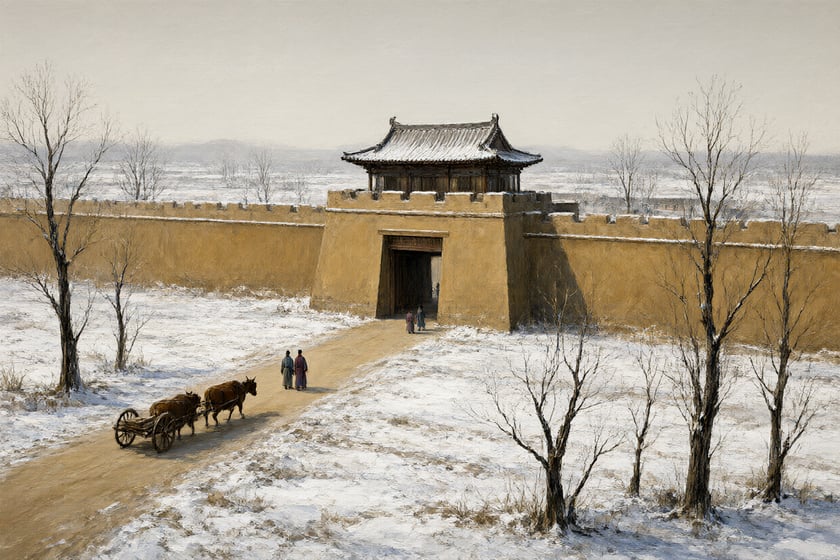
Overview
Dingtao was a county in Jiyin Commandery, Yanzhou, during the Eastern Han. Its former site lies northwest of present-day Dingtao District, Heze City, Shandong Province. In 195, the second year of the Xingping era, Cao Cao and Lü Bu fought for control of Yanzhou, and Dingtao was one of the key strongholds contested by both sides. After Cao Cao captured it, Yanzhou was pacified once more.
History
In 193, the fourth year of the Chuping era, Cao Cao defeated Yuan Shu at Kuangting and pursued him as far as Ningling. Yuan Shu fled to Jiujiang, and in summer Cao Cao returned with his army to Dingtao.
In spring 195, Cao Cao made a surprise attack on Dingtao. Wu Zi, the Administrator of Jiyin, held the southern city, and Cao Cao was unable to capture it. Just then, Lü Bu arrived with troops to relieve the city, but Cao Cao defeated him as well. That summer, Cao Cao defeated Lü Bu’s subordinates Xue Lan and Li Feng at Juye, killing Xue Lan and others. Lü Bu and Chen Gong then led more than ten thousand men into battle. According to the Wei Shu, cited in Pei Songzhi’s annotation, Cao Cao’s soldiers had all gone out to harvest wheat, leaving fewer than a thousand men in camp. Cao Cao ordered women to take up positions on the walls and guard them, while concealing his troops behind a large embankment west of the camp. Lü Bu suspected an ambush in the woods south of the embankment and did not dare attack rashly. When he returned the next day, he fell into the ambush and was routed. Lü Bu fled during the night. Cao Cao attacked Dingtao again, finally captured it, and sent forces to pacify the other counties. Lü Bu fled east to join Liu Bei, and by the end of the year Yanzhou was pacified. Yu Jin also accompanied Cao Cao in capturing the counties of Shouzhang, Dingtao, and Lihu.
Under Cao Wei, Dingtao became an enfeoffment for members of the imperial clan. In 224, the fifth year of the Huangchu era, Emperor Wen of Wei issued an edict changing the titles of all the princes to county princes; Cao Ju, Prince of Pengcheng, was re-enfeoffed as Prince of Dingtao County. In 232, the sixth year of the Taihe era, the princes’ fiefs were changed back to commanderies, and Cao Ju was again enfeoffed as Prince of Pengcheng.
Figures
- Dong Zhao: A native of Dingtao in Jiyin. He entered official service after being recommended for filial piety and integrity, and initially served Yuan Shao as a military adviser. He acted as administrator of Julu and Wei Commanderies, using stratagems to pacify powerful local clans.
- Wu Zi: Administrator of Jiyin during the conflict between Lü Bu and Cao Cao. When Cao Cao launched a surprise attack on Dingtao, Wu Zi held the southern city, which Cao Cao’s forces were unable to capture at the time.
- Cao Ju: A member of the Wei imperial clan, enfeoffed as Prince of Dingtao County from 224 to 232.
Differences in Historical Fiction
The twelfth chapter of Romance of the Three Kingdoms describes Cao Cao planting flags in the woods outside Dingtao as a feint and hiding elite troops in an ambush behind a long embankment. After Lü Bu set fire to the woods, he fell into the ambush and was routed. Chen Gong and Gao Shun escorted Lü Bu’s family out of the city as they fled, and Cao Cao entered the city immediately afterward. The ambush behind the embankment is based on the account in the Wei Shu cited in Pei Songzhi’s annotation. However, in the Wei Shu, Lü Bu suspected an ambush in the woods and withdrew; he did not set fire to them. Moreover, this battle took place before Cao Cao captured Dingtao, not beneath the walls of Dingtao. The account says that Wu Zi, Administrator of Jiyin, defended Dingtao’s southern city. The novel also says that Zhang Chao burned himself to death at Dingtao and that Zhang Miao fled to Yuan Shu. The Records of the Three Kingdoms, however, records that Zhang Chao killed himself after the fall of Yongqiu, while Zhang Miao went to Yuan Shu to seek help and was killed by his own followers.
Today
The former site of Dingtao lies northwest of present-day Dingtao District, Heze City, Shandong Province. In 2016, Dingtao County was abolished and re-established as a district, becoming Dingtao District, Heze City, which retained the ancient county’s name.