Background
In the twelfth year of Jian’an (207), after gaining the upper hand in the fighting in Hebei, Cao Cao faced an unresolved strategic problem: Yuan Shang and Yuan Xi had retreated north, where they could still draw on Wuhuan forces and pose a renewed threat. The campaign against the Wuhuan was therefore not merely a pursuit of the remnants of a defeated enemy; it also concerned whether Cao Cao could turn his military victory in Hebei into a stable order in the north. Romance of the Three Kingdoms portrays the campaign as an extension of the fighting in Hebei, and presents “Yuan Shao’s former ties with the Wuhuan” and “the survival of the Yuan brothers” as important reasons for continuing north. This illustrates the political logic emphasized by the novel, but should not be treated as a complete account of all the historical motives.
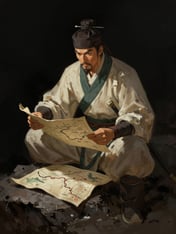
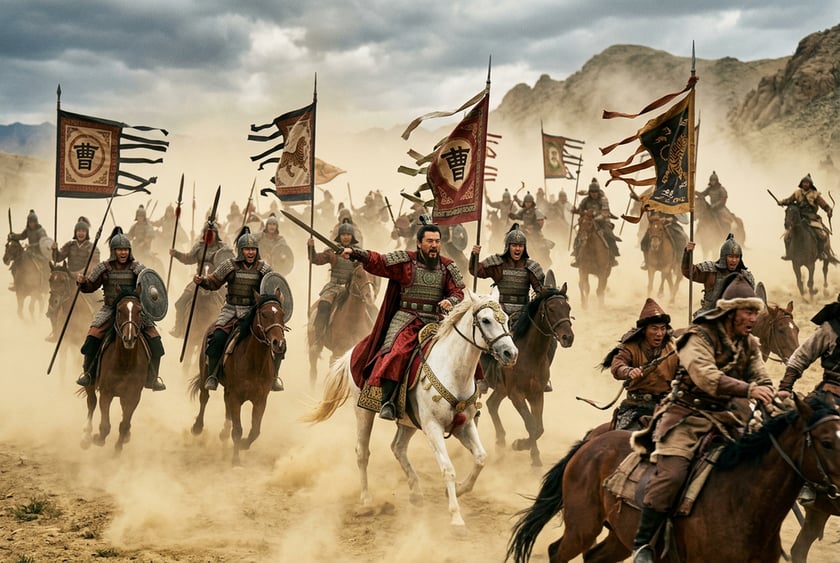
The most immediate challenge of the northern expedition was how to operate in remote, unfamiliar terrain with difficult transport. The novel relates that after Cao Cao’s army entered a desert region, it encountered sandstorms and rugged roads, and Cao Cao briefly considered turning back. Guo Jia, however, urged him to leave behind the heavy baggage, travel light and rapidly, and launch a swift surprise attack while the enemy was unprepared. Later, Tian Chou pointed out that seasonal water conditions made the existing roads unsuitable for carts, horses, and boats. He proposed taking a different route through the Lulong Pass and across the rugged terrain of Baitan, thereby catching the enemy off guard. The narrative thus suggests that victory depended not on numbers alone, but on the coordination of intelligence, route selection, and speed.
Main Figures
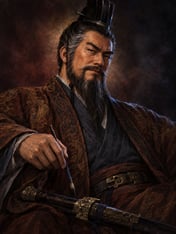
Cao Cao was the central decision-maker behind the expedition. He had to weigh the benefits of advancing north against the concerns of those who favored remaining behind: Xu would be left exposed, and Liu Bei or Liu Biao might exploit the opportunity to act. In the novel, Guo Jia offers a way of assessing the risks and a guiding principle for action. He argues that Liu Biao would be unable to use Liu Bei effectively, and that the Wuhuan, relying on their remoteness, would be unprepared; he therefore recommends seizing the strategic opening. When Cao Cao hesitates over the treacherous roads, Guo Jia continues to urge a rapid advance with a light force. This portrayal highlights the influence of an adviser on his commander’s judgment, while also attributing part of the success to bold decision-making.
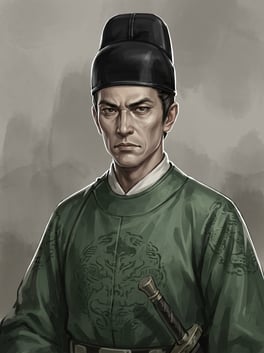
Tian Chou’s role reflects a combination of local knowledge and political integrity. Familiar with the conditions of the roads, he proposes changing the army’s route. After the campaign, when Cao Cao seeks to reward him with a marquisate, Tian Chou declines, saying that he does not wish to “sell” the old road through Lulong; Cao Cao then appoints him Gentleman of Discussion instead. Through this episode, the novel presents a noteworthy approach to governance: military operations depend on local knowledge, but recognizing people’s loyalty and integrity can also help turn temporary cooperation into political integration. As for Zhang Liao and Xu Chu, as well as Tadun, Yuan Shang, and Yuan Xi, the passages cited do not describe their specific actions in battle, so no battlefield details about them can be added on that basis.
Core Issues
The first core issue is the conflict between “security on the frontier” and “strategic overextension.” Those opposed to the northern expedition fear that, with Cao Cao far from the center, Liu Bei or Liu Biao might exploit the opening. Guo Jia’s answer is not to deny the risk, but to reassess the opponents’ capabilities and intentions. This reflects a classic dilemma in the exercise of power: if expansion is halted simply because of a potential threat in the rear, hostile forces may regroup on the frontier; yet a reckless expedition may leave the heartland exposed. Through Guo Jia’s judgment, the novel casts the campaign as a choice to trade on a limited window of opportunity for long-term security.
The second issue is the tension between military speed and the capacity of the supply system. A swift attack by a light force can leave the enemy less time to respond, but it also weakens logistical support. The novel later relates that on the return march, the weather was hot and dry, there was no water for two hundred li, and food ran short; the soldiers even killed horses for food and dug for water. These details show that “speed” was not merely the secret of success, but also a source of risk: if judgment about the march, the route, or supplies went even slightly awry, the expeditionary army might be worn down by the elements before it encountered a formidable enemy. Cao Cao ultimately acknowledges that the campaign was “a dangerous expedition into distant territory,” and says that its success involved an element of luck. This further cautions against treating a single victory as a strategy that can simply be repeated as a matter of course.
The third issue concerns accounts of achievement and the limits of the source material. The event summary accompanying the topic lists “Gongsun Kang Executes the Two Yuans” and “Death of Guo Jia” as sub-events, but the cited passage from Romance of the Three Kingdoms only describes Guo Jia falling ill and urging the expedition, along with Cao Cao’s army on the march. It does not recount the circumstances of Guo Jia’s death, nor does it give details of how Gongsun Kang dealt with Yuan Shang and Yuan Xi. Analysis can therefore note how these events relate within the broader narrative, but cannot establish their precise course or causal connections on the basis of the current passages alone. More importantly, Romance of the Three Kingdoms is a work of literary fiction. It helps illuminate how later generations understood Cao Cao’s decisiveness and the role of his advisers, but cannot on its own replace the examination of historical evidence.
Political Consequences
In terms of political effect, the novel depicts the campaign against the Wuhuan as part of an effort to eliminate the remnants of the Yuan clan and reduce the risk of continued disruption along the northern frontier. It follows on from the earlier fighting in Hebei and aims not merely to defeat an army, but also to cut off the possibility that the Yuan clan might continue through its ties to northern forces. Under this narrative logic, the expedition increased Cao Cao’s opportunity to turn military advantage into regional dominance. However, the cited passages do not provide a complete account of postwar institutional arrangements, frontier administration, or the parties’ long-term relations. These consequences should therefore be understood as strategic interpretations, not as facts individually established by the passages cited.
Cao Cao’s appointment and reward of Tian Chou, and his eventual acceptance of Tian Chou’s refusal of a marquisate, also show that political work after victory involved more than rewarding military officers. How local knowledge, prior commitments, and personal integrity were handled mattered to whether conquest could secure a basis for cooperation. Meanwhile, after returning from the campaign, Cao Cao generously rewarded those who had earlier remonstrated with him and said that this success should not be treated as a general rule. In doing so, he both upheld a system in which people within his ranks could offer advice and set limits on high-risk decisions: loyalty to one’s commander did not mean remaining silent, and victory should not strip dissenting opinions of their value. In the novel, this political stance adds an aspect of organizational governance to the military adventure.
Counterfactual Analysis
If Cao Cao had heeded the objections and postponed the northern expedition, he could have reduced the short-term losses caused by a long-distance march and kept more troops in the Central Plains to respond to potential developments. But if the ties between the Yuan brothers and the Wuhuan remained intact, Cao Cao would have faced the possibility of a renewed concentration of northern threats. Such a choice would not necessarily have led to immediate defeat, but it would have transformed the risk from a single, intense expedition into a prolonged drain: the frontier would have required constant vigilance, and the new order in Hebei might have been harder to consolidate quickly. Guo Jia’s judgment compares these long-term costs with the temporary opening at hand, rather than simply seeking to extend the gains of victory.
Conversely, if Cao Cao’s army had not taken the route Tian Chou recommended, or had continued to advance slowly with a massive baggage train, its march would have been more vulnerable to the constraints of the roads and seasonal conditions, and the element of surprise might have been diminished. Yet even after taking the Lulong route and advancing light, the account of the return march—with its shortages of water and food—shows that the expedition came close to the limits of what its supply system could sustain. A more cautious counterfactual plan might have involved improving access to water, arranging for food supplies along the route, and preparing a retreat plan before setting out. But excessive preparation could also have delayed the campaign and weakened the surprise attack. The key point of this campaign is not that risk-taking is always right, but that it shows how Cao Cao wagered on speed, intelligence, security in the rear, and supplies—and, after succeeding, acknowledged that such a wager could not become standard practice.