Background
The Death of Guo Jia came at a turning point, as Cao Cao’s northern campaign against the Wuhuan was drawing to a close. The basic timeline presented by the surviving sources is that Guo Jia accompanied Cao Cao on campaigns for more than a decade; Cao Cao’s forces pacified the Wuhuan and shook Liaodong with their reputation; Guo Jia fell gravely ill on the return journey from Liucheng; Cao Cao sent someone to visit him; and Guo Jia soon died at the age of thirty-eight. His death was therefore not a battlefield death, but a personal tragedy connected with illness, occurring during or on the return from a distant expedition. The cited sources do not specify the nature of his illness, so it cannot be supplied by conjecture.
The “outcome” of this death should be understood with care: Guo Jia did indeed die, and Cao Cao clearly expressed his grief. But if “outcome” refers to the cause of death, its precise timing, or its direct impact on the campaign in Liaodong, the sources do not provide a complete answer. In particular, Romance of the Three Kingdoms links Guo Jia’s coffin and a letter he supposedly left behind to a dramatic scene after Cao Cao arrived at Yi Prefecture. Records of the Three Kingdoms, by contrast, says only that Guo Jia fell gravely ill and died, and that Cao Cao attended his funeral; it makes no mention of the letter. The two accounts can be used separately to examine historical records and later literary portrayals, but they should not be treated as evidence of the same kind.
Key Figures
In historical accounts, Guo Jia’s political value went beyond the image of a strategist who “came up with unorthodox plans.” Cao Cao said, “Only Fengxiao could understand my intentions,” and later emphasized that Guo Jia often adapted to changing circumstances in the face of the enemy during major deliberations, bringing plans that had yet to be decided to completion. This appraisal highlights their collaboration in decision-making: Guo Jia could understand the commander’s intentions and turn his judgment into workable measures as military circumstances changed. The sources also count him among Cao Cao’s longtime campaign companions, indicating that his influence came from repeated involvement in decision-making rather than from a single isolated battle.
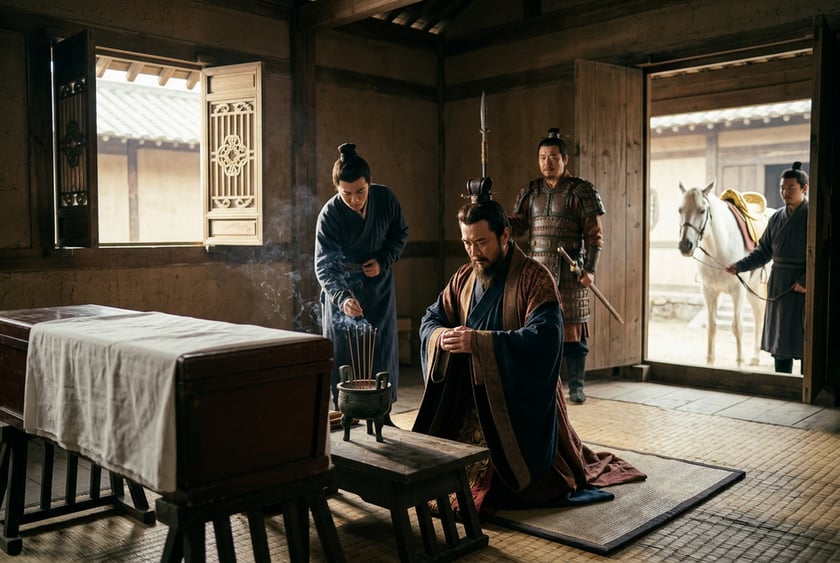
Cao Cao was both Guo Jia’s commander and, after his death, his mourner and the driving force behind his political honors. Historical accounts say that Cao Cao personally attended the funeral and grieved deeply. He also spoke to Xun You and others of Guo Jia’s youth, explaining that he had hoped to entrust him with future affairs once the realm was settled, but that Guo Jia had suffered an “untimely death in middle age.” Cao Cao later submitted a memorial recounting Guo Jia’s achievements and requesting an increase in his fief. In this account, Xun You was present when Cao Cao spoke and was among the colleagues to whom Cao Cao conveyed his grief and the loss of a talented man. The sources offer no independent assessment by Xun You, so no reaction should be attributed to him.
Central Issues
The Death of Guo Jia highlights the tension between individual talent and the institutions of the state. Cao Cao’s mourning shows that Guo Jia’s abilities could not readily be replaced through ordinary appointments or collegial relationships. At the same time, Cao Cao used a formal memorial, an increase in fief, and a posthumous title to incorporate this personal loss into the state’s system of honors. This reveals a political transformation: a commander’s trust in and grief for a close adviser were converted, through formal memorials, into institutional recognition of a meritorious official and his family. Posthumous honors could not restore Guo Jia’s capacity to advise, but they could preserve his contributions as an achievement recognized by Cao Cao’s regime.
The claim that “if Guo Jia had been alive, there would have been no great defeat” warrants particular scrutiny. In chapter fifty, Romance of the Three Kingdoms has Cao Cao mourn Guo Jia after a different defeat, using a counterfactual to underscore Guo Jia’s excellence and irreplaceability. This shows how the novel makes Guo Jia a key figure for explaining Cao Cao’s setbacks, but it does not prove that every historical defeat resulted from Guo Jia’s absence. Records of the Three Kingdoms, by comparison, praises his role in major deliberations and his ability to adapt to the enemy over many years of campaigning; it does not claim that he could have guaranteed Cao Cao would never lose again. Political history must distinguish between “making an important contribution” and “being able to determine everything.”
The story of the letter left behind also serves a different function in shaping memory. Romance of the Three Kingdoms says that Guo Jia left a letter on his deathbed, which Cao Cao read and then acknowledged with a nod, leaving those present unsure of its meaning. The detail is placed within the narrative thread in which the affairs of Liaodong are resolved. It allows the dead man to continue influencing military and political events, heightening his reputation for foresight and his legendary quality. But neither the cited passages from Records of the Three Kingdoms nor Cao Cao’s memorial, as recorded there, mentions this letter. The letter can therefore be used to analyze how the novel constructs an image of Guo Jia as a strategist whose influence continued after death, but it cannot serve on its own as evidence that Guo Jia had made advance arrangements for affairs in Liaodong.
Political Consequences
The immediate consequence that can be established is that Cao Cao lost a key adviser who had long participated in military decision-making. Cao Cao’s statement that he had hoped to entrust Guo Jia with future affairs once the realm was settled suggests that his expectations of Guo Jia may have extended beyond the campaigns then underway. But the specific scope of “future affairs” is not explained, so it cannot be asserted that Guo Jia had been designated as an heir or given a formal succession role. The more cautious conclusion is that Guo Jia’s early death cut short Cao Cao’s plans for his future political and military role, depriving the regime of an adviser who enjoyed the commander’s deep trust and understood his decision-making habits.
Second, the posthumous honors and increase in fief turned Guo Jia’s personal achievements into an inheritable family honor. Historical accounts say that Cao Cao requested an increase of eight hundred households, bringing the total to one thousand, and posthumously granted Guo Jia the title Marquis Zhen, with his son Guo Yi succeeding him. This arrangement both rewarded a meritorious official and served as an example to officials still living: even if those who campaigned for many years and took part in major decisions died young, the regime might still recognize their achievements and provide for their descendants. The words “honoring the dead as though they were living, rewarding the past to encourage those to come,” used in Cao Cao’s memorial, make clear that political incentive was also a consideration behind such honors and support.
Counterfactual Speculation
If Guo Jia had not died on the return from the expedition, the more defensible speculation is not that Cao Cao would necessarily have changed the outcome of a particular battle, but that Guo Jia might have continued to take part in later military deliberations and offer his judgment as a trusted adviser. This possibility is supported by the historical account of his long service on campaigns, his participation in major deliberations, and his ability to adapt to the enemy, as well as Cao Cao’s statement that he had “intended to entrust future affairs to him.” However, these sources do not say what specific duties Guo Jia would have taken on or what position he would have held on later strategies. It can therefore only be said that his continued participation was possible; this possibility cannot be presented as a definite historical outcome.
Another counterfactual is whether Cao Cao would necessarily have found political and military affairs harder to manage without Guo Jia. Cao Cao’s eulogy, and the lament in the novel—“If Fengxiao had been here, he would never have let me suffer such a great defeat”—give this judgment strong emotional force. But the former is a remembrance after the loss of a trusted adviser, while the latter is a moment of regret in a literary narrative; neither can verify what might have happened in a history that never took place. The more cautious conclusion is that Guo Jia’s death was indeed a significant loss of talent, but the scale of that loss—and whether it would have been enough to change a particular decision or the outcome of a war—cannot be established from the surviving cited passages.