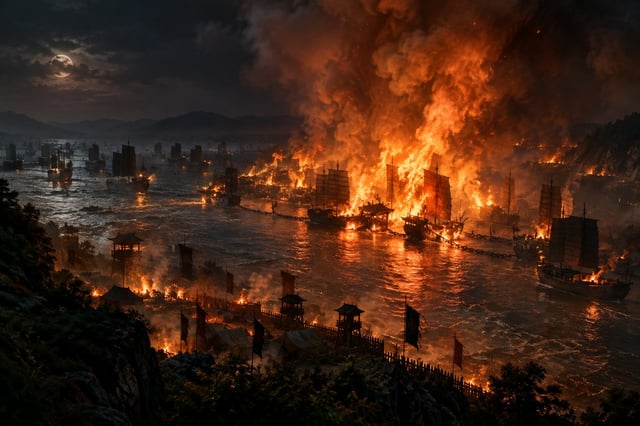
Historical Background
According to chapter 49 of the Romance of the San Guo, the Seven-Star Altar wind ceremony took place on the eve of the coalition's great battle at Chibi and was introduced into the narrative as the final meteorological guarantee for the "fire attack strategy". From a cultural-history perspective, this episode was not invented from thin air but is embedded in multiple layers of popular belief that had accumulated since the Wei-Jin period. First: although northwesterly winds prevail along the middle Yangtze in winter, there are genuine short windows of southeasterly wind during breaks in the anticyclone, and local boatmen had long used the ritual of "making offerings to the river and the wind" to pray for favorable winds — the Seven-Star Altar drew its raw material from this folk custom. Second: since the Eastern Han, Daoism had taken deep root in the Jing-Chu region; the Five-Pecks-of-Rice Way of Zhang Ling and Zhang Lu merged with the tradition of Jiangnan occultists, and techniques such as "Qimen Dunjia" and "summoning wind and rain" were documented methods within the esoteric system of the time. Third: the historical Zhuge Liang had himself cultivated the image of a hermit — "personally farming at Nanyang, fond of singing 'Liangfu'" — and already possessed the raw material of a man with a streak of the occult; Luo Guanzhong of the late Yuan dynasty simply amplified that quality into actionable magical ability.
The Ritual
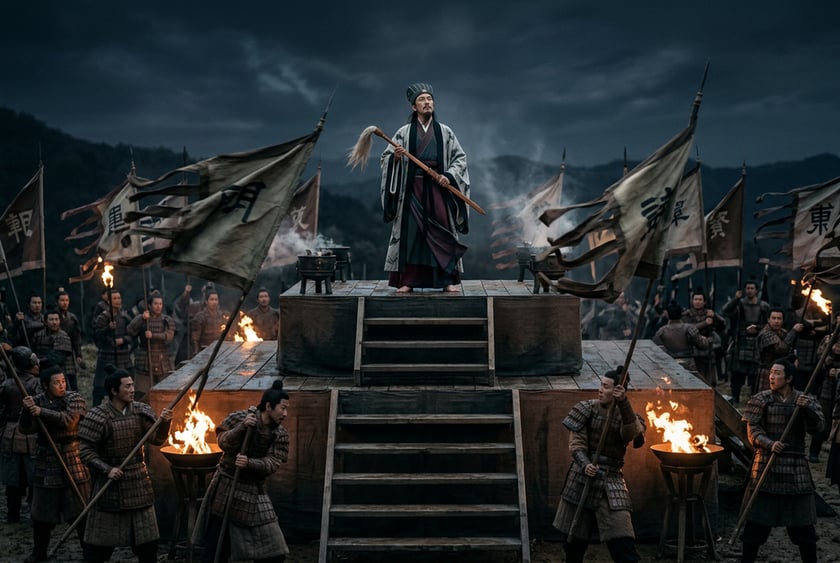
The Romance's description of the ritual is so precise it reads more like a Daoist liturgical manual than a novel. The altar had three tiers: the lower tier displayed twenty-eight lunar-mansion banners arranged in four cardinal quadrants — the Azure Dragon, Black Tortoise, White Tiger, and Vermilion Bird — corresponding to the four quadrant-groups of mansions; the middle tier was ringed by sixty-four yellow banners arranged according to the eight trigrams in their eight positions; the upper tier had four attendants bearing long poles, chicken-feather fans, seven-star pennants, swords, and incense burners, while the lower tier had twenty-four men holding banners, canopies, halberds, and long spears in a surrounding formation. Kongming himself "bathed and fasted, wore a Daoist robe, went barefoot and with hair unbound", ascending the altar three times a day to burn incense, pour water, and offer prayers in silence, and he issued four prohibitions to the soldiers guarding the altar: "no leaving your post at will, no speaking to one another, no careless talk, no showing fright" — a configuration that fully matches the standard procedures for a medieval Daoist high-officiant ascending the altar, showing that the author drew on genuine liturgical knowledge in writing this scene.
Cultural Symbolism
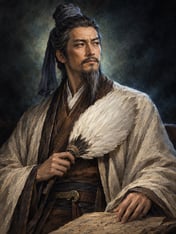
This fictional ceremony carries three layers of cultural symbolism. The first layer is an ironic commentary on "human will mastering Heaven": on the surface Zhuge Liang uses magic to summon wind; the underlying narrative actually implies that "a person who truly understands astronomy has no need of magic" — the historical Zhuge Liang was skilled at reading celestial phenomena and possessed exceptional meteorological judgment; the Romance packages this knowledge as sorcery, which is popular culture's divinizing processing of the intellectual's capabilities. The second layer is the character-elevation of the "wise general" into a "divine master": in the San Guozhi, Zhuge Liang was a politician and administrator who was "stronger at managing troops than at devising stratagems"; the Romance, through a succession of episodes — Chibi, Kongchengji, the Eight-Formation Array, the Wuzhangyuan star-propitiating ritual — elevates him to a "semi-divine" status; the Seven-Star Altar wind ceremony is the single most critical link in this elevation chain. The third layer is the founding of the "since Zhou Yu was born, why was Zhuge Liang born as well" narrative: immediately after the wind ceremony succeeds, Zhou Yu forms the intention to have Zhuge Liang killed, a plot element that paves the way for the subsequent "three provocations of Zhou Yu" and fixes the historically magnanimous Zhou Yu in the counter-role of a man consumed by jealousy.
Transmission and Evolution
The story of the Seven-Star Altar wind ceremony spread extremely widely in popular culture, extending well beyond the Romance text itself. First: in the Chibi region of Hubei and in Wuhan, place-names such as "Worship-Wind Terrace" and "Offering-Wind Terrace" survive to this day, and scenic areas have given concrete physical form to these fictionally located sites as tourism symbols. Second: on the theatrical stage, "Borrowing the East Wind" became a centerpiece aria in Peking, Han, and Sichuan opera; Ma Lianliang's rendition of "Borrowing the East Wind" became a defining classic of the laosheng repertoire. Third: in popular religion, Zhuge Liang has been venerated by some regions as the "Divine Marquis Wu," and the Seven-Star Altar ceremony reinforced his divine attribute of "being able to commune with celestial phenomena." The cost, however, was equally significant: modern history education has long had to expend effort clarifying that "the southeasterly wind was a historical phenomenon, not caused by Zhuge Liang," while the true reasons for the Chibi victory — Zhou Yu's fire-attack planning, Huang Gai's feigned surrender, the chance window in the winter weather patterns of the middle and lower Yangtze — are obscured in popular understanding. This is the double-sidedness of the cultural construction of the Romance of the San Guo: it created a Zhuge Liang more vivid than the historical one, and it made the historical reality all the harder to present in its original form.