Background
Volume 43 of Romance of the Three Kingdoms portrays Sun Quan’s decision to resist Cao Cao as a political process that shifts from hesitation to a settled course of action. Lu Su first explains to Sun Quan that although Zhuge Liang did not openly state a strategy for defeating Cao Cao, he may have deliberately used provocative words to goad him. Sun Quan’s anger then turns to delight, and he invites Zhuge Liang back into the hall for another discussion. The key to this episode is not merely that Sun Quan receives military advice, but that he changes how he interprets the situation: he begins to see Zhuge Liang’s offense as a tactic intended to push him toward a choice, rather than as simple disrespect.
Sun Quan is not facing an abstract choice between war and peace. Under the pressure of Cao Cao’s southward advance, the question is whether Jiangdong should use military action to preserve its autonomy. Zhuge Liang’s counsel leaves Sun Quan “resolved,” and he orders Lu Su to convey his decision to the civil and military officials. This shows that a decision made in private consultation still has to pass through communication and deliberation before it becomes a policy of the regime. The novel thus presents Sun Quan’s decision-making as having two stages: the ruler must first form a strategic judgment, then bring officials and generals—whose views are sharply divided—to confront it.
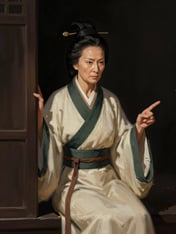
It is important to note that the material in question comes from Romance of the Three Kingdoms and is suited to analyzing how the novel portrays political choice; it should not be equated directly with a complete record of the actual meeting in the thirteenth year of Jian’an. This discussion concerns the text’s decision-making process and the characters’ positions. Although Wu Guotai appears on the list of participants, the cited passage does not describe her specific words or actions in this decision, so her influence cannot be added on that basis.
Key Figures
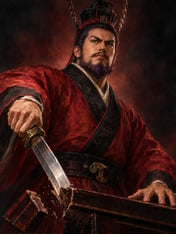
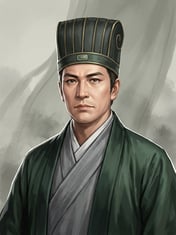
Sun Quan is at the center of the decision, but he does not appear as a resolute commander from the outset. He first grows angry at Kongming’s words, then apologizes and continues the consultation after hearing Lu Su’s explanation, and finally announces that he will raise troops. This sequence portrays not mere forcefulness, but a ruler able to reassess information, rein in his emotions, and turn a personal judgment into a formal order. His decision nonetheless bears the clear mark of consultation: Kongming provides strategic persuasion, while Lu Su brings Sun Quan back to the path of discussion and judgment.
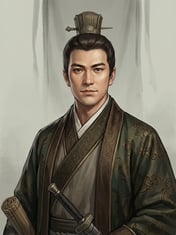
Lu Su is an important intermediary amid the division of opinion at court. He both arranges for Sun Quan to meet Kongming again and, after Zhang Zhao and others oppose sending out troops, argues that those advocating peace may be more concerned with protecting themselves. He cautions Sun Quan against letting hesitation make him hostage to the majority view. Lu Su’s role in the novel is not merely to voice support for “war”; it is also to explain the interests and risks behind the officials’ differing opinions and to help the ruler turn debate into an actionable choice.
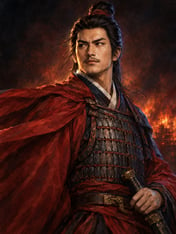
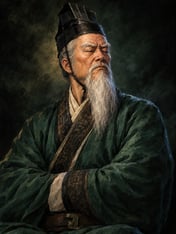
Zhang Zhao and Gu Yong represent the cautious, peace-seeking side. Citing Cao Cao’s past victory over Yuan Shao and his even greater strength now, Zhang Zhao emphasizes the balance of power and the danger of underestimating the enemy, comparing a campaign to “carrying firewood to put out a fire.” Gu Yong, meanwhile, questions whether Sun Quan might be used by Liu Bei, who is borrowing Jiangdong’s military strength to resist Cao Cao. The two are not simply opposing war; they raise two practical concerns: insufficient military capability and the possibility that an ally will shift the costs onto Jiangdong. Zhou Yu is listed as a commander, but these quotations do not show him speaking in this part of the decision-making discussion, so his role in the meeting cannot be inferred from the list of names alone.
Core Issues
The foremost issue is how to assess risk. Zhang Zhao focuses on Cao Cao’s forces and past victories, arguing that a reckless decision to fight could expose Jiangdong to unbearable losses. Lu Su, by contrast, stresses that delay is itself a risk: if Sun Quan continues to hesitate, he may lose the initiative. Their views are not simply a contest between courage and timidity, but reflect different judgments about the timing of risk. Those favoring peace fear the harm of fighting now; those favoring war fear that hesitation will worsen the situation and steadily narrow the available choices.
The second issue is autonomy within the alliance. Gu Yong points out that Liu Bei, having been defeated by Cao Cao, hopes to borrow Jiangdong’s military strength. This implicitly casts an alliance with Liu Bei against Cao Cao as taking on the cost for an ally. Lu Su’s reply, in turn, interprets Zhang Zhao and the others’ position as a desire for personal safety. Both sides are contesting the right to define “Jiangdong’s interests.” The novel does not portray the decision as simply adopting Zhuge Liang’s strategy; instead, it has Sun Quan adjudicate between the needs of an external alliance and disputes over internal interests.
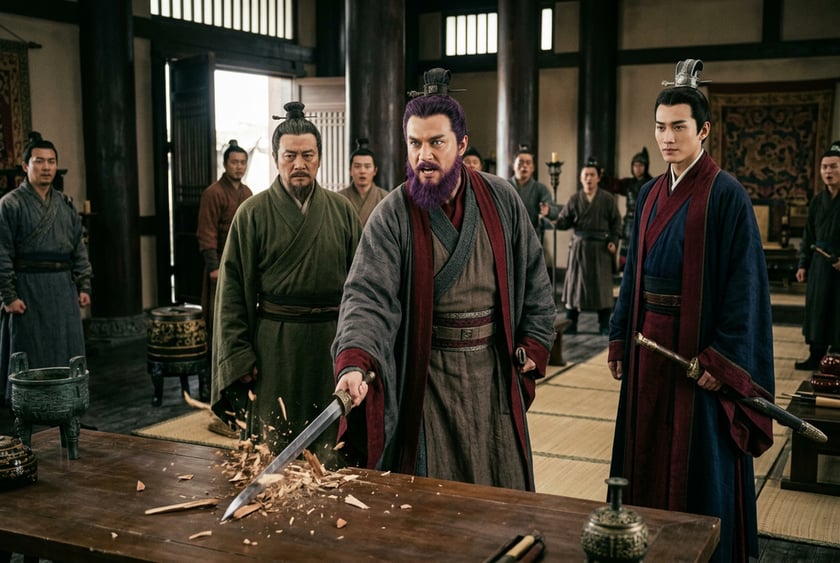
The third issue is how a ruler should handle disagreement. After hearing the objections, Sun Quan “bowed his head and said nothing”; even after Lu Su urges him on, he still asks to withdraw briefly and think it over. His silence has not disappeared entirely: it is a political pause before a decision. The statement that “the military officers seemed inclined to fight, while the civil officials all wanted to surrender” presents the dispute as a confrontation between factions. Sun Quan’s task, then, is not only to choose a military course, but also to prevent divisions among officials from paralyzing the regime.
Political Consequences
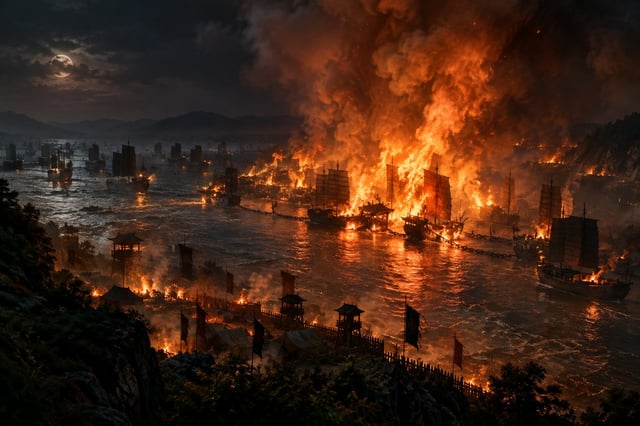
At the narrative level, Sun Quan’s announcement that they would “discuss raising troops that very day” moves Jiangdong from personal judgment into the stage of mobilizing the regime. His order for Lu Su to convey the message to the civil and military officials also means that the decision is to be formally carried out through the bureaucracy. However, “discussing the raising of troops” does not mean the material has established the outcome of the campaign or that all officials were persuaded. Since the outcome of the episode as presented is unclear, the more prudent conclusion is that the text confirms Sun Quan’s turn toward resisting Cao Cao and his decision to begin deliberations on raising troops, but these passages alone cannot establish the full consequences of the war.
The political significance of this decision is that Sun Quan does not allow the peace faction’s position to become the default. The opposition of Zhang Zhao and the others does force him to confront the disparity in strength, the risks of war, and Jiangdong’s reliance on an alliance. But Lu Su reframes the dispute as a question of whether the regime will lose the initiative by being too intent on playing it safe. In the novel’s narrative logic, Sun Quan’s authority is not established by eliminating dissent, but by hearing dissent and still making a decision. Lu Su, meanwhile, serves the political function of connecting the ruler’s will with the court’s debate.
Counterfactual Analysis
If Sun Quan had accepted Zhang Zhao and Gu Yong’s position and refrained from raising troops—or even leaned toward surrendering to Cao Cao—he might have avoided the immediate risks of war in the short term. But according to Lu Su’s warning, this choice could have cost Jiangdong the initiative and left it without an effective response to Cao Cao’s advance south. “Could” here can only be understood as a counterfactual inference based on the characters’ debate: the material provides no evidence sufficient to determine Cao Cao’s next move, and it certainly cannot support the claim that Jiangdong would inevitably have fallen or would necessarily have been safe.
Conversely, if Sun Quan had hastily sent out troops without first hearing Zhuge Liang’s views or receiving Lu Su’s counsel, the basis for the decision, as presented in the novel, would have been weaker. His decision to invite Kongming back, hear his arguments, and then face the objections of Zhang Zhao and the others shows that decisiveness does not mean rejecting consultation. The crucial question is who bears final responsibility after the consultation. Sun Quan may accept advice or reject it, but the choice itself must be made by the ruler and turned into an order.
A more cautious historical analysis should preserve a twofold conclusion: this narrative highlights the tensions among alliance politics, risk assessment, and the ruler’s decision, while portraying Sun Quan as moving from hesitation to resistance against Cao Cao under pressure. Yet these passages from Romance of the Three Kingdoms alone cannot verify the details of the meeting, what each person actually said, or the outcome of the campaign. The most reliable object of interpretation, then, is not the novel as a verbatim record, but the way it shows that a major decision must address military risk, division at court, and the autonomy of the regime all at once.