





Background
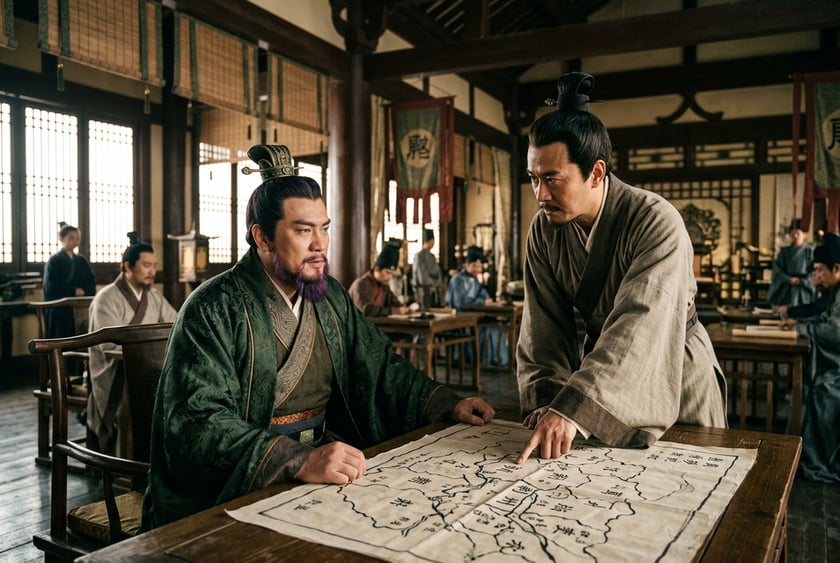
“Liu Bei Borrows Jing Province” is one of the most frequently discussed and complex cases in the history of traditional Chinese diplomacy. To understand it, we must first dispel a common misconception: the so-called “borrowing” did not mean that Sun Quan handed over all of Jing Province, which he already firmly controlled, to Liu Bei. Rather, after Chibi, Sun Quan and Liu Bei reached an arrangement to “divide the spoils, then readjust” the territory they had won in their contest for the middle reaches of the Yangtze. The actual situation after Chibi was that Cao Cao withdrew to the Xiangfan line north of Jiangling; Eastern Wu controlled strategic points along the Yangtze, including Jiangling (Nan Commandery), Xiakou, and Wuchang; and Liu Bei rapidly moved south to occupy the four southern commanderies of Jing Province (Wuling, Changsha, Guiyang, and Lingling). In other words, each side had already acquired part of the territory through its own independent military action. After Zhou Yu died of illness in 210, the fifteenth year of Jian'an, Lu Su took charge of the eastern front. His proposed strategic shift was to let Liu Bei garrison Jiangling, “Eastern Wu’s foremost position against Cao Cao,” so that Liu Bei would bear the pressure of confronting Cao Cao directly, while Eastern Wu recalled its main forces toward Huainan for an offensive against Hefei. This was the essence of the “loan”: a political bargain that traded a forward position for a division of strategic responsibilities.
Key Figures
The central decision-maker on Sun Quan’s side was Lu Su. As early as his counsel from his couch, he had proposed the long-term strategy of “establishing a tripartite balance from Jiangdong and allying with Liu Bei to resist Cao Cao,” a different course from Zhou Yu’s strategy of “controlling Yi Province and Jing Province and contending for supremacy independently.” Before his death, Zhou Yu had secretly discussed a plan to “borrow a route to destroy Guo”: ostensibly to enter Shu by way of an agreed passage, but in reality to conquer Shu and, in the process, absorb Liu Bei’s forces. This plan was developed into a dramatic climax in the Romance of the Three Kingdoms, but its historical credibility had already been questioned in Pei Songzhi’s annotations. After Zhou Yu’s death, Lu Su succeeded him, and Sun Quan’s decision to support Lu Su’s cooperative approach was itself a major shift in Eastern Wu’s strategic direction. The central decision-maker on Liu Bei’s side was Zhuge Liang. The core of the Longzhong Plan was to “control Yi Province and Jing Province,” and “Liu Bei Borrows Jing Province” provided the crucial stepping-stone for this strategy: without Jiangling as a base, Liu Bei could never have launched his western campaign into Yi Province from Gongan in 212. Lu Su repeatedly traveled north as an envoy to “demand Jing Province” in the years that followed, probing the boundaries within the alliance. The historical prototype for the “Single-Sword Meeting” scene in the Romance of the Three Kingdoms arose from these events. Lü Fan played a role as one of the planners of the proposal to have Sun Quan’s sister marry Liu Bei, reflecting Eastern Wu’s attempt to exert political influence over Liu Bei not only through territory, but also through marital ties.
Central Issue
The central issue in this episode is how to define boundaries within an alliance. The Sun-Liu alliance reached its peak of trust during the Battle of Red Cliffs, but immediately afterward faced a fundamental question: how should the fruits of victory be divided? Alliances during the Three Kingdoms period were never based on shared values, but on common threats. Once that common threat receded—when Cao Cao withdrew north—the distribution of resources within the alliance immediately became a new source of conflict. Lu Su’s “loan” was a highly creative political design: by yielding a portion of territory in exchange for a division of strategic responsibilities, it prolonged an alliance that might otherwise have broken apart at once by at least five years. The design was ingenious in three ways. First, it maintained a united front against Cao Cao. Second, it preserved Eastern Wu’s leverage through a relationship structured around “land as debt”—the land was borrowed, and Eastern Wu could demand it back at any time. Third, it left Liu Bei to bear the greatest military pressure, buying Eastern Wu time to expand on the eastern front. Yet the design was structurally fragile: once Liu Bei grew powerful in the west and no longer wished to acknowledge the “loan,” the entire arrangement could collapse in an instant. This is the underlying logic behind the Xiang River boundary agreement of 215 and Guan Yu’s defeat in 219.
Political Consequences
The most immediate consequence was that the Sun-Liu alliance maintained a “honeymoon of cooperation” from 210 to 215. Sun Quan was able to focus on advancing north to attack Hefei (the Battle of Hefei in 215) and subduing the Shanyue (which were gradually pacified from 210 to 215), while Liu Bei could advance west from Gongan to seize Yi Province (211–214), then move north to take Hanzhong (217–219). A second consequence was that Eastern Wu’s strategic position was significantly weakened: lending out Jiangling meant losing direct military control over the middle reaches of the Yangtze. This strategic disadvantage was partially corrected in 215 through the Xiang River boundary agreement, under which Sun Quan and Liu Bei each held half of Jing Province, but the fundamental situation remained unchanged. A third consequence was the structural deterioration of the “debt-based alliance.” Eastern Wu continued to regard Jiangling as a “credit,” while Liu Bei’s side increasingly viewed it as territory already rightfully theirs. This divergence in perception finally erupted in 219, when Sun Quan resolved to take Jiangling back and Lü Meng crossed the river in white robes to launch a surprise attack that killed Guan Yu, shattering the alliance. The fourth consequence unfolded over the longer term in geopolitics: the division of Jing Province between Sun Quan and Liu Bei was completely undone. Eastern Wu once again held sole control of the middle and lower reaches of the Yangtze, but lost Liu Bei as a northern buffer. From then on, it was isolated in the south of the Yangtze and forced into a prolonged defensive posture—the fundamental reason Eastern Wu could never advance north.
Counterfactual Analysis
What might have happened if Lu Su had not proposed the “loan” and Sun Quan had insisted on holding Jiangling? The most likely short-term scenario is that the Sun-Liu alliance would have rapidly broken apart between 210 and 212. Without the support of a base at Jiangling, Liu Bei could not have advanced west into Shu; he might have been forced to remain confined to Gongan and the four southern commanderies of Jing Province, eventually declining under pressure from both Cao Cao and Sun Quan. In that scenario, the Three Kingdoms configuration might never have emerged at all: Shu Han might never have been founded, and history might have returned to a bipolar confrontation between Wei and Wu. A further-reaching possibility is this: if, while lending Jiangling, Sun Quan had insisted that Liu Bei acknowledge it as sovereign territory belonging to Eastern Wu, with Liu Bei merely administering it in trust, and had formalized this status in a written alliance, then the 215 Xiang River agreement would have been a “transfer” rather than a “boundary settlement.” Eastern Wu might have recovered Jiangling earlier without resorting to force, and the tragedies of Guan Yu’s Northern Campaign and Lü Meng’s attack on Jing Province might have been avoided. This shows that the greatest political danger in “Liu Bei Borrows Jing Province” was not the loan itself, but Eastern Wu’s failure to formalize the creditor-debtor relationship clearly. It is a classic example of the question of where the boundary lies between a “spoken alliance” and a “written agreement” in traditional Chinese diplomacy, and remains of scholarly interest today.