Sun Quan's Faction · Assistant; Acting Administrator
Gu Yong
courtesy name 元叹 · 168–243
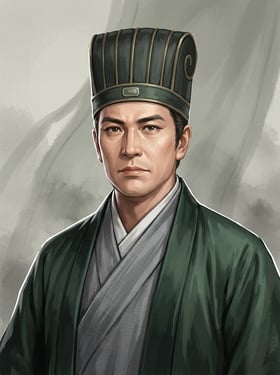
Gu Yong drank no wine, spoke little, was proper in bearing, and stern and upright. He once urged Sun Quan to heed Zhang Zhao's advice to surrender, and also remonstrated that Sun Quan should style himself 'Supreme General and Earl of the Nine Provinces' and ought not to accept enfeoffment from the state of Wei.

Life
In the novel: 14 chapters · In the Records: 6 volumes
Life168–243
208 CE (Jian'an 13)
230 CE (Taihe 4)
242 CE (Zhengshi 3)
Allegiance
- Sun Quan's Faction
- Eastern Wu
- Hatched: dated by chapter
- Life event
- Death
List all 3 stops
- Wu County168Birthplace
- Chaisang208Sun Quan's Decision to Resist Cao Cao+1 more
- Jianye230–242The Lü Yi Abuse of Power Case+1 more
On the boards
Compare with someone →Where this person ranks on each board.
Who they were
Character profile
- Character
- Gu Yong drank no wine, spoke little, was proper in bearing, and stern and upright. He once urged Sun Quan to heed Zhang Zhao's advice to surrender, and also remonstrated that Sun Quan should style himself 'Supreme General and Earl of the Nine Provinces' and ought not to accept enfeoffment from the state of Wei.
- Manner of speech
- Gu Yong did not open his mouth lightly, but every time he spoke he struck to the heart of the matter.
- Life
- When Cai Yong took refuge in the land of Wu, Gu Yong followed him to study the zither and calligraphy, and Cai Yong passed his own name-title on to him. In his youth, upon coming of age, he was recommended by the province and commandery as chief of Hefei, and later transferred to Lou, Qu'e, Shangyu and other places, achieving notable results everywhere. When Sun Quan served as Grand Administrator of Kuaiji, he appointed Gu Yong to act in the administrator's duties. After Sun Quan proclaimed himself King of Wu, Gu Yong rose in successive promotions to Grand Judge and Chamberlain, concurrently Prefect of the Masters of Writing, and was enfeoffed as Marquis of Yangsui Village. In the fourth year of Huangwu he was transferred to Grand Master of Ceremonies, advanced to Marquis of Liling, succeeded Sun Shao as Chancellor, and took charge of the affairs of the Masters of Writing. In the sixth year of Chiwu, Gu Yong died at the age of seventy-six.
- Anecdotes
- At the public court Gu Yong's manner in presenting memorials was compliant in tone, yet the principles he upheld were correct, and so he was respected and trusted. He was once recommended by Zhang Hong, and together with Zhang Hong managed the guest lodge, receiving visitors from all quarters. He served as Chancellor for nineteen years, and after his death was given the posthumous title of Marquis Su.
Historical Record
Gu Yong, courtesy name Yuantan, was from Wu County, Wu Commandery. His great-grandfather, Gu Feng, had served as Administrator of Yingchuan. As a young man, Gu Yong studied the qin and calligraphy under Cai Yong, who greatly admired his talent and even bestowed his own name upon him. Thus Gu Yong shared a name with Cai Yong, while his courtesy name, “Yuantan,” also alluded to Cai Yong’s admiration. Gu Yong was recommended by the commandery and province when he was barely twenty. He successively served as Chief of Hefei, Chief of Lou County, Chief of Qu'e, and Chief of Shangyu, achieving notable results in each post. When Sun Quan held the post of Administrator of Kuaiji, he did not often reside in the commandery, so he appointed Gu Yong as his Assistant to act in his stead. During Gu Yong’s tenure, he suppressed bandits, brought peace to the commandery’s borders, and won the allegiance of officials and commoners. Several years later, he was summoned to court to serve as Left Marshal. After Sun Quan became King of Wu, Gu Yong successively served as Grand Administrator of Justice and Minister of Ceremonies, while also holding the post of Director of the Secretariat. He was enfeoffed as Marquis of Yangsui Township.
In the fourth year of Huangwu, Gu Yong’s mother came from Wu to the capital. Sun Quan went in person to congratulate her and paid his respects to her in the courtyard. All the ministers and high officials attended, and the crown prince also came afterward to offer his congratulations. Gu Yong did not drink and was sparing with words, but his speech and conduct were always entirely appropriate. Sun Quan once praised him, saying, “Lord Gu says little, but when he speaks, he always hits the mark.” At banquets and celebrations, attendants dared not behave improperly in Gu Yong’s presence. Sun Quan once remarked, “With Lord Gu seated here, people cannot enjoy themselves.” This shows how his authority inspired awe. That same year, Gu Yong was reassigned as Grand Master of Ceremonies, promoted to Marquis of Liling, and succeeded Sun Shao as chancellor, overseeing the affairs of the Secretariat. In selecting and appointing Wen Wu officers and officials, he enabled each to make full use of his abilities, without favoritism or bias. Gu Yong often made discreet inquiries into the people’s hardships and the successes and failures of government affairs, then secretly reported what he learned to Sun Quan. If his recommendations were adopted, he credited the ruler; if they were rejected, he never disclosed them. Sun Quan therefore held him in very high regard. At court discussions, Gu Yong spoke deferentially, yet the principles he upheld were entirely fair. Sun Quan once sought opinions on the successes and failures of government policy. Zhang Zhao considered the laws and regulations too complicated and the punishments too severe, and recommended some reductions. Sun Quan remained silent, then turned to ask Gu Yong’s view. Gu Yong replied, “What I have heard is the same as what Zhang Zhao has set forth.” Sun Quan consequently accepted their advice, and it was decided that the punishments would be reduced.
Later, Lü Yi and Qin Bo served in the Secretariat, where they were responsible for inspecting documents from the various offices and commanderies. Lü Yi and the others gradually abused their authority, creating monopolies in the liquor trade and exploiting the profits, exposing offenses and investigating wrongdoing. They reported even the most minor matters, and by applying the law harshly and distorting the facts to frame people, they slandered senior officials and persecuted the innocent. Gu Yong and others were consequently impeached and censured. Lü Yi’s treachery was eventually exposed, and he was taken into custody. Gu Yong went to investigate the case, and Lü Yi appeared before him as a prisoner. Gu Yong questioned him about his testimony in a pleasant manner, and as he was leaving, asked Lü Yi, “Is there anything you wish to say?” Lü Yi kowtowed but said nothing. At the time, Secretariat Gentleman Huai Xu berated Lü Yi to his face. Gu Yong rebuked Huai Xu, saying, “The law has its proper procedures. Why go so far?” Pan Jun had once wanted to kill Lü Yi with his own hand at a banquet to rid the state of this menace, but when Lü Yi heard of it, he claimed to be ill and did not attend. Whenever Pan Jun appeared before Sun Quan, he invariably spoke of Lü Yi’s treachery and malice. Lü Yi therefore gradually fell out of favor and was eventually executed.
In the Novel
In Romance of the Three Kingdoms, Gu Yong’s portrayal largely accords with the historical record, though his appearances and role are given greater dramatic color. He first appears in Chapter 29, when Zhang Hong recommends him to Sun Quan, describing him as “sparing with words, a non-drinker, strict, and upright.” Sun Quan thereupon appoints him as Assistant to act in the Administrator’s place, consistent with the historical account of his early service as Assistant Administrator of Kuaiji. In the novel, Gu Yong often appears alongside civil officials such as Zhang Zhao as one of Sun Quan’s important advisers, taking part in many crucial decisions.
On the eve of the Battle of Red Cliffs, Gu Yong joins Zhang Zhao in urging Sun Quan to surrender to Cao Cao. They argue that Liu Bei is “like using kindling to put out a fire” and should not be relied upon. When Zhou Yu pretends that he intends to surrender to Cao Cao, Gu Yong also expresses agreement with Zhang Zhao and the others, reflecting his role in the novel as a member of the pro-surrender faction. However, when Liu Bei sets out to take Xichuan, Gu Yong advises Sun Quan to cut off Liu Bei’s route of return and seize Jing and Xiang, revealing his strategic acumen. After Guan Yu Attends the Meeting Armed with a Single Blade, Gu Yong proposes sending someone to Xu to have Liu Bei appointed Governor of Jing Province, thereby driving a wedge between Cao and Liu and taking advantage of the opportunity to move against them. The plan is accepted, though it is not explicitly recorded in the Records of the Three Kingdoms.
In the novel, after Sun Quan becomes king, Gu Yong advises him not to accept a title from the Wei emperor, but instead to style himself Supreme General and Earl of the Nine Provinces, reflecting his determination to uphold Wu’s dignity. After the Battle of Xiaoting, when Sun Quan wants to appoint Lu Xun as commander-in-chief, Gu Yong joins Zhang Zhao, Bu Zhi, and others in questioning Lu Xun’s youth and lack of prestige, fearing that the generals will not submit to him. Sun Quan ultimately follows Kan Ze’s advice and entrusts Lu Xun with an important command. In the first year of Huangwu, Gu Yong and Zhang Zhao jointly memorialize Sun Quan to adopt a new era name, and assist the crown prince in defending Wuchang. When Wei launches a major invasion of Eastern Wu, Gu Yong advises Sun Quan to write to Zhuge Liang and have him send troops to Hanzhong to divide the Wei forces, while dispatching a senior general to station troops at Nanxu to resist Wei. This again demonstrates his strategic acumen. Before the Battle of Shiting, Gu Yong also recommends Lu Xun as commander-in-chief to counter Cao Xiu’s attack.
Key Relationships
Eastern Wu (serves):* Gu Yong served Sun Quan throughout his life and was a key minister of the Eastern Wu regime. He began assisting Sun Quan when the latter first took up the post of Administrator of Kuaiji, held a succession of offices, and ultimately rose to the position of chancellor, earning Sun Quan’s deep trust and esteem.
Cai Yong (student_of):* Gu Yong studied the qin and calligraphy under Cai Yong, who greatly admired his talent and even bestowed his own name upon him, showing the depth of their teacher-student bond.
Gu Ji (parent_of):* The historical sources do not directly state that Gu Ji was Gu Yong’s son. Gu Yong did have a son, Gu Yu, and the family enjoyed considerable prestige in Wu.
Gu Yu (parent_of):* Gu Yu was Gu Yong’s son. The historical sources mention that father and son once attended a banquet hosted by Sun Quan.
Zhang Zhao (colleague):* Gu Yong and Zhang Zhao were both senior ministers of Eastern Wu and discussed affairs together on many occasions. In the novel in particular, they often appear together as representatives of the pro-surrender or conservative factions.
Lü Yi (adversary):* Lü Yi once framed Gu Yong and other ministers. When investigating Lü Yi’s case, Gu Yong showed the generosity and composure of an elder.
Lu Xun (colleague):* Gu Yong and Lu Xun were both senior ministers of Eastern Wu. In the novel, Gu Yong once objected to Lu Xun’s appointment, but ultimately acknowledged his abilities.
Zhuge Jin (colleague):* In the novel, Zhuge Jin follows Gu Yong’s plan and goes to Jing Province to ask Guan Yu for his daughter’s hand in marriage on behalf of Sun Quan’s heir, but Guan Yu refuses.
Notable Scenes
Acting as Administrator of Kuaiji:* When Sun Quan was not residing in the commandery, Gu Yong acted in his place as Administrator of Kuaiji, suppressing bandits and bringing peace to the commandery’s borders. This demonstrated his outstanding administrative ability and political skill.
Sun Quan Pays His Respects to Gu Yong’s Mother:* In the fourth year of Huangwu, Gu Yong’s mother came to the capital. Sun Quan went in person to pay his respects and hosted a banquet; all the ministers and high officials attended. This was not only a great honor for Gu Yong, but also reflected Sun Quan’s regard for filial piety.
“Lord Gu says little, but when he speaks, he always hits the mark”:* Sun Quan’s assessment of Gu Yong neatly captures his character: sparing with words, yet always speaking with reason. It also reflects Gu Yong’s importance and influence at court.
The Investigation of Lü Yi’s Case:* Even while investigating Lü Yi, who had framed him, Gu Yong remained pleasant and bore no grudge, displaying an elder’s broad-mindedness and impartial character. His rebuke of Huai Xu for berating Lü Yi to his face also reflects his strict commitment to upholding the law.
Urging Surrender Before the Battle of Red Cliffs:* In the novel, Gu Yong joins Zhang Zhao in urging Sun Quan to surrender to Cao Cao. Though their advice is ultimately rejected, it reflects Gu Yong’s position as a member of the pro-surrender faction at the time.
Proposing the Seizure of Jing and Xiang:* In the novel, Gu Yong advises Sun Quan to cut off Liu Bei’s route of return and seize Jing and Xiang while Liu Bei is away on his expedition to Xichuan, demonstrating his keen strategic vision.
Advising Against Accepting a Title from the Wei Emperor:* In the novel, when Sun Quan accepts a title from the Wei emperor, Gu Yong advises him not to do so, reflecting his commitment to upholding Wu’s independence and dignity.
Questioning Lu Xun’s Appointment as Commander-in-Chief:* In the novel, after the Battle of Xiaoting, when Sun Quan wants to appoint Lu Xun as commander-in-chief, Gu Yong joins Zhang Zhao and others in questioning Lu Xun’s youth and lack of prestige. This reflects the court’s view of Lu Xun at the time and, by contrast, highlights his eventual success.
Quotes
12 lines in the books · 3 featured
「許都豈無細作在此。若知孫、劉不睦,操必使人勾結劉備。備懼東吳,必投曹操。若此,則江南何日得安?為今之計,莫若使人赴許都,表劉備為荊州牧。曹操知之,則懼而不敢加兵於東南。且使劉備不恨於主公。然後使心腹用反間之計,令曹劉相攻,吾乘隙而圖之,斯為得耳。」
This stratagem shows Gu Yong's deep foresight and his crystal-clear grasp of the relations among the three parties of Sun, Liu, and Cao.
「主公宜自稱上將軍九州伯之位,不當受魏帝封爵。」
This line reflects Gu Yong's political foresight and cautious attitude toward Sun Quan Proclaims Himself Emperor.
「陸遜年幼望輕,恐諸公不服;若不服則生禍亂,必誤大事。」
This line shows Gu Yong's skill in judging and employing men, strongly recommending Lu Xun to avoid internal strife.
- Family
- Friends
- Teacher & student
- Other
Who is Gu Yong connected to?
Pick someone to see how many steps lie between them and Gu Yong.
History vs. novel
8 points · 6 novel-only
| History | Novel |
|---|---|
| Acting PrefectNovel embellishes | |
When Sun Quan concurrently held the post of Prefect of Kuaiji, he appointed Gu Yong as his deputy to act in the prefect’s stead. Gu Yong pacified bandits and thieves, bringing peace to the commandery and winning the submission of its officials and people. vol. 52 | Zhang Hong recommended Gu Yong to Sun Quan, describing him as quiet, a teetotaler, and upright. Sun Quan appointed him as his deputy to act in the prefect’s stead; the novel does not describe how he pacified the bandits and thieves. ch. 29 |
| Advocating Surrender at ChibiNovel only | |
| — | Before the Battle of Chibi, Gu Yong agreed with Zhang Zhao’s urging that Sun Quan surrender to Cao Cao, arguing that Liu Bei wanted to use Eastern Wu’s troops to resist Cao Cao and that they should not be manipulated by him. ch. 43 |
| Urging Zhou Yu to Surrender to Cao CaoNovel only | |
| — | When Zhou Yu asked Zhang Zhao and the others for their opinions, Gu Yong and others agreed that they should urge Cao Cao to surrender; Zhou Yu then said that he, too, wanted to surrender. ch. 44 |
| Driving a Wedge Between Cao Cao and Liu BeiNovel only | |
| — | After Zhou Yu’s death, Gu Yong advised Sun Quan to send Hua Xin to Xu and ask Cao Cao to petition for Liu Bei to be appointed governor of Jing Province. They could then find a way to sow discord between Cao Cao and Liu Bei and seize the opportunity to profit. ch. 56 |
| Blocking the River and Seizing JingxiangNovel only | |
| — | When Liu Bei sent troops far afield to Xichuan, Gu Yong advised first blocking the river entrance and cutting off his route back, then taking the opportunity to march out and seize Jingxiang. Sun Quan praised the plan as excellent. ch. 61 |
| Refusing Wei’s InvestitureNovel only | |
| — | The Wei emperor invested Sun Quan as a king. Gu Yong urged him to style himself General-in-Chief and Earl of the Nine Provinces, rather than accept a title from the Wei emperor; Sun Quan nevertheless led his officials out of the city to welcome the envoy. ch. 82 |
| Questioning Lu XunNovel only | |
| — | Before the Battle of Xiaoting, Gu Yong, Zhang Zhao, and Bu Zhi all questioned whether Lu Xun was too young and lacked prestige, fearing that the generals would not submit to him. Sun Quan ignored their objections and still decided to appoint Lu Xun. ch. 83 |
| Interrogating Lu Yi’s CaseHistory only | |
After Lu Yi was arrested and detained, Gu Yong treated him kindly during questioning and, as they parted, asked whether he had anything to say. Huai Xu insulted Lu Yi to his face, while Gu Yong rebuked Huai Xu, saying that the government must uphold proper laws. vol. 52 | — |
- Acting PrefectNovel embellishes
- History
When Sun Quan concurrently held the post of Prefect of Kuaiji, he appointed Gu Yong as his deputy to act in the prefect’s stead. Gu Yong pacified bandits and thieves, bringing peace to the commandery and winning the submission of its officials and people.
vol. 52
- Novel
Zhang Hong recommended Gu Yong to Sun Quan, describing him as quiet, a teetotaler, and upright. Sun Quan appointed him as his deputy to act in the prefect’s stead; the novel does not describe how he pacified the bandits and thieves.
ch. 29
- Advocating Surrender at ChibiNovel only
- Novel
Before the Battle of Chibi, Gu Yong agreed with Zhang Zhao’s urging that Sun Quan surrender to Cao Cao, arguing that Liu Bei wanted to use Eastern Wu’s troops to resist Cao Cao and that they should not be manipulated by him.
ch. 43
- Urging Zhou Yu to Surrender to Cao CaoNovel only
- Novel
When Zhou Yu asked Zhang Zhao and the others for their opinions, Gu Yong and others agreed that they should urge Cao Cao to surrender; Zhou Yu then said that he, too, wanted to surrender.
ch. 44
- Driving a Wedge Between Cao Cao and Liu BeiNovel only
- Novel
After Zhou Yu’s death, Gu Yong advised Sun Quan to send Hua Xin to Xu and ask Cao Cao to petition for Liu Bei to be appointed governor of Jing Province. They could then find a way to sow discord between Cao Cao and Liu Bei and seize the opportunity to profit.
ch. 56
- Blocking the River and Seizing JingxiangNovel only
- Novel
When Liu Bei sent troops far afield to Xichuan, Gu Yong advised first blocking the river entrance and cutting off his route back, then taking the opportunity to march out and seize Jingxiang. Sun Quan praised the plan as excellent.
ch. 61
- Refusing Wei’s InvestitureNovel only
- Novel
The Wei emperor invested Sun Quan as a king. Gu Yong urged him to style himself General-in-Chief and Earl of the Nine Provinces, rather than accept a title from the Wei emperor; Sun Quan nevertheless led his officials out of the city to welcome the envoy.
ch. 82
- Questioning Lu XunNovel only
- Novel
Before the Battle of Xiaoting, Gu Yong, Zhang Zhao, and Bu Zhi all questioned whether Lu Xun was too young and lacked prestige, fearing that the generals would not submit to him. Sun Quan ignored their objections and still decided to appoint Lu Xun.
ch. 83
- Interrogating Lu Yi’s CaseHistory only
- History
After Lu Yi was arrested and detained, Gu Yong treated him kindly during questioning and, as they parted, asked whether he had anything to say. Huai Xu insulted Lu Yi to his face, while Gu Yong rebuked Huai Xu, saying that the government must uphold proper laws.
vol. 52
Combat
On the field
Duels, kills and executions as the texts tell them, counted separately for the Records and the Romance.
Stratagems
Plans this person devised or saw through, as the texts tell them.
- Romance
- 1 carried out · 0 worked · 0 turned down · 0 seen through
- RomanceRecommend Liu Bei in a MemorialPersuasionSeen throughagainst Cao CaoCh. 56「莫若使人赴許都,表劉備為荊州牧。曹操知之,則懼而不敢加兵於東南」
Events
Events (11)
Battles and events the texts place this person in, by date.
Battles
Other events
Places
- Native of
- Wu CountyRecords
Continue
Sun Quan's Decision to Resist Cao Cao
Relationship timeline11 entries ▸
History · vol. 52
- Cai Yong§25
Teacher
When Cai Bojie returned from Shuofang and took refuge in Wu to escape enmity, Yong studied music and writing under him
- Gu Ji§27
Child
appointed his youngest son Ji Cavalry Commandant
- Gu Yu§27
Child
Second son Yu suffered from a severe illness; inherited the title in the first year of Yongan
- Gu Shao§31
Child
Yong’s eldest son
Novel · ch. 29
- Cai Yong§39
Teacher
a follower of Cai Yong, who was a Gentleman of the Palace
Novel · ch. 43
- Sun Quan§27
Advised
joined in recommending surrender to Cao
Novel · ch. 56
- Sun Quan§2
Advised
offered the plan to submit a memorial recommending Liu Bei as governor of Jing Province; recommended Hua Xin as envoy
Novel · ch. 61
- Sun Quan§5
Advised
Devised a plan: “Liu Bei has divided his forces and gone far away across dangerous mountains; why not send a force first to block the river entrance and cut off his route of retreat?”
All 11
Loading…
Inner monologues · AI-generated3 monologues ▸
- Looking back on my life at this moment, the one thing I can most take pride in may be that I spoke little and never spok
- I often think back to my youth, when I studied music and texts under Cai Bojie. The Master taught me to be focused and c
- I am Gu Yong, courtesy name Yuan Tan. I recall that when I was young, little about me was recorded. I dare not invent an