
Background
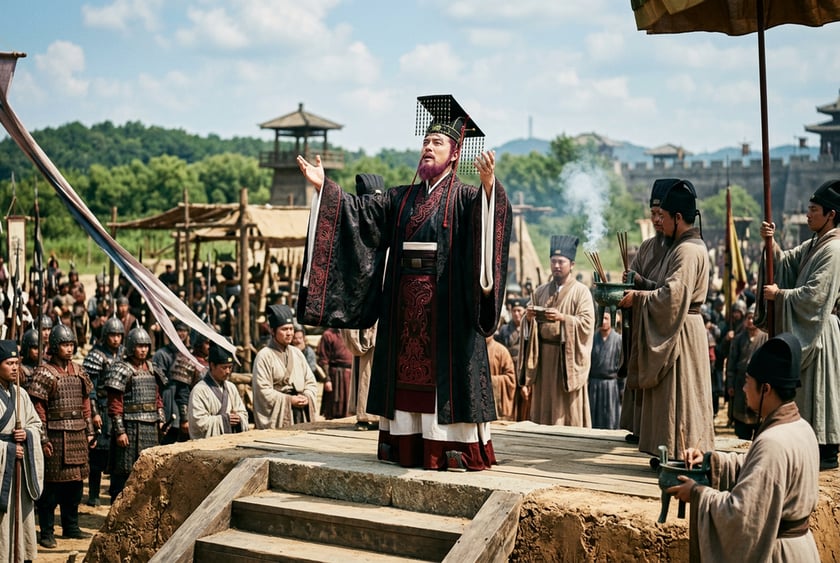
Sun Quan Proclaims Himself Emperor in the first year of Huanglong (229), not as a sudden change of title, but as the elevation of the Jiangdong regime that had already taken shape into an imperial state. The Records of the Three Kingdoms records that, in spring, the ministers and officials collectively urged Sun Quan to “assume the exalted title.” In the fourth month of summer, reports from Xiakou and Wuchang described the appearance of a yellow dragon and a phoenix. Sun Quan then ascended the imperial throne at the southern suburb on the bing-shen day. This sequence presents a political process: officials first urged him to advance, auspicious omens provided an explanation in terms of the Mandate of Heaven, and the suburban sacrifice made the accession a public ceremony. From this perspective, establishing Wu was both a change in the ruler’s title and a concentrated argument for the regime’s legitimacy.
The proclamation addressed to Heaven places this action within a historical narrative of the Han house’s decline and the division of power among rival leaders. The text says that after 434 years, the Han dynasty’s “allotted course had run its end”; it also accuses Cao Pi of seizing the imperial regalia and Cao Rui of subsequently “committing evil,” then declares that the Han sacrifices had ended and the imperial throne stood vacant. Sun Quan, in turn, cites his birth in the southeast, his reception of the times’ mandate, and his aspiration to bring peace to the world as reasons he was qualified to succeed to the imperial throne. Here, the “fall of Han” is not merely an assessment of the past; it is an argument conferring legitimacy on the new regime. But this is a political self-presentation in Sun Quan’s proclamation upon ascending the throne, and should not be treated as a neutral historian’s judgment on the end of Han rule.
Key Figures
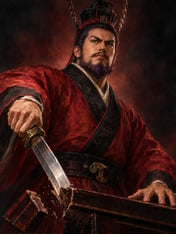
Sun Quan was at the center of the decision and ceremony of accession. The sources record that, after the assembled ministers urged him to advance, he ascended the throne at the southern suburb, describing his acceptance as being “in awe of the Mandate of Heaven, and not daring to refuse.” This phrasing presents the active construction of imperial authority as a response to Heaven’s mandate and the consensus of the ministers: Sun Quan appears both as the agent who established the new emperor and, in the text, as one charged with shouldering responsibility for the realm. After his accession, he changed the era name to Huanglong and posthumously honored his father, Sun Jian, his mother, Lady Wu, and his elder brother, Sun Ce. This shows that the new imperial lineage not only established the ruler of the present but also incorporated family history into the imperial order.
Sun Deng’s appointment as Crown Prince was the clearest succession arrangement in this political transition. On the day Sun Quan proclaimed himself emperor, Sun Deng, formerly crown prince of the King of Wu, was elevated to Crown Prince, meaning the new title simultaneously redefined the institutional standing of the heir. Lu Xun, Zhuge Jin, and Hu Zong are listed among those who deliberated; Teng Yin and Sun Deng are listed as witnesses. However, the surviving passage does not record in detail what any of them said or did in urging the accession, making the sacrifices, or reaching the decision. It is therefore inappropriate to recast this collective action as the personal initiative of any one individual. What can be confirmed is that the accession narrative places the ruler, heir, and officials together in the establishment of the new order.
Central Issues
The first central issue is the source of legitimacy. The proclamation to Heaven invokes the Han dynasty’s allotted years coming to an end, Cao Wei’s seizure of power and loss of virtue, Sun Quan’s reception of the mandate in the southeast, and the approval of the assembled officials and cities. It does not proclaim imperial authority on the basis of military possession alone, but combines historical judgment, moral accusation, omens from Heaven, and the ministers’ support. The reports of a yellow dragon and a phoenix are especially significant symbolically: they recast local sightings as signs of the Mandate of Heaven, providing an interpretive framework for the sacrifice at the southern suburb. However, the sources say only that Xiakou and Wuchang “both reported” the auspicious omens. This cannot independently prove that they were genuine, nor should their function in the political narrative be overlooked.
The second issue is how the proclamation of emperorhood was connected to institution-building. Accession at the southern suburb, a general amnesty, the change of era name, the posthumous honoring of ancestors, the appointment of a Crown Prince, and the promotion and reward of officials and military officers formed a sequence of political acts. Sacrifice gave imperial authority a ritual form; the change of era name marked a new age; posthumous honors incorporated family memory into the state’s ritual order; the designation of an heir pointed to the regime’s continuity; and grants of rank and rewards helped bring officials and military officers into the new order. Thus, “establishing Wu” cannot be understood simply as Sun Quan changing his title. It was a simultaneous reorganization of the state’s calendar, ancestral lineage, succession rules, and system of political rewards.
Political Consequences
The immediate consequence was the transition of Sun Quan’s regime from the system of the King of Wu to an imperial system, giving Wu a clear imperial title and era name. Sun Quan posthumously honored his parents and elder brother and made Sun Deng Crown Prince, organizing imperial authority into a dynastic order with a family lineage and an expectation of succession. The grants of rank and rewards to officials and military officers extended the ceremonial change into practical political relationships, while the general amnesty displayed the new ruler’s governing posture through a universal act of grace. These measures show that the effects of proclaiming himself emperor were expressed not only in the title, but also had to be consolidated through ritual institutions, official rewards, and succession arrangements.
At the regional level, Sun Quan’s proclamation of himself as emperor made the southeastern regime’s claim to independence explicit, explaining its relationship to existing imperial authority by asserting that “the Han mandate had ended and Cao Wei had lost virtue.” The related sub-event concerning the Wu–Shu oath of alliance and the tripartition of the realm indicates that the question of proclaiming himself emperor also arose within a strategic environment of competing powers. However, the cited passage from the Records of the Three Kingdoms does not describe the contents of the oath, the course of negotiations, or how the pact affected the accession. It can therefore be treated only as relevant background, not as proof that the oath directly brought about the proclamation. The material also does not explain specific subsequent changes in diplomacy or warfare, so political consequences must be distinguished from what can be established from the evidence.
Counterfactual Analysis
If Sun Quan had not proclaimed himself emperor in 229, the Jiangdong regime might still have continued to function under its existing rule, but its formal status would have remained at the level of King of Wu. Without the accession at the southern suburb, the change of era name, and imperial rites, it would have missed a public declaration that recast local rule as an independent dynasty. Sun Deng, too, would not at that moment have been elevated from crown prince of the King of Wu to Crown Prince, and the institutional expression of the family’s succession order might have been delayed. Such a scenario would not necessarily mean that the regime immediately weakened, but it might have left Sun Quan with fewer symbolic resources for asserting autonomy abroad and uniting officials and the imperial clan at home. Since the available material records only the measures actually taken upon accession, this is an inference about their institutional function, not an alternative course of events recorded in the sources.
Another possibility is that Sun Quan might have postponed proclaiming himself emperor while awaiting more favorable political conditions, or first strengthening the alliance and internal consensus. But postponement would also have preserved ambiguity in his formal status: Sun Quan could have continued to wield real power without yet fixing the claim that “the Mandate of Heaven had shifted” in the form of an imperial ceremony and era name. Conversely, proclaiming himself emperor did not automatically resolve disputes over legitimacy; the proclamation’s criticism of Han and Wei itself shows that the new regime still had to explain why it was entitled to inherit the imperial mandate. The surviving records are sufficient to analyze its institutional design and political arguments, but not to determine whether Wu would inevitably have been stronger or weaker had Sun Quan not proclaimed himself emperor, or to confirm that the long-term effects fully matched his expectations.