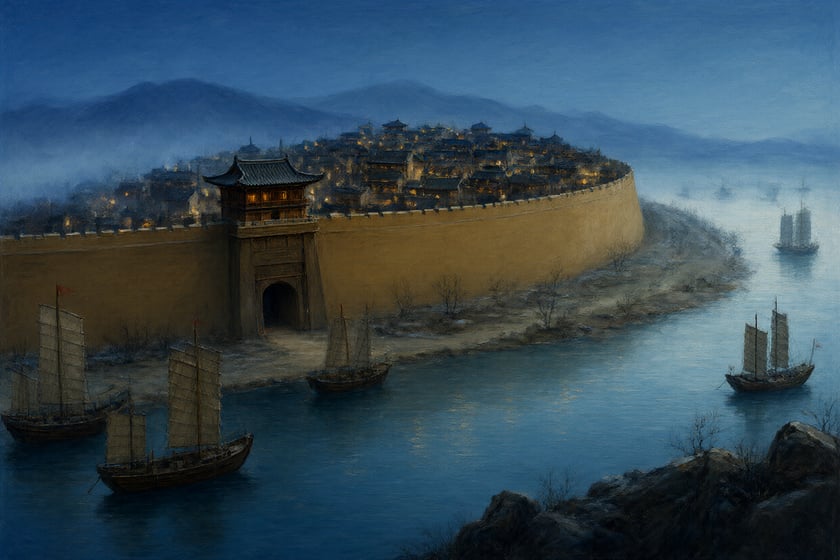
Overview
Wuchang was originally E County in Jiangxia Commandery, Jing Province, during the Eastern Han dynasty. Its site lies in present-day Ezhou, Hubei Province. In the second year of Huangchu (221), Sun Quan moved his capital from Gong’an to E, renamed it Wuchang, and established Wuchang Commandery from six counties, including Wuchang. Sun Quan proclaimed himself emperor there. After he moved the capital to Jianye, Wuchang remained an important stronghold for Eastern Wu in the middle reaches of the Yangtze.
History
In the thirteenth year of Jian’an (208), Liu Bei followed Lu Su’s advice, stationed his forces at Fankou in E County, and sent Zhuge Liang with Lu Su to meet Sun Quan. After Sun Quan moved the capital in the second year of Huangchu (221), he had Wuchang’s walls built that August and ordered his generals to remain vigilant on the frontier, warning them not to go out without an armed escort. While in Wuchang, Sun Quan once drank himself into a stupor at the Fishing Terrace and splashed water on his ministers. Zhang Zhao sternly admonished him, and only then did Sun Quan stop drinking. He also put his newly built ship, the “Chang’an,” through a trial run at the Fishing Terrace’s promontory. When it encountered a gale, his close attendant Gu Li drew his sword and forced the helmsman to steer into Fankou for shelter. In the fifth year of Huangwu (226), Sun Quan campaigned against Shiyang and ordered Han Zong to defend Wuchang. Han Zong, however, behaved improperly and later defected to Wei. In the seventh year of Huangwu (228), after Lu Xun routed Cao Xiu at Shiting, he passed through Wuchang on his return. Sun Quan ordered his attendants to hold his own imperial canopy over Lu Xun as he entered and left the palace gates.
In the fourth month of the first year of Huanglong (229), Xiakou and Wuchang both reported the appearance of a yellow dragon and a phoenix. Sun Quan assumed the imperial title at the southern suburb altar. That same year, the Shu envoy Chen Zhen arrived in Wuchang and joined Sun Quan on the altar to swear an oath dividing the territories of the realm among the states. In the ninth month, Sun Quan moved the capital to Jianye, while Grand General Lu Xun assisted Crown Prince Sun Deng and took charge of affairs in Wuchang. In the eighth month of the first year of Chiwu (238), Wuchang reported the appearance of a qilin. The ministers asked to mark the auspicious event by changing the era name, and Sun Quan adopted Chiwu as the new era name.
After Lu Xun died in the eighth year of Chiwu (245), Zhuge Ke was stationed in Wuchang as Grand General and took over affairs in Jing Province. Sun Quan divided Wuchang’s defense zone into left and right sections; Lü Dai commanded the right, extending from Wuchang upriver to Puqi. In the tenth year of Chiwu (247), while Jianye’s Taichu Palace was being built, Sun Quan ordered timber and tiles from the Wuchang Palace to be dismantled and transported there. The officials responsible for the matter said the Wuchang Palace had been in use for twenty-eight years and might no longer be fit for use, but Sun Quan insisted that its materials be taken. After Sun Quan’s death, Zhuge Ke considered moving the capital and also had the Wuchang Palace repaired. In the twelfth month of the first year of Jianxing (252), the Wei general Guanqiu Jian advanced on Wuchang. That same month, lightning fire destroyed Wuchang’s Duan Gate; after it was rebuilt, the inner hall was struck by fire as well.
In the ninth month of the first year of Ganlu (265), Sun Hao followed a memorial from Bu Chan, Inspector of Xiling, and moved the capital to Wuchang. It was said that this was because diviners who read the appearance of the clouds claimed that Jing Province bore the aura of kingship and that Jianye Palace was inauspicious. Lu Kai submitted a remonstrance, arguing that Wuchang’s terrain was steep and its soil poor; ships moored there were liable to drift or sink, while people living in the mountains faced danger from the precipitous slopes. It was no place to establish a capital and nourish the people. He also quoted the children’s rhyme, “Better to drink Jianye’s water than eat Wuchang’s fish”. In the twelfth month of the first year of Baoding (266), Sun Hao returned the capital to Jianye, leaving General of the Guards Teng Mu to defend Wuchang. In the winter of the third year of Tianji (279), the Jin armies invaded Wu along several routes, and Wang Rong’s force headed for Wuchang. Yu Bing, Wu’s commander of all military affairs above Wuchang, first surrendered his tally, canopy, and seals, then submitted to Jin.
Notable Figures
- Crown Prince’s Household in Wuchang: When Crown Prince Sun Deng was stationed in Wuchang, he was kind and benevolent. Shi Yi was appointed to assist him, and the Crown Prince consulted him on all matters. Pan Jun and Lu Xun were stationed there together and jointly managed the affairs of the garrison.
- Sun Fen, King of Qi: The younger brother of Sun Ba, he was made King of Qi in the second year of Taiyuan (252) and lived in Wuchang. After Sun Quan’s death, Zhuge Ke moved him to Yuzhang.
- Wuchang’s Commanders: After Wuchang’s defense was divided, Fan Shen was appointed commander of the left division. He maintained strict military discipline and was later appointed Grand Marshal by Sun Hao. Xue Ying was sent to supervise the digging of Shengxi, but the project failed, and he was posted away as commander of the left division. Lu Kai, a kinsman of Lu Xun, transferred from command at Baqiu to become commander of the right division. Lu Shu, the posthumous son of Lu Su, served as Wuchang’s commander during the Yongan era.
Differences from the Historical Record
In Romance of the Three Kingdoms, during the Battle of Red Cliffs, Zhuge Liang tells Liu Qi to return and defend “Wuchang”. In fact, the place was still called E County at the time, and Liu Bei’s forces were stationed at Fankou in E County. The novel says Zhang Zhao urged Sun Quan to proclaim himself emperor on the grounds that a phoenix had alighted on East Mountain in Wuchang, and that Sun Quan built an altar in Wuchang’s southern suburb and ascended the throne on the day of the summer fourth month, bingyin. The Records of the Three Kingdoms says only that the ministers and officials urged him to accept the throne, that Xiakou and Wuchang reported auspicious signs, and that Sun Quan ascended the throne on the bing-shen day of the fourth month. The novel also says that Du Yu advanced on Wuchang after capturing Jiangling, whereupon Wuchang surrendered. The Records of the Three Kingdoms records only that Jin ordered Wang Rong’s force to head for Wuchang, and that Wu commander Yu Bing submitted after handing over his tally and canopy; it does not mention Du Yu advancing on Wuchang.
Today
The site of Wuchang from the Three Kingdoms period lies in present-day Ezhou, Hubei Province, where the remains of Wu King City can be found in the urban area. Wuchang District in today’s Wuhan is a place name adopted in a later period and is not the same location as the Wuchang where Sun Quan established his capital.