Overview
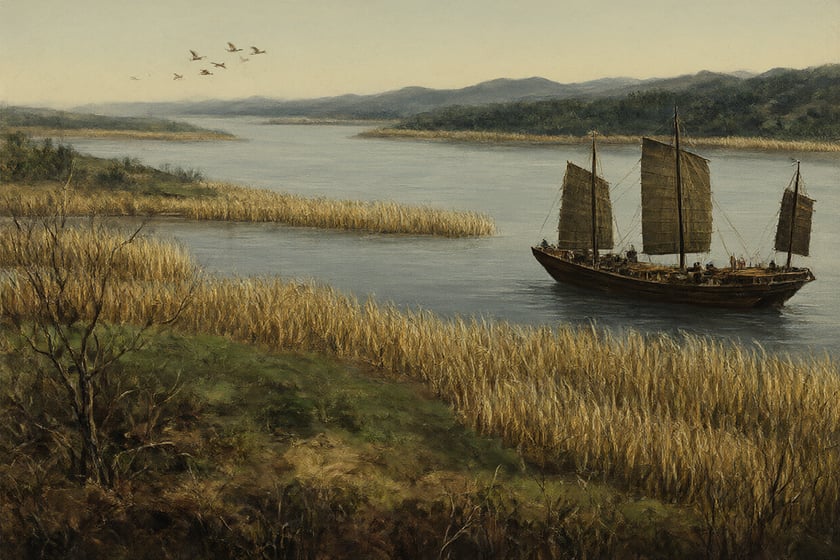
Jiangxia Commandery was a commandery under Jing Province in the Eastern Han. During the Eastern Han, its seat was Xiling, west of present-day Xinzhou District in Wuhan, Hubei. Its territory roughly covered parts of eastern Hubei around present-day Wuhan, Xiaogan, Huanggang, and Ezhou, extending north to the southern part of present-day Xinyang in Henan. Xiakou, Wuchang, and Chibi all lay within its borders. Located at the strategic point where the Han River joins the Yangtze, it was Jing Province’s eastern gateway: in Liu Biao’s time, it served as the eastern bulwark against the Sun clan; after the Battle of Red Cliffs, it became a frontier commandery where Wei and Wu faced each other across the river, with the north belonging to Wei and the south to Wu.
History
When Liu Biao controlled Jing Province, he appointed Huang Zu as Jiangxia’s administrator, and Huang became an enemy of the Sun clan. Huang Zu once sent his subordinate Deng Long with several thousand men to invade Chaisang, but Zhou Yu captured him alive. In the spring of 208, the thirteenth year of Jian’an, Sun Quan attacked Jiangxia. Zhou Yu served as chief commander of the vanguard, and Huang Zu was defeated and killed. Liu Biao’s eldest son, Liu Qi, felt threatened because his stepmother favored his younger brother Liu Cong. Heeding Zhuge Liang’s reminder that “Shengsheng was in the capital and in danger, while Chong’er was abroad and safe,” he took up the post of Jiangxia administrator after Huang Zu’s death. That same year, Liu Biao died of illness, Liu Cong surrendered the province to Cao Cao, and Liu Bei fled south to Xiakou.
After Cao Cao pacified Jing Province, he appointed Liu Biao’s former subordinate Wen Ping as Jiangxia administrator because the commandery bordered Wu and its people were unsettled. Wen Ping commanded the troops in the north and was entrusted with frontier affairs. After the Battle of Red Cliffs, Cheng Pu accompanied Zhou Yu in capturing Nan Commandery and took up the post of Jiangxia administrator, with his seat at Shaxian. In 215, the twentieth year of Jian’an, Sun Quan and Liu Bei divided Jing Province; Jiangxia, along with Changsha and Guiyang, fell to Sun Quan east of the dividing line. From then on, Jiangxia was split in two: Wei held the north, while Eastern Wu held the southern part along the river.
Wei and Wu fought repeatedly over Jiangxia. In 223, the second year of Wu’s Huangwu era, Sun Quan built a city on Jiangxia Mountain. In the eighth month of 226, the seventh year of Wei’s Huangchu era, Sun Quan attacked Wei’s Jiangxia Commandery. Wen Ping held his position. Emperor Ming of Wei judged that Wu’s forces would not dare fight for long, and Xun Yu, sent to inspect the frontier, raised troops and lit signal fires along the way; Sun Quan withdrew. Sun Huan, Wu’s Jiangxia administrator, served as the vanguard in this campaign on his home ground, forcing Gaocheng to surrender and capturing three generals. In 227, the first year of Taihe, Wei separated the southern part of Jiangxia and established the Southern Commandant of Jiangxia. In 236, the fifth year of Jiahe, Lu Xun sent Zhou Jun and Zhang Liang to raid Xinshi, Anlu, and Shiyang in Wei’s Jiangxia Commandery, killing or capturing more than a thousand people. In 237, the first year of Jingchu, Zhu Ran led twenty thousand men to besiege Wei’s Jiangxia Commandery, but was driven back by Hu Zhi, the Inspector of Jing Province. Later, Wang Ji, Wei’s Inspector of Jing Province, submitted a memorial proposing the construction of Shangchang City. He moved the seat of Jiangxia Commandery there to bring it closer to Wu’s Xiakou, after which Wu’s forces dared not cross the river lightly. As late as 277, the first year of Tianji, Sun Shen, Wu’s commander at Xiakou, still led troops into Jiangxia and Runan, burning and plundering settlements.
Notable People
- Natives of Jiangxia: Liu Yan was from Jingling and a descendant of the Prince of Lu, Gong, of the Han. Fei Yi and Fei Guan were both from Meng County and were related through their mothers to the Fei clan, the maternal family of Liu Zhang, Governor of Yi Province; both later remained in Shu. Li Tong was from Pingchun, was renowned for his chivalry in the Jiang and Ru regions, and raised troops at Langling near the end of the Han. Meng Ren, also known by his personal name Meng Zong, an official of Eastern Wu who served as Minister of Works, was also from Jiangxia and was celebrated for his filial devotion to his mother.
- Wei’s administrators of Jiangxia: After Wen Ping came Wang Jing, Lu Shi, and others. Lu Shi was at odds with Wen Ping’s son Wen Xiu. Lu Xun forged a letter in reply to Lu Shi and left it on the border; Lu Shi was consequently suspected and dismissed from office. Huan Yu, who served during the Jiaping era, governed with integrity and frugality, combining authority with benevolence. His reputation was second only to Wen Ping’s.
- Wu’s administrators of Jiangxia: After Cheng Pu, Sun Huan took over his brother Sun Jiao’s command. During his year in office, he treated the worthy with respect and humility, earning the praise of both troops and civilians. Others included Cai Yi and Diao Jia, who was falsely accused by Lü Yi of slandering the government. He was cleared only because Shi Yi testified truthfully on his behalf.
- Officials serving in Jiangxia: When Pan Jun was young, Liu Biao appointed him as an aide in the Jiangxia section of the staff. Pan Jun executed the corrupt magistrate of Shaxian according to the law, shocking the entire commandery.
Differences in Historical Fiction
In Romance of the Three Kingdoms, while Liu Bei was serving under Liu Biao, the surrendered generals Zhang Wu and Chen Sun rebelled in Jiangxia. Liu Bei led troops against them; Zhao Yun killed Zhang Wu with a spear, Zhang Fei killed Chen Sun, and the counties of Jiangxia were pacified. This episode does not appear in the Records of the Three Kingdoms. The novel says that when Sun Quan defeated Jiangxia in 208, Gan Ning shot Huang Zu in the back and cut off his head. Sun Quan then followed Zhang Zhao’s advice, abandoned Jiangxia, and withdrew to Jiangdong. The “Biography of the Lord of Wu” in the Records of the Three Kingdoms instead says that, as Huang Zu fled, the cavalryman Feng Ze caught up with him and beheaded him. The novel also says that after Changban, Zhuge Liang initially proposed that Liu Bei garrison Xiakou while Liu Qi returned to Jiangxia, so they could support one another from two positions. In the end, however, Liu Bei and Zhuge Liang accompanied Liu Qi to Jiangxia, leaving Guan Yu to defend Xiakou. The “Biography of the Former Lord” in the Records of the Three Kingdoms says instead that Liu Bei and Liu Qi went together to Xiakou.
Today
The former territory of Jiangxia lies mainly in present-day Wuhan, Hubei, and the surrounding areas of Xiaogan, Huanggang, and Ezhou, extending north to the southern part of present-day Xinyang in Henan. Wuhan still has a Jiangxia District, which preserves the name of the ancient commandery, but it is on the south bank of the Yangtze and does not coincide with the Eastern Han commandery seat of Xiling, west of present-day Xinzhou District.