Meng Zong
courtesy name 恭武 · also called 孟仁 · –271
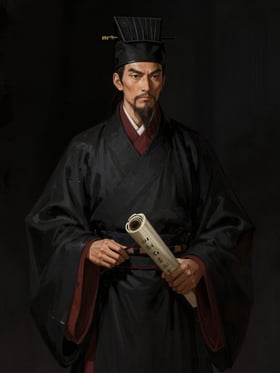
Wu official Meng Zong received a reduced sentence for rushing to his mother's funeral and welcomed Sun He; the Romance has him garrison Wuchang.

Life
In the novel: 1 chapter · In the Records: 4 volumes
Life?–271
258 CE (Ganlu 3)
Appearances
By chapter (5)
Novel
- 113
Records
- 47
- 48
- 59
- 64
- Life event
List all 2 stops
On the boards
Compare with someone →Where this person ranks on each board.
Historical Record
The Records of the Three Kingdoms gives his name as Meng Zong, with a note that his original name was changed to “Ren” to avoid the taboo on Sun Hao’s name. The available sources do not explain the origin of the style name “Gongwu,” so no further account is given here. Meng Zong served in the state of Wu, and records mention him in succession as Wu Commandant, Palace Attendant, Left Vice Minister of the Imperial Secretariat, and Minister of Works. The most notable episode in his career occurred when his mother died: he hurried to attend the funeral and then placed himself under arrest at Wuchang to await punishment. Lu Xun described his usual conduct and appealed to Sun Quan for leniency on his behalf. Sun Quan reduced the punishment by one degree, while expressly ruling that the case must not be cited as a precedent. The proposal to establish a formal rule against rushing home for funerals was thus abandoned. The episode reveals both Meng Zong’s filial devotion and the ruler’s balancing of law and human feeling at the time; it was not simply a matter of pardoning him outright.
During Sun Xiu’s reign, Meng Zong served as Palace Attendant and, alongside Puyang Xing, as Left Vice Minister of the Imperial Secretariat; another source notes that he later rose to Minister of Works. At the time of the Deposition of Sun Liang, Sun Chen ordered Palace Attendant Meng Zong to make an announcement at the ancestral temple, declaring that the young emperor was ill, confused, and unfit to continue serving the ancestral temples. He then summoned the officials and announced his intention to depose and install rulers. The officials were terrified and said they would obey Sun Chen’s order. This episode places Meng Zong within the coup at the Wu court and the procedure for deposing the emperor, but the record shows him making the announcement under orders; it does not say that he took part in plotting the deposition. During Sun Hao’s reign, serving as acting prime minister, he joined Grand Minister of Ceremonies Yao Xin and others in leading officials and two thousand central-army infantry and cavalry to escort the ceremonial carriage east to Mingling to welcome the spirit of Sun He. Sun Hao personally received them and saw them off with a bow. The ceremony reflects another aspect of Meng Zong’s career: his high position and his role in state ritual affairs.
In the Novel
In chapter 113 of Romance of the Three Kingdoms, Meng Zong is portrayed as a Secretariat Drafter amid the tense standoff between Sun Xiu and Sun Chen. After Sun Chen’s gift of oxen and wine for Sun Xiu’s birthday was rejected, he complained to Zhang Bu. The next day, Zhang Bu submitted a secret memorial, and Sun Xiu became apprehensive. The novel then has Sun Chen order Meng Zong to lead fifteen thousand elite troops from the central camp out to Wuchang, and to hand over all the weapons in the armory. Meng Zong thus becomes an important operative in Sun Chen’s effort to move troops away and prepare to take control of the situation. Though not a central figure in the plot to capture and kill Sun Chen, he is placed at a critical point as the danger of a coup draws near.
This narrative must be distinguished from the historical accounts. The historical sources do record that Sun Chen later sought to move to Wuchang because of Meng Zong’s request, and that Meng Zong was ordered to make the announcement at the ancestral temple when Sun Liang was deposed. But the Records of the Three Kingdoms passage provided here does not say that Meng Zong was ordered to lead fifteen thousand elite troops or to move weapons from the armory, nor does it present these actions as part of Sun Chen’s coup preparations. The novel uses Meng Zong’s posting away from the capital to turn the power struggle at the Wu court into a visible military threat, setting the stage for Ding Feng’s plan to capture and kill Sun Chen.
Key Relationships
Meng Zong’s relationship with Lu Xun is most clearly seen in the funeral case. Lu Xun vouched for his usual conduct and appealed on his behalf, prompting Sun Quan to reduce his sentence by one degree. Sun Quan nevertheless barred later officials from citing the case as a precedent, showing that Lu Xun’s appeal changed Meng Zong’s personal outcome without lifting the relevant prohibition. His relationship with Sun Quan thus involved both receiving leniency and serving as a subject under strict laws.
Meng Zong’s connection with Sun Chen spans two political events. The historical account records that he was ordered to make the announcement at the ancestral temple when Sun Liang was deposed, while the excerpt also notes that Sun Chen later sought to move to Wuchang because of Meng Zong’s request. The novel goes further, portraying him as a Secretariat Drafter who led troops out to Wuchang. Both accounts place him on the margins of, and at the scene of, changes in political power at the Wu court, but only the novel explicitly has him lead troops and transport weapons. During Sun Hao’s reign, he took part in escorting Sun He’s spirit carriage as acting prime minister, sharing responsibility for state ceremonies with Yao Xin and others.
Defining Scenes
The historical scene that best captures Meng Zong’s personal circumstances is his placing himself under arrest at Wuchang to await punishment after rushing home for his mother’s funeral. He neither concealed himself nor defied the order out of filial devotion, but voluntarily submitted to judgment. Lu Xun cited his past conduct and requested a reduction of one degree; Sun Quan granted the request but forbade later officials from citing it as a precedent. The scene’s tension lies in the juxtaposition of a son’s filial feelings and the state’s prohibition: Meng Zong received a reduced punishment, but his case did not become a precedent for bending the rules.
Another scene is the announcement at the ancestral temple during the Deposition of Sun Liang. Acting on Sun Chen’s orders, Meng Zong addressed the ancestral temple and the assembled officials, announcing the grounds for deposing the emperor. The officials were terrified and dared not object. The Records of the Three Kingdoms presents him as a high-ranking official carrying out the procedure for deposing and installing a ruler, without saying whether he approved of it; the novel’s portrayal of him as actively plotting a coup should not be read back into this account.
The novel’s defining image is Meng Zong leading fifteen thousand elite troops out to Wuchang, while Sun Chen empties the armory of its weapons. Wei Miao and Shi Shuo use this as grounds to report a rebellion, after which Sun Xiu summons Ding Feng to discuss the matter. Here Meng Zong is cast as a military operative in a crisis. The specific details of the troops’ deployment and the weapons’ removal belong exclusively to the novel and must not be treated as historical fact.
Events
Events (2)
Battles and events the texts place this person in, by date.
Other events
Places
Continue