Overview
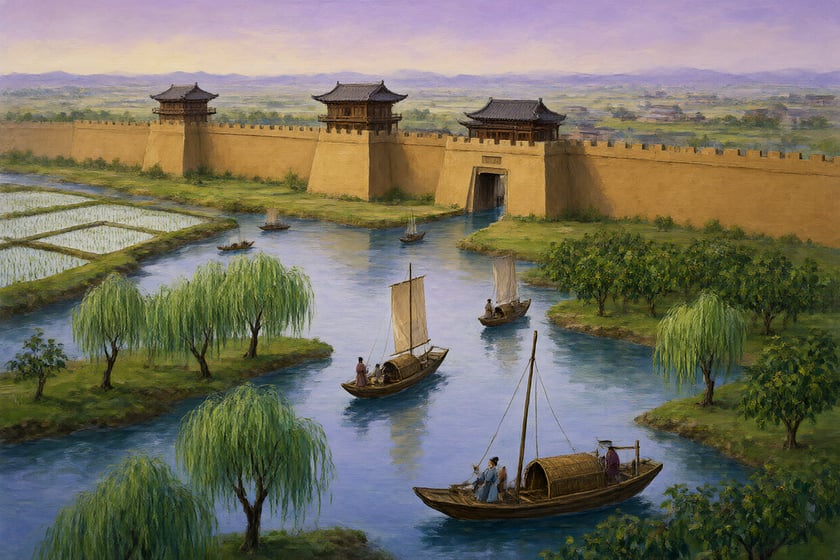
Wu County was a county in Wu Commandery, Yang Province, during the Eastern Han dynasty, corresponding to present-day Suzhou, Jiangsu Province. Historical records often refer to it simply as “Wu.” The western gate of the city was called Chang Gate; legend held that it was built by Fuchai, King of Wu, during the Spring and Autumn period. After Sun Ce's Pacification of Jiangdong in the late Han, he took control of Wu. In Jian'an 5 (200), Sun Quan took over his elder brother’s legacy here, and for roughly the next ten years Wu County served as the Sun family’s principal base. Wu County was also home to many great Jiangdong clans. Eastern Wu’s senior officials Gu Yong, Lu Xun, Lu Ji, Zhu Huan, Zhang Wen, and others were all natives of Wu.
History
During the Xingping era, a children’s rhyme circulated in Wu: “Open Chang Gate, and an emperor shall emerge.” It was later regarded as fulfilled when Sun Quan Proclaims Himself Emperor. After Sun Ce took control of Wu, he treated Zhang Zhao, Zhang Hong, and Qin Song as honored guests, and discussed the realm with them in Wu. The young Lu Ji, seated at the end of the gathering, loudly advocated cultivating civil virtue to win over distant peoples, impressing Zhang Zhao and the others. In Jian'an 3 (198), Zhou Yu foresaw that Yuan Shu would never amount to anything. Taking advantage of his appointment as chief of Juchao, he returned east and went to Wu to join Sun Ce.
In Jian'an 5 (200), Sun Ce died. Cao Cao recommended Sun Quan for appointment as General Who Attacks Rebels and Administrator of Kuaiji. Sun Quan remained stationed in Wu County, sending only the commandery’s assistant administrator to Kuaiji to handle official documents. By then, Zhou Yu had brought Lu Su’s mother to Wu and urged Lu Su to stay and assist Sun Quan. Sun Quan and Lu Su shared a couch and drank together. Lu Su proposed a strategy of establishing a tripartite balance in Jiangdong, advancing into Jing Province, and then pursuing imperial rule—the plan later known as Lu Su's Couch Strategy. At the beginning of Sun Quan’s administration, he personally inspected the granaries and prisons in each county. Lü Dai, serving as Wu’s assistant administrator, handled the inspection ably and was consequently promoted.
In Jian'an 15 (210), Zhou Yu died of illness at Baqiu, and his coffin was transported back to Wu. Sun Quan went to Wuhu to meet the funeral procession, and the government provided everything needed for the funeral. Pang Tong escorted Zhou Yu’s coffin to Wu. As he departed westward, Lu Ji, Gu Shao, Quan Cong, and others saw him off at Chang Gate. Pang Tong assessed them one by one, calling Lu Ji “a worn-out horse with the strength to gallop,” and Gu Shao “a worn-out ox able to bear heavy loads and travel far.” He also remarked that Quan Cong was generous and eager for a good reputation, much like Fan Zizhao of Runan. By this time Sun Quan had moved his residence to the capital, and Liu Bei and Zhou Yu both went there to meet him. Wu County was no longer the Sun family’s political center, but it remained in the heartland of Eastern Wu.
Zhu Zhi, Administrator of Wu Commandery, served there for thirty-one years, and many sons of the four great families of Wu held posts in the commandery. In his later years, he requested permission to garrison at Guzhang to pacify and control the Shanyue. After returning to Wu County a little over a year later, he died in Huangwu 3 (224). During Sun Hao’s reign, he grew suspicious of the imperial kinsman Sun Fen and had him transferred from Zhang'an back to Wu city and placed under confinement. He even forbade the men and women of Sun Fen’s household from marrying; in the end, he forced Sun Fen and his sons to drink poison and die.
People
- Born in Wu County: In his youth, Gu Yong studied music and writing under Cai Yong, who had taken refuge in Wu. After Sun Quan became King of Wu, Gu Yong was repeatedly promoted, eventually serving as Minister of Justice and Minister of Ceremonies, while concurrently holding the post of Director of the Secretariat. Lu Xun came from a great Jiangdong family. Orphaned young, he took charge of the family household. When Lu Ji was six, he featured in the story of “hiding tangerines for his mother”. Lu Kai was a clansman’s son of Lu Xun and never put down his books, even while commanding troops. Zhang Wen had a striking appearance, and Gu Yong praised him as unrivaled in his time. Zhu Huan once served as chief of Yuyao; during a severe epidemic, he dispatched capable officials to deliver medicine and distribute porridge. Zhu Ju was handsome and physically strong, and skilled in debate.
- Served in Wu County: Lü Dai once served as Wu’s assistant administrator. At nineteen, Yin Li served as assistant administrator of Wu County. He later accompanied Zhang Wen on an embassy to Shu Han and won Zhuge Liang’s praise. When Meng Zong served as magistrate of Wu, he was not allowed to bring his family to his post, so he often sent seasonal produce to his mother. When he heard that she had died, he violated the rules by abandoning his office and rushing home for the funeral. His sentence was reduced by one degree from death.
- Resided in Wu County: After being caught up in disorder, Xu Sheng lived as a guest in Wu and became known for his courage. Sun Quan’s wife Lady Xu was dismissed because of her jealousy and lived in Wu for more than ten years.
Differences in Historical Portrayal
In Romance of the Three Kingdoms, when Sun Ce attacked Yan Baihu, Han Dang is said to have fought all the way to the foot of Chang Gate, while Sun Ce advanced by land and water to besiege Wu city. The Records of the Three Kingdoms, “Biography of Sun Ce,” and the commentary by Pei Songzhi, quoting the Wu Records, also state that Sun Ce attacked and defeated Yan Baihu, but do not say that he laid siege to Wu city. Both accounts describe Lu Su’s first meeting with Sun Quan. The Records of the Three Kingdoms says that the two “shared a couch and drank together”, while the novel has them lying together on the same couch, feet to feet, as Lu Su offers his strategy at midnight.
Today
The former site of Wu County is present-day Suzhou, Jiangsu Province. Chang Gate still stands on the western side of Suzhou’s old city, and its name can be traced back to the western gate of the ancient city of Wu.