Eastern Wu · Commander of Baqiu
Lu Kai
courtesy name 敬风 · 198–269
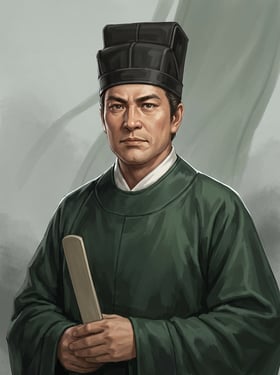
Lu Kai was bold in remonstrance and outspoken, loyal, vigorous, and forthright, his heart set on the public good, his sense of justice showing in his face; his memorials all addressed matters plainly, without embellishment.

Life
In the novel: 1 chapter · In the Records: 5 volumes
Life198–269
264 CE (Xianxi 1)
265 CE (Xianxi 2)
266 CE (Taishi 1)
- Lu Kai's Plot to Depose Sun HaoJianyeInstigator
- Eastern Wu· Undated
- Life event
- Death
List all 4 stops
On the boards
Compare with someone →Where this person ranks on each board.
Who they were
Character profile
- Character
- Lu Kai was bold in remonstrance and outspoken, loyal, vigorous, and forthright, his heart set on the public good, his sense of justice showing in his face; his memorials all addressed matters plainly, without embellishment.
- Manner of speech
- Lu Kai remonstrated bluntly and fearlessly, citing the classics for support; he once laid out a direct remonstrance enumerating 'twenty matters in which the late emperor's ways were not followed.'
- Life
- Lu Kai, styled Jingfeng, was a man of Wu in Wu Commandery, a clansman's son of the Chancellor Lu Xun. He served as chief of Yongxing and Zhuji, and was later appointed Commandant Who Establishes Martial Might in command of troops, distinguishing himself in the campaign against Zhuya. When Sun Hao took the throne, he was promoted to Grand General Who Guards the West, area commander of Baqiu concurrently governing as Governor of Jing Province, advanced to Marquis of Jiaxing, and in the first year of Baoding promoted to Chancellor of the Left.
- Anecdotes
- Lu Kai was a senior minister of Sun Wu. He once plotted secretly with the General of the Left Liu Ping, the Grand Marshal Ding Feng, and the Grandee Secretary Ding Gu to depose Hao, but without success. He often bore Hao's repeated defiance of his imperial will, and, with He Ding's slanderous contrivances added, he submitted a memorial grieving over the death of Wang Fan.
Historical Record
Lu Kai, courtesy name Jingfeng, was from Wu County in Wu Commandery and a kinsman of Lu Xun. Early in the Huangwu era, he successively served as magistrate of Yongxing and Zhuji, earning a reputation for effective governance. He was then appointed Commandant of Jianwu and given command of troops. Even while leading an army, he never put down his books and was fond of the Taixuan. During the Chiw Wu era, he served as Administrator of Dan’er and took part in the campaign against Zhuya, where he achieved victories. In the second year of Wufeng, he again campaigned against the bandit Chen Bi in Lingling. For his success, he was appointed Inspector of Baqiu, made a General of the Household, and enfeoffed as Marquis of Duxiang. He later served successively as Right Area Commander of Wuchang, General Who Sweeps Away Wei, and General Who Pacifies the Distant. When Sun Xiu ascended the throne, Lu Kai was appointed General Who Conquers the North and concurrently made Governor of Yu Province. After Sun Hao Ascends the Throne, Lu Kai was promoted to Senior General Who Guards the West, placed in command of Baqiu, concurrently made Governor of Jing Province, and advanced to Marquis of Jiaxing. In the first year of Baoding, he was promoted to Left Chancellor.
Lu Kai was renowned for daring to remonstrate. When Sun Hao sought friendly relations with Jin, Ding Zhong proposed attacking and taking Yiyang. Lu Kai argued that Jin had recently annexed Ba and Shu and was powerful, and that Wu should not send troops in pursuit of a mere chance of success. He urged Sun Hao to abandon the campaign. He also spoke frankly about palace construction: when Sun Hao began building Xianming Palace at enormous expense, Lu Kai persisted in remonstrating, but his advice was not accepted. When Sun Hao did not want his ministers to look up at him, Lu Kai argued that ruler and ministers should know one another, and that only when sudden events arose would it become clear where each should go. Sun Hao then allowed him to raise his head and look.
In his memorials, Lu Kai repeatedly spoke of the people’s livelihood and the affairs of state. He declared, “The people are the foundation of the state,” and advocated reducing corvée labor, supporting scholars and filling the granaries, and easing harsh policies. Citing the fall of Qin, the rise of Han, and the fall of Shu as warnings, he pointed to the dangers of extravagance, disorder in punishments and government, the exhaustion of the people’s strength, and rejecting worthy men and refusing remonstrance. He also criticized Wuchang’s rugged, barren terrain, arguing that it was unsuitable as a capital for securing the state and nourishing the people. Citing the children’s rhyme, “I would rather drink Jianye’s water than eat Wuchang’s fish,” he urged Sun Hao not to move the capital rashly. A lengthy memorial listing “twenty matters in which [Sun Hao] failed to follow the late emperor” criticized his move of the capital, the execution of Wang Fan, improper appointments, extravagance in the inner palace, and the conscription of the people. However, Pei’s commentary also notes that it is difficult to determine whether Lu Kai truly submitted this memorial, and so it was not included in the main text.
Lu Kai once rebuked the favored He Ding to his face, accusing him of using crafty flattery to bring ruin upon the state. On his deathbed, he also stated explicitly that He Ding must not be entrusted with state affairs, and recommended Yao Xin, Lou Xuan, He Shao, Zhang Ti, Xue Ying, Teng Xiu, Lu Xi, Lu Kang, and others as worthy men who could assist the state. Lu Kai died of illness in the first year of Jianheng, aged seventy-two. The Records of the Three Kingdoms also records that Lu Kai submitted a memorial lamenting the execution of Wang Fan, calling him a loyal and upright man fit to serve as a senior minister of state. Pei’s commentary separately relates that Lu Kai conspired with Ding Feng and Ding Gu to depose Sun Hao and install Sun Xiu’s son, but abandoned the plan when Liu Ping refused to cooperate. This account is introduced with “some say,” and the note describes how the plot was brought to an end.
In the Novel
Chapter 120 of Romance of the Three Kingdoms places Lu Kai amid the increasingly oppressive rule of Sun Hao: Sun Hao indulges in wine and women and favors Cen Hun; Puyang Xing and Zhang Bu are executed for remonstrating, leaving the court ministers afraid to speak. The novel portrays Lu Kai and Wan Yu as serving jointly as chancellors, and makes Lu Kai’s memorial remonstrating against extravagance and militarism, along with his citation of a Jianye children’s rhyme to dissuade Sun Hao, key episodes. In this way, it presents him as someone who dares to speak frankly and offend the throne even when everyone else is afraid. This accords with the basic historical image of Lu Kai as Left Chancellor who remonstrated with Sun Hao on matters of livelihood and statecraft. However, the novel’s narrative arrangement and specific scenes involving Sun Hao’s court are literary inventions and should not be used to supply episodes not explicitly recorded in the Records of the Three Kingdoms.
Key Relationships
- Sun Hao: As a senior minister of Eastern Wu, Lu Kai repeatedly remonstrated with Sun Hao, opposing an attack on Jin and criticizing the construction of Xianming Palace, the move of the capital, and improper appointments. Sun Hao did not accept some of his advice.
- Lu Xun and the Lu clan: Lu Kai was a kinsman of Lu Xun; among those he recommended on his deathbed were his younger clansman Lu Xi and Lu Kang. Pei’s commentary says that while Lu Kang was alive, Sun Hao showed some tolerance toward Lu Kai because Lu Kang guarded the frontier. After Lu Kang’s death, Lu Kai’s family was moved to Jian’an.
- He Ding: Lu Kai rebuked He Ding to his face for his crafty flattery. He Ding resented him and plotted to slander him, but Lu Kai remained steadfast in putting the public good first.
- Wang Fan: Lu Kai submitted a memorial lamenting Wang Fan’s execution, praising his loyalty and integrity, and directly declaring that Sun Hao’s killing of a loyal minister harmed the foundations of the state.
- Wan Yu: Historical accounts record that Wan Yu served as Right Chancellor and Lu Kai as Left Chancellor. In his memorials, Lu Kai criticized Sun Hao for honoring Wan Yu above veteran ministers.
- Ding Feng, Ding Gu, and Liu Ping: Pei’s commentary says that Lu Kai once conspired with Ding Feng and Ding Gu to depose Sun Hao, but Liu Ping refused to take part, and the plan came to nothing. This account is cited by Pei’s commentary as “some say” and attributed to the Wu Lu.
Signature Scenes
- Urging against an attack on Yiyang: After returning from Jin, Ding Zhong proposed taking Yiyang while the opportunity remained. Lu Kai remonstrated that the enemy was strong and Wu should not lightly initiate hostilities. Sun Hao ultimately did not send out troops.
- Speaking frankly about the people’s hardship and Wuchang’s unsuitability: Lu Kai declared that the people were the foundation of the state, called for an end to forced labor, relief for the people, and the accumulation of reserves, and opposed making Wuchang a place from which to secure the state and nourish the people, citing both a children’s rhyme and the local terrain. His argument linked the strength of the state to the suffering of the people.
- Recommending worthy men while ill: Sun Hao sent Dong Chao to inquire about Lu Kai’s final words. Lu Kai first urged Sun Hao not to place He Ding in an important position, then named several ministers who could be appointed. Even on his deathbed, his remonstrance remained focused on state affairs and able talent.
- The lengthy remonstrance in the novel: Romance of the Three Kingdoms portrays Lu Kai submitting a memorial in response to Sun Hao’s extravagance and militarism, and using a Jianye children’s rhyme to remonstrate with him. This is a specific scene in the novel’s narrative. Although historical accounts record that Lu Kai did offer related remonstrances and discuss the rhyme, the novel’s arrangement should not be treated as the wording of the historical record.
Quotes
5 lines in the books · 3 featured
「夫兵不得已而用之耳,且三國鼎立已來,更相侵伐,無歲寧居。今彊敵新并巴蜀,有兼土之實,而遣使求親,欲息兵役,不可謂其求援於我。今敵形勢方彊,而欲徼幸求勝,未見其利也。」
This line reflects Lu Kai's clear-eyed grasp of the Three Kingdoms situation, admonishing Sun Hao not to lightly start a war.
"何定不可任用,宣授外任,不宜委以國事。奚熙小吏,建起浦裡田,欲復嚴密故跡,亦不可聽。姚信、樓玄、賀劭、張悌、郭逴、薛瑩、滕脩及族弟喜,抗,或清白忠勤,或姿才卓茂,皆社稷之楨干,國家之良輔。願陛下重留神思,訪以時務,各盡其忠,拾遺萬一。"
This passage portrays Lu Kai as a loyal minister who recommends worthy men and worries for the state and its people.
「常侍王蕃黃中通理,知天知物,處朝忠蹇,斯社稷之重鎮,大吳之龍逢也。昔事景皇,納言左右,景皇欽嘉,歎為異倫。而陛下忿其苦辭,惡其直對,梟之殿堂,屍骸暴棄,邦內傷心,有識悲悼。」
This line directly remonstrates against Sun Hao's killing of the loyal minister Wang Fan, showing Lu Kai's loyalty and courage and his criticism of tyranny.
- Family
- Friends
- Enemies
- Other
Who is Lu Kai connected to?
Pick someone to see how many steps lie between them and Lu Kai.
History vs. novel
8 points · 1 novel-only
| History | Novel |
|---|---|
| Appointment of the Left ChancellorNovel embellishes | |
In the eighth month of the first year of Baoding, Wu changed its era name and granted a general amnesty. Lu Kai was appointed Left Chancellor, and Wan Yu Right Chancellor. vol. 48 | The novel says that Sun Hao successively changed the era names to Yuanxing, Gantian, and Baoding, then appointed Lu Kai and Wan Yu as Left and Right Chancellors, without specifying that Lu Kai held the left and Wan Yu the right. ch. 120 |
| The Debate over YiyangNovel embellishes | |
Ding Zhong proposed seizing Yiyang by surprise. Lu Kai urged against it, arguing that Jin was powerful and a campaign was unlikely to succeed; Sun Hao ultimately did not send out troops. vol. 48 | The novel depicts Lu Kai submitting a memorial to remonstrate with Sun Hao, but does not mention Ding Zhong’s proposal to seize Yiyang by surprise or Lu Kai’s opposition to it. ch. 120 |
| Lu Kai’s Early CareerHistory only | |
Early in his career, Lu Kai served as the Administrator of Yongxing and Zhuji, where he governed with distinction. He later led troops in campaigns against bandits in Zhuya and the mountains of Lingling, and was ennobled for his achievements. vol. 61 | — |
| Rebuking He DingHistory only | |
Lu Kai confronted the favored He Ding, accusing him of disrupting state affairs and currying favor to mislead the ruler. He warned him to mend his ways or risk calamity. vol. 61 | — |
| Recommending Worthies on His DeathbedHistory only | |
When gravely ill, Lu Kai asked Sun Hao not to give He Ding important responsibilities and recommended talented men such as Yao Xin, Lou Xuan, and He Shao to assist the state. He died soon afterward at the age of seventy-two. vol. 61 | — |
| Eight Counts in a Candid RemonstranceHistory only | |
Lu Kai submitted a memorial criticizing Sun Hao for failing to follow the policies of the late emperor. He listed eight problems, including the persecution of Wang Fan, the appointment of Wan Yu, mistreatment of the people, indulgence in pleasure, neglect of government, and extravagance. vol. 61 | — |
| A Plot to Depose and Replace the RulerHistory only | |
The Wu Record, quoted in the Records of the Three Kingdoms, records that Lu Kai once plotted with Ding Feng and Ding Gu to depose Sun Hao and install a replacement while Sun Hao was visiting the ancestral temple. The plan failed because Liu Ping refused to cooperate. vol. 61 | — |
| The Burden of Supplying WuchangNovel only | |
| — | The novel says that when Sun Hao resided in Wuchang, the people of Yang Province had to transport supplies upstream and suffered greatly. It also says his boundless extravagance left both public and private coffers depleted. ch. 120 |
- Appointment of the Left ChancellorNovel embellishes
- History
In the eighth month of the first year of Baoding, Wu changed its era name and granted a general amnesty. Lu Kai was appointed Left Chancellor, and Wan Yu Right Chancellor.
vol. 48
- Novel
The novel says that Sun Hao successively changed the era names to Yuanxing, Gantian, and Baoding, then appointed Lu Kai and Wan Yu as Left and Right Chancellors, without specifying that Lu Kai held the left and Wan Yu the right.
ch. 120
- The Debate over YiyangNovel embellishes
- History
Ding Zhong proposed seizing Yiyang by surprise. Lu Kai urged against it, arguing that Jin was powerful and a campaign was unlikely to succeed; Sun Hao ultimately did not send out troops.
vol. 48
- Novel
The novel depicts Lu Kai submitting a memorial to remonstrate with Sun Hao, but does not mention Ding Zhong’s proposal to seize Yiyang by surprise or Lu Kai’s opposition to it.
ch. 120
- Lu Kai’s Early CareerHistory only
- History
Early in his career, Lu Kai served as the Administrator of Yongxing and Zhuji, where he governed with distinction. He later led troops in campaigns against bandits in Zhuya and the mountains of Lingling, and was ennobled for his achievements.
vol. 61
- Rebuking He DingHistory only
- History
Lu Kai confronted the favored He Ding, accusing him of disrupting state affairs and currying favor to mislead the ruler. He warned him to mend his ways or risk calamity.
vol. 61
- Recommending Worthies on His DeathbedHistory only
- History
When gravely ill, Lu Kai asked Sun Hao not to give He Ding important responsibilities and recommended talented men such as Yao Xin, Lou Xuan, and He Shao to assist the state. He died soon afterward at the age of seventy-two.
vol. 61
- Eight Counts in a Candid RemonstranceHistory only
- History
Lu Kai submitted a memorial criticizing Sun Hao for failing to follow the policies of the late emperor. He listed eight problems, including the persecution of Wang Fan, the appointment of Wan Yu, mistreatment of the people, indulgence in pleasure, neglect of government, and extravagance.
vol. 61
- A Plot to Depose and Replace the RulerHistory only
- History
The Wu Record, quoted in the Records of the Three Kingdoms, records that Lu Kai once plotted with Ding Feng and Ding Gu to depose Sun Hao and install a replacement while Sun Hao was visiting the ancestral temple. The plan failed because Liu Ping refused to cooperate.
vol. 61
Combat
On the field
Duels, kills and executions as the texts tell them, counted separately for the Records and the Romance.
- RecordsJuan 61Struck downChen BiWon「討山賊陳毖於零陵。斬毖克捷」
Stratagems
Plans this person devised or saw through, as the texts tell them.
- Records
- 1 carried out · 0 worked · 0 turned down · 0 seen through
- RecordsDepose Sun Hao at the Ancestral TempleOtherFailedagainst Sun HaoJuan 61「故密語平,平拒而不許,誓以不洩,是以所圖不果」
Events
Events (4)
Battles and events the texts place this person in, by date.
Other events
- 264Sun Hao's Accession and the Decline of WuAdvisor
- 265Sun Hao's Purge of Loyal MinistersVictim
- 265Sun Hao Moves the Capital to WuchangAdvisor
- 266Lu Kai's Plot to Depose Sun HaoInstigator
Places
- Native of
- Wu CountyRecords
- Governed
- Jing ProvinceRecords
Continue
Sun Hao's Accession and the Decline of Wu
Relationship timeline14 entries ▸
History · vol. 61
- Lu Xun§10
Kin
Clan kinsman of Chancellor Xun
- Sun Hao§11
Advised
Repeatedly remonstrated with Huang Hao over twenty matters in which he did not follow the late emperor; Huang Hao often resented his frank remonstrances and defiance of his wishes
- He Ding§22
Enemy
Rebuked He Ding to his face for being sycophantic and deceitful; Ding greatly resented him and sought to harm him; on his deathbed, again advised against employing him
- Dong Chao§23
Friend
in Jianheng 1, fell ill; Hao sent the Director of the Secretariat Dong Chao to ask what he wished to say
- Lu Kang§23
Kin
On his deathbed, recommended Kang as a worthy assistant; at the time, Kang was a senior general at the frontier, and Hao tolerated Kai because of this
- Lu Xi§23
Kin
Junior clan brother; recommended as a pillar of the state
- Lu Yi§24
Child
father and son
- Ding Feng§25
Friend
conspired with Grand Marshal Ding Feng and Censor-in-Chief Ding Gu to depose Hao, but did not succeed
- Liu Ping§25
Rival
secretly told Liu Ping, wanting him to take control; Ping refused and would not agree, swearing not to reveal it
- Ding Gu§25
Friend
conspired with Ding Feng and Ding Gu to depose Hao and install Sun Xiu's son
- Wang Fan§29
Friend
Submitted a memorial calling Wang Fan the Long Pang of Great Wu; was distressed that Hao had Wang Fan’s head displayed in the hall
- Wan Yu§29
Rival
Submitted a memorial mocking him for having once been a household servant and now rising swiftly to the imperial court, and for being a petty, mediocre talent whom Your Majesty honored with the exalted position of assistant
All 14
Loading…
Inner monologues · AI-generated3 monologues ▸
- I, Lu Kai, hold the office of Chancellor and receive the state’s favor and generous emoluments. What concerns me is not
- As my illness has grown severe and my strength wanes by the day, Your Majesty sent the Secretariat Director Dong Chao to
- My name is Lu Kai, my courtesy name Jingfeng, and I am from Wu County in Wu Commandery. I am a kinsman of the Chancellor