Eastern Wu · Army Supervisor of Xiakou
Wang Fan
courtesy name 永元 · 228–266
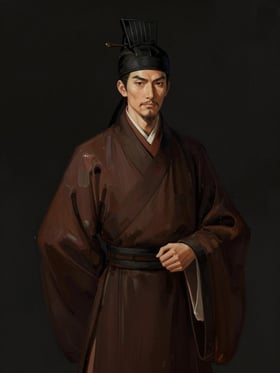
Wang Fan, an Eastern Wu court attendant, angered Sun Hao with his bluntness and was executed; he is absent from the Romance.

Life
In the Records: 3 volumes
Life228–266
265 CE (Xianxi 2)
Appearances
By chapter (3)
Records
- 58
- 61
- 65
- Eastern Wu· Undated
- Life event
- Death
List all 2 stops
- Lujiang228Birthplace
- Jianye265Sun Hao's Purge of Loyal Ministers
On the boards
Compare with someone →Where this person ranks on each board.
Historical Record
Wang Fan, courtesy name Yongyuan, was from Lujiang. He was widely read and knowledgeable, and was skilled in various arts and techniques. In his early years, he served as a Gentleman of the Secretariat, but later left office. After Sun Xiu took the throne, Wang Fan, He Shao, Xue Ying, and Yu Si were appointed Palace Attendants-in-Ordinary of the Cavalier Corps, all with the additional title of Commandant of the Imperial Son-in-Law. Public opinion at the time praised them. Wang Fan was sent on a mission to Shu Han, where the people praised him; after returning to Wu, he served as Military Supervisor at Xiakou.
In the early years of Sun Hao’s reign, Wang Fan returned to court as an Attendant, holding the same office as Wan Yu. Wan Yu had long been acquainted with Sun Hao, while Chen Sheng, Vice Director of the Central Secretariat, repeatedly slandered Wang Fan. Wang Fan was upright in character and dignified in bearing. He refused to cater to the ruler’s moods or comply with his wishes, and at times his words and actions offended Sun Hao, for which he was repeatedly reprimanded. In a memorial, Lu Kai later described him as “loyal and steadfast in court,” a pillar of the state, and pointed out that Sun Hao resented him for speaking frankly.
In the second year of Ganlu, Ding Zhong returned from a mission to the Jin state, and Sun Hao hosted a great banquet for his officials. Wang Fan became drunk and collapsed on the floor. Suspicious of him, Sun Hao ordered that he be taken out. Not long afterward, Wang Fan asked to return, though he was still drunk. Wang Fan had always been dignified and composed in his bearing. Sun Hao flew into a rage and ordered his attendants to execute him beneath the hall. Teng Mu, General Who Guards the Army, and Liu Ping, General Who Conquers the West, pleaded on his behalf but could not save him. Wang Fan was thirty-nine when he died, and his family was exiled to Guangzhou. Volume 58 of the Records of the Three Kingdoms also groups him with Lou Xuan and Li Xu, recording that after attaining high office, he was soon put to death.
In the Novel
The novel does not feature this person. The surviving novel materials contain no fictional episodes or literary portrayal of Wang Fan, so his words and actions in the novel cannot be described on that basis; nor is there any novelistic adaptation to compare with the historical biography.
Key Relationships
Wang Fan served Eastern Wu and once held the posts of Palace Attendant-in-Ordinary of the Cavalier Corps and Military Supervisor at Xiakou. He served alongside He Shao, Xue Ying, and Yu Si as a Palace Attendant-in-Ordinary, and contemporary opinion regarded them as upright men. At Sun Hao’s court, Chen Sheng repeatedly slandered him, while Wan Yu held the same office as he did. The sources record that Wang Fan refused to flatter the ruler or comply with his wishes, and repeatedly offended Sun Hao, but they do not establish as historical fact any specific dispute between Wang Fan and Wan Yu.
Lu Kai was a forthright mourner after Wang Fan’s execution. He described Wang Fan as perceptive and principled, loyal and outspoken, and condemned Sun Hao for killing him and abandoning his body because he resented his remonstrances. Lu Kai’s memorial conveys the grief Wang Fan’s death caused at court. Teng Mu and Liu Ping pleaded for him when the execution was about to take place, but ultimately could not change the outcome.
Signature Scenes
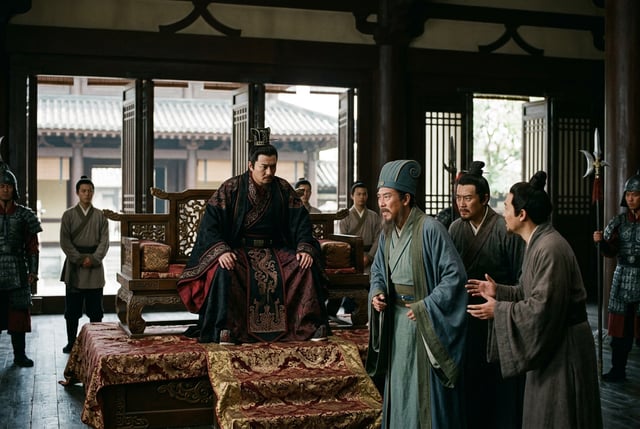
The account of Wang Fan’s death centers on suspicion at a banquet and a sudden execution: after Ding Zhong returned from his mission to Jin, Sun Hao held a banquet. Wang Fan became drunk and collapsed, and was taken away. When he asked to return, he was still drunk. Sun Hao saw that his expression and bearing remained composed, then immediately flew into a rage and ordered his execution. Teng Mu and Liu Ping’s unsuccessful pleas make the scene not only an example of Sun Hao’s violent decisiveness, but also of how Wang Fan, though a close attendant, could find no protection.
The Jiangbiao Zhuan, quoted in Pei Songzhi’s annotations, gives a different account: because shamans and historians had said that the Jianye palace was inauspicious, Sun Hao intended to travel west to Wuchang and move the capital. He therefore used a grand gathering to test his officials. He asked Wang Fan about the meaning of the classics, and Wang Fan was executed before he could answer. This account differs from the biography’s description of the banquet, Wang Fan collapsing drunk, and the circumstances of his execution. Pei Songzhi also noted contradictions in the relevant records, so the two accounts should not be conflated. Wang Fan’s death later became a key point in Lu Kai’s remonstrance: comparing Wang Fan to the ancient loyal minister Long Feng, Lu Kai argued that Sun Hao’s execution of a loyal official had grieved the people of the realm and caused those of understanding to mourn.
- Family
- Friends
- Enemies
Who is Wang Fan connected to?
Pick someone to see how many steps lie between them and Wang Fan.
Combat
On the field
Duels, kills and executions as the texts tell them, counted separately for the Records and the Romance.
- RecordsJuan 65ExecutionSun HaoLost「皓大怒,呵左右於殿下斬之」
Events
Events (1)
Battles and events the texts place this person in, by date.
Other events
- 265Sun Hao's Purge of Loyal MinistersVictim
Places
Continue
Sun Hao's Purge of Loyal Ministers
Relationship timeline1 entry ▸
History · vol. 65
- Wan Yu§4
Rival
at the beginning of Sun Hao’s reign, again entered service as a Regular Attendant and held the same office as Wan Yu; common men took offense, saying that Fan demeaned himself
Inner monologues · AI-generated1 monologue ▸
- My name was Fan, my courtesy name Yongyuan, and I was from Lujiang. In the closing years of the Han, a scholar’s standin