Eastern Wu · Crown Prince
Sun He
courtesy name 子孝 · 224–253
Not to be confused with Sun He (孙河, ?–204) — Sun He served Eastern Wu, campaigned with Sun Ce, recommended Wu Can, and was killed for pursuing Gui Lan and Dai Yuan.
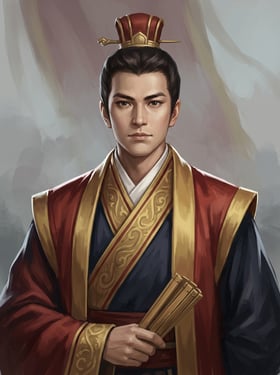
Sun He loved learning and was humble toward men of talent, respected his tutors, disliked gaming, and often grieved with anxious sorrow over his father's military expeditions.

Life
In the novel: 2 chapters · In the Records: 8 volumes
Life224–253
242 CE (Zhengshi 3)
250 CE (Jiaping 2)
Appearances
By chapter (10)
Novel
- 108
- 120
Records
- 47
- 48
- 50
- 52
- 58
- 59
- 61
- 65
- Eastern Wu· Undated
- Life event
- Death
List all 2 stops
- Jianye242–250Sun He Designated Crown Prince+3 more
- Xindu250–253Died hereSun He Deposed and Forced to Commit Suicide
On the boards
Compare with someone →Where this person ranks on each board.
Who they were
Character profile
- Character
- Sun He loved learning and was humble toward men of talent, respected his tutors, disliked gaming, and often grieved with anxious sorrow over his father's military expeditions.
- Life
- In his youth Sun He was favored because his mother, Lady Wang, enjoyed favor. In the fifth year of Chiwu he was made Crown Prince, but later, because of enmity between Lady Wang and the Princess Quan, Lady Wang died of grief, and Sun He gradually lost favor and faced deposition. In the end he was placed under confinement, later moved to Guzhang, and then enfeoffed as Prince of Nanyang and sent to Changsha. After Zhuge Ke was executed, Sun Jun stripped him of his seal and cord and moved him to Xindu, then bestowed death upon him; Sun He and his consort Lady Zhang both took their own lives. After Sun Hao ascended the throne, he was posthumously honored as Emperor Wen.
- Anecdotes
- A son of Sun Quan, once made Crown Prince, he was the natural father of Sun Hao. His wife, Lady Zhang, took her own life to follow him after Sun He's death.
Historical Record
Sun He, courtesy name Zixiao, was Sun Quan’s son and Sun Deng’s younger brother. When he was young, Sun Quan favored him because his mother, Lady Wang, was much loved. When Sun He was fourteen, Sun Quan established a palace guard for him and ordered the Director of the Secretariat, Kan Ze, to teach him the arts of writing. Sun He was eager to learn, treated worthy men with respect and humility, honored his tutors, and showed concern for scholars. In the fifth year of Chiwu (242), when he was nineteen, Sun He was named crown prince. Kan Ze became Grand Tutor, Xue Zong Junior Tutor, and Cai Ying, Zhang Chun, Feng Fu, Yan Wei, and others served in the Eastern Palace. Historical accounts say that he diligently studied and discussed the meaning of the classics and examined the abilities and conduct of court officials. When Sun Quan went on campaign, Sun He worried about the fighting and repeatedly urged his father to act with caution in order to secure complete victory.
Sun He did not simply content himself with the formalities of being heir apparent. Believing that officials’ mutual accusations would foster disorder, he once mediated a dispute between the commander Liu Bao and Ding Yan. He also opposed becoming absorbed in games of chance, arguing that one should cherish time and pursue one’s studies. He ordered the eight men attending him to each write an essay of admonition. The discourse written by Wei Zhao was composed at Sun He’s command.
His position as crown prince became caught up in the succession dispute of Sun Quan’s later years. Lady Wang and All Princess were at odds. When Sun Quan fell ill, Sun He went to make offerings at the ancestral temple, but came under suspicion after All Princess sent people to spy on him and then slandered him. After Lady Wang died of grief, Sun He gradually lost favor. Meanwhile, Sun Ba, Prince of Lu, received special favor and challenged the crown prince’s standing. Lu Xun, Wu Can, Gu Tan, and others set forth the distinction between legitimate and secondary heirs in support of the crown prince, but some were executed or exiled as a result. Sun Quan later confined Sun He. Zhu Ju, Qu Huang, and others led a group to petition for Sun He’s restoration, but they too were beaten with staves. Sun He was eventually deposed and moved to Guzhang.
In the first month of the second year of Taiyuan (252), Sun He was enfeoffed as Prince of Nanyang and moved to Changsha. Sun Quan died that same year, and Zhuge Ke took power. After Zhuge Ke was executed, Sun Jun took Sun He’s seal and ribbons of office and moved him to Xindu, then sent an envoy to order him to die. Sun He bade farewell to Consort Zhang, who said that she would share his fate, whether good or ill, and then took her own life. The people of Wu deeply mourned them. After Sun Hao Ascends the Throne, he posthumously honored his father with the title Emperor Wen. Later, Sun He was reburied at Mingling, and a settlement was established to tend his tomb.
In the Novel
Chapter 108 of Romance of the Three Kingdoms briefly introduces Sun He: he was Sun Quan’s second son, born to Lady Wang of Langya, and was named crown prince after Sun Deng. Because he was on bad terms with All Princess, he was slandered and eventually deposed, “dying in grief and resentment.” The novel compresses the complicated palace succession struggle into a straightforward sequence of cause and effect, highlighting All Princess’s slander and Sun He’s loss of position. The historical account, however, gives a more specific ending: Sun He was first moved to Guzhang, later enfeoffed as Prince of Nanyang and moved to Changsha, and then ordered to die by an envoy sent by Sun Jun. Thus, the novel’s statement that he “died in grief and resentment” is a literary summary and cannot replace the historical account of his enfeoffment, transfers, and death by order.
Chapter 120 again begins with Sun Hao Ascends the Throne, identifies Sun He as the father of Sun Hao, and records that Sun Hao posthumously honored him with the title Emperor Wen. This accords with the historical account. Here, the novel focuses on Sun Hao’s acts of honoring his family after ascending the throne, without elaborating on Sun He’s studies, remonstrances, or the Struggle of the Two Palaces during his lifetime.
Key Relationships
- Sun Quan: father and son, ruler and subject. Out of love for Lady Wang, Sun Quan cherished Sun He and named him crown prince in the fifth year of Chiwu. He later deposed him over the succession, while Sun He had repeatedly urged him to act cautiously when he went on campaign.
- Lady Wang and All Princess: key figures in the palace conflict. Lady Wang was Sun He’s mother. Historical accounts say that she and All Princess were at odds; All Princess slandered Sun He over matters including the ancestral temple offerings. Lady Wang died of grief, and Sun He consequently lost favor.
- Sun Ba: a rival of a different mother. Sun Ba was Prince of Lu and received special favor from Sun Quan, challenging the position of Crown Prince Sun He. The debate over the distinction between legitimate and secondary heirs implicated many court officials, and Sun Ba was ultimately also ordered to die.
- Consort Zhang: his wife, who stood by him to the end. Before an envoy was sent to order Sun He to die, he bade farewell to Consort Zhang. She said that she would not seek to live alone, and then took her own life.
- Sun Hao: father and son. Sun Hao was Sun He’s son. After ascending the throne, he posthumously honored Sun He with the title Emperor Wen and established Mingling for his worship.
Signature Scenes
Diligent study and admonition in the Eastern Palace. In the palace, Sun He studied and discussed the classics and consulted court officials, linking learning with governance and moral self-cultivation. He opposed wasting time on games of chance and ordered those attending him to each write an essay. Wei Zhao accordingly composed a piece at his command. This scene depicts not battlefield exploits, but the learning, encouragement of study, and concern for affairs of state that historical accounts emphasize in an heir apparent.
Petitioning beneath the Baijue Tower and the deposition. After Sun He was confined, Zhu Ju, Qu Huang, and others covered themselves in mud, bound themselves, and went to the palace gates for several days in a row to petition for his restoration as crown prince. Sun Quan climbed the Baijue Tower and saw them, but did not accept their petition. Sun He was later moved to Guzhang, while some who remonstrated were executed or exiled. This account turns the Struggle of the Two Palaces from a debate over succession into a political tragedy in which court officials risked their lives to plead, yet could not save the heir’s position.
Farewell to Consort Zhang after moving to Changsha. Sun He was first enfeoffed as Prince of Nanyang and settled in Changsha. Later, after Zhuge Ke was executed, Sun Jun had him moved and ordered to die. Consort Zhang bade him farewell and died with him, bringing the outcome of the succession struggle down to the life-and-death parting of a married couple. The novel, by contrast, reduces this long sequence to his “dying in grief and resentment” after being deposed.
Lines
- 史 ch.59 §17
「文武在事,當能幾人,因隙構簿,圖相危害,豈有福哉?」
- Family
- Lord & vassal
- Friends
- Enemies
- Teacher & student
- Other
Who is Sun He connected to?
Pick someone to see how many steps lie between them and Sun He.
History vs. novel
5 points
| History | Novel |
|---|---|
| The Crown Prince’s EducationHistory only | |
When Sun He was fourteen, Sun Quan established palace guards and ordered Kan Ze to teach him calligraphy. Sun He was eager to learn and humble toward men of talent. At nineteen, he was appointed crown prince, with Kan Ze, Xue Zong, and others serving as his assistants. vol. 59 | — |
| Concern and Remonstrance over the CampaignHistory only | |
When Sun Quan lay in wait for the Wei general Zhuge Dan, Sun He worried that his father was taking risks in the field. He repeatedly urged him to act cautiously and strive for complete victory, and was not at ease until Sun Quan returned to court. vol. 59 | — |
| Opposition to GamesHistory only | |
Sun He believed that scholars’ absorption in games could hinder their work, so he ordered the eight men attending him to each write a piece urging restraint. Wei Zhao accordingly composed the Discourse on Games. vol. 59 | — |
| Posthumous Title and ReburialNovel embellishes | |
In the year Sun Hao Ascends the Throne, Sun He was posthumously given the title Emperor Wen and reburied at Mingling, where a settlement was established to tend his tomb. vol. 59 | The novel says that after Sun Hao Ascends the Throne, he posthumously gave his father Sun He the title Emperor Wen, but it does not mention the reburial at Mingling or the establishment of a settlement. ch. 120 |
| Accession and EnfeoffmentNovel embellishes | |
After Sun Xiu died, Sun Hao Ascends the Throne, enfeoffs Sun Feng as Prince of Yuzhang, and posthumously gives Sun He the title Emperor Wen. vol. 48 | The novel likewise says that Sun Hao Ascends the Throne, enfeoffs Sun Feng as Prince of Yuzhang, and posthumously gives Sun He a title, but it also adds an era-name change and describes subsequent affairs of state. ch. 120 |
- The Crown Prince’s EducationHistory only
- History
When Sun He was fourteen, Sun Quan established palace guards and ordered Kan Ze to teach him calligraphy. Sun He was eager to learn and humble toward men of talent. At nineteen, he was appointed crown prince, with Kan Ze, Xue Zong, and others serving as his assistants.
vol. 59
- Concern and Remonstrance over the CampaignHistory only
- History
When Sun Quan lay in wait for the Wei general Zhuge Dan, Sun He worried that his father was taking risks in the field. He repeatedly urged him to act cautiously and strive for complete victory, and was not at ease until Sun Quan returned to court.
vol. 59
- Opposition to GamesHistory only
- History
Sun He believed that scholars’ absorption in games could hinder their work, so he ordered the eight men attending him to each write a piece urging restraint. Wei Zhao accordingly composed the Discourse on Games.
vol. 59
- Posthumous Title and ReburialNovel embellishes
- History
In the year Sun Hao Ascends the Throne, Sun He was posthumously given the title Emperor Wen and reburied at Mingling, where a settlement was established to tend his tomb.
vol. 59
- Novel
The novel says that after Sun Hao Ascends the Throne, he posthumously gave his father Sun He the title Emperor Wen, but it does not mention the reburial at Mingling or the establishment of a settlement.
ch. 120
- Accession and EnfeoffmentNovel embellishes
- History
After Sun Xiu died, Sun Hao Ascends the Throne, enfeoffs Sun Feng as Prince of Yuzhang, and posthumously gives Sun He the title Emperor Wen.
vol. 48
- Novel
The novel likewise says that Sun Hao Ascends the Throne, enfeoffs Sun Feng as Prince of Yuzhang, and posthumously gives Sun He a title, but it also adds an era-name change and describes subsequent affairs of state.
ch. 120
Combat
On the field
Duels, kills and executions as the texts tell them, counted separately for the Records and the Romance.
- RecordsJuan 50ExecutionSun JunLost「遣使賜死」
Events
Events (5)
Battles and events the texts place this person in, by date.
Places
- Died at
- XinduRecords
Continue
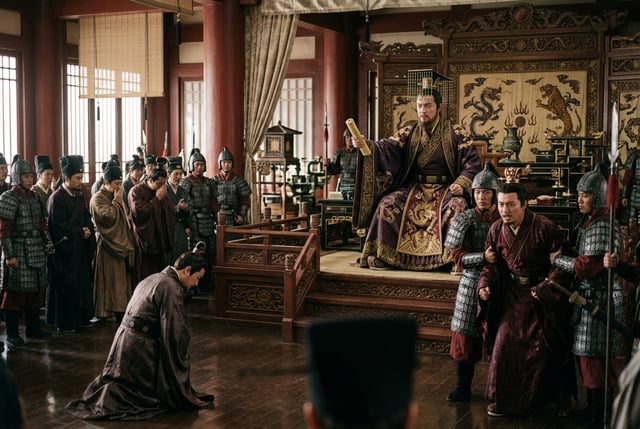
Deposition of the Crown Prince and Execution of Prince of Lu Sun Ba
Relationship timeline6 entries ▸
Inner monologues · AI-generated3 monologues ▸
- In my youth, I was favored by my mother, Lady Wang. At fourteen, I was assigned palace guards and received instruction i
- I was once crown prince and was later enfeoffed as Prince of Nanyang, then ordered to travel to Changsha. When I passed
- I was born in the palace. My mother was Lady Wang of Langya. During the Huangwu era, my mother entered the palace and wo