Sun Quan's Faction · Advisor
Kan Ze
courtesy name 德润 · –243
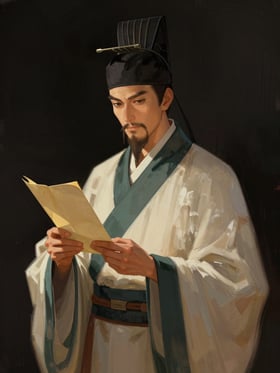
Kan Ze, a Wu Confucian from Kuaiji, was famed for scholarship and counsel; the novel adds his feigned-surrender letter.

Life
In the novel: 6 chapters · In the Records: 3 volumes
Life?–243
208 CE (Jian'an 13)
242 CE (Zhengshi 3)
- Sun Quan's Faction
- Hatched: dated by chapter
- Life event
List all 3 stops
On the boards
Compare with someone →Where this person ranks on each board.
Historical Record
Kan Ze, courtesy name Derun, was from Shanyin, Kuaiji. His family had farmed for generations. He loved learning but was poor and had no means to buy books, so he copied books for others in exchange for paper and brushes. Once he finished copying a book, he would recite it from beginning to end. He also studied and discussed texts with teachers and read widely, mastering calendrical calculations as well, and gradually earned a reputation. Later, he was recommended as a Filial and Incorruptible candidate and served successively as chief of Qiantang and magistrate of Chen. When Sun Quan held the title of General of Agile Cavalry, he summoned Kan Ze to serve as an Assistant in the Western Bureau. After Sun Quan Proclaims Himself Emperor, Kan Ze served as a Minister of the Secretariat. During the Jiahe era, Kan Ze became Director of the Central Secretariat and was additionally appointed Palace Attendant. In the fifth year of Chiwู, he was appointed Tutor to the Crown Prince while continuing to oversee the affairs of the Central Secretariat.
For his diligence in Confucian learning, Kan Ze was enfeoffed as Marquis of Duxiang. He was humble, respectful, and scrupulous in character, treating even minor officials in the palace and government with equal courtesy, and never speaking of others’ shortcomings. When the court debated difficult questions of classical interpretation, it often consulted him. Believing that the commentaries were too extensive to be used in full, he weighed the interpretations of various schools, abridged the texts of the Rites and their commentaries, and taught at the palaces of Sun Deng and Sun He. He also established protocols for entering and leaving and for receiving guests. In addition, he wrote the Commentary on the Qianxiang Calendar to correct dates and times. The political views attributed to him in historical accounts emphasize upholding ritual and law while governing with leniency. During the Lü Yi case, when some advocated the punishment of burning and dismemberment, Kan Ze argued that such a penalty should not be revived in an age of great enlightenment, and Sun Quan accepted his advice. When officials sought to impose stricter regulations and penalties, he likewise argued that matters should be handled in accordance with ritual and law.
When Sun He was fourteen, Sun Quan established a palace guard for him and ordered the Director of the Central Secretariat, Kan Ze, to teach him calligraphy. After Sun He Designated Crown Prince, Kan Ze served as his Grand Tutor. Kan Ze died in the winter of the sixth year of Chiwู. Sun Quan was deeply grieved and went several days without eating. The Records of the Three Kingdoms also records that Kan Ze personally humbled himself to seek instruction from Zhao Da, who nevertheless kept his methods secret and did not pass them on.
In the Novel
The Romance of the Three Kingdoms portrays Kan Ze as a persuasive and courageous strategist of Eastern Wu. The novel says that he was poor but studious, had once worked as a hired laborer, and borrowed books to read and recite; it also says that Sun Quan summoned him as an adviser and that he was on friendly terms with Huang Gai. These particular roles and experiences belong to the novel’s account and should not be confused with the offices recorded in historical accounts. In the Chibi story, after Huang Gai is beaten as part of the Bitter-Flesh Stratagem, Kan Ze detects Zhou Yu’s intentions from his manner and is entrusted with carrying a letter of feigned surrender to Cao Cao’s camp.
Cao Cao suspects the letter is a fraud. Even when rebuked and threatened with execution, Kan Ze remains composed. He explains that the letter gives no date because “one who betrays his lord and becomes a turncoat cannot set a fixed time,” causing Cao Cao to change his expression and apologize. This verbal duel and the feigned-surrender mission are inventions of the novel and are not recorded in the Records of the Three Kingdoms. The novel also has Kan Ze work with Gan Ning after returning to Jiangdong, pretending to be discontented in order to induce Cai Zhong and Cai He to reveal themselves and pass along information. During the preparations for the subsequent fire attack, he also helps guard the water camp and keep the two Cai brothers unsuspecting.
Before the Battle of Xiaoting, the novel has Kan Ze strongly recommend Lu Xun as Grand Commander. In the face of objections from the assembled ministers, he even stakes his entire family on the appointment, and advises Sun Quan to build an altar and bestow the commander’s tally and battle-axe according to ancient rites, so that the army would submit to Lu Xun’s orders. This recommendation of a general is likewise unique to the novel. The Records of the Three Kingdoms records Kan Ze’s Confucian learning, administrative service, and role as tutor to the crown prince, but does not say that he took part in the feigned surrender or recommended Lu Xun to command the army.
Key Relationships
- Sun Quan: Their relationship as ruler and subject is recorded in historical accounts. Sun Quan summoned Kan Ze to serve in his administration and later appointed him Director of the Central Secretariat, Grand Tutor, and to other posts. Kan Ze contributed to government with his views on ritual and law, and Sun Quan grieved deeply when he died.
- Sun He: Historical accounts say that Kan Ze taught Sun He calligraphy and later served as his Grand Tutor after Sun He became crown prince, establishing a clear teacher-student relationship.
- Huang Gai and Gan Ning: Accomplices and collaborators in the novel. At Huang Gai’s request, Kan Ze presents the letter of feigned surrender, and he works with Gan Ning to lure Cai Zhong and Cai He into revealing themselves. This set of relationships and stratagems is unique to the novel.
- Cao Cao: An adversary in the novel. The two debate face to face over the letter of feigned surrender, and Kan Ze wins Cao Cao’s trust through his quick wit. This episode is unique to the novel.
- Lu Xun: The candidate whom Kan Ze strongly recommends and vouches for in the novel, thereby persuading Sun Quan to ceremonially grant Lu Xun authority to command the army. This episode is unique to the novel.
Signature Scenes
- Using ritual and law to avert harsh punishment: During the Lü Yi case, when some advocated severe penalties, Kan Ze urged Sun Quan not to revive the punishment of burning and dismemberment in an age of great enlightenment. Sun Quan heeded him. This illustrates the compassionate yet principled character attributed to him in historical accounts.
- The verbal duel in Cao Cao’s camp: The novel has Kan Ze cross the river by night to deliver the letter to Cao Cao’s camp. Cao Cao points out the flaw that no date for the rendezvous has been set; Kan Ze counters that a feigned surrender should not specify a date, prompting Cao Cao to apologize and host him with wine. This entire confrontation is unique to the novel.
- Strongly recommending Lu Xun: In the novel, as Sun Quan hesitates in the face of the Shu army’s invasion, Kan Ze calls Lu Xun a “pillar that holds up the sky,” fit to shoulder great responsibility, and stakes his whole family on him. He then advises building an altar and bestowing the commander’s tally and battle-axe. This episode is unique to the novel.
Quotes
31 lines in the books · 3 featured
「然則公之受責,莫非苦肉計乎?」
This line sees through Zhou Yu's Bitter-Flesh Stratagem, displaying Kan Ze's discernment.
「殺便殺,何必多問!」
Facing Cao Cao's threats, Kan Ze shows no fear, highlighting his loyalty and courage.
「昔日東吳大事,全任周郎;後魯子敬代之;子敬亡後,決於呂子明;今子明雖喪.見有陸伯言在荊州。此人名雖儒生,實有雄才大略,以臣論之;不在周郎之下;前破關公,其謀皆出於伯言。主上若能用之,破蜀必矣。如或有失,臣願與同罪。」
Strongly recommending Lu Xun, showing that Kan Ze knew men and employed them well, with a far-reaching impact on Eastern Wu's development.
- Friends
- Enemies
- Teacher & student
- Other
Who is Kan Ze connected to?
Pick someone to see how many steps lie between them and Kan Ze.
History vs. novel
8 points · 5 novel-only
| History | Novel |
|---|---|
| Poverty and Diligent StudyNovel embellishes | |
Kan Ze came from a poor family and loved learning. He earned paper and brushes by copying books for others; once he finished copying a text, he could recite it fluently. He also visited teachers and friends far and wide, studied a wide range of books, and was versed in calendrical calculations vol. 53 | The novel also portrays him as poor and devoted to learning, doing manual labor and borrowing books to read. It further adds that he had an exceptional memory, was quick-witted, and possessed unusual courage ch. 47 |
| Recommending Lu XunNovel only | |
| — | Before the Battle of Xiaoting, Kan Ze strongly recommended Lu Xun as grand commander, saying his abilities were no less than Zhou Yu's, and staking his entire family's lives on the recommendation. Sun Quan accepted his advice ch. 83 |
| Huang Gai's Bitter-Flesh StratagemNovel only | |
| — | After Huang Gai was punished, Kan Ze recognized that it was the Bitter-Flesh Stratagem. Huang Gai then revealed his feigned surrender plan to him and asked him to deliver the letter of surrender ch. 46 |
| Delivering a False Surrender Letter to Cao Cao's CampNovel only | |
| — | Disguised as a fisherman, Kan Ze went to Cao Cao's camp by night. Even when challenged by Cao Cao, he calmly defended himself, explaining why the false surrender letter specified no date, and ultimately won Cao Cao's trust ch. 47 |
| Contacting the Cai BrothersNovel only | |
| — | The novel says that after returning to Jiangdong, Kan Ze made contact with Gan Ning and took advantage of Cai Zhong and Cai He's feigned surrender to pass on information, further winning Cao Cao's trust ch. 47 |
| Advising Against Capturing Guan YuNovel only | |
| — | Lu Su arranged a banquet to lure Guan Yu to attend. Kan Ze urged Sun Quan not to act rashly, warning that Guan Yu was a tiger of a warrior and that, if the plan failed, they might suffer at his hands instead. Sun Quan did not heed him ch. 66 |
| Advising Against the Burning-and-Dismemberment PunishmentHistory only | |
After Lü Yi's crimes were exposed, someone suggested subjecting him to the punishment of burning and dismemberment. Kan Ze argued that this punishment should not be revived in an age of peace and enlightened rule, and Sun Quan followed his advice vol. 53 | — |
| Revising the Rites and Instructing the Two PrincesHistory only | |
Kan Ze edited and revised the text of the Book of Rites and commentaries by various scholars, and taught the crown prince Sun Deng and the Prince of Lu, Sun Ba. He also established rules of daily conduct and guest protocol for the two palaces vol. 53 | — |
- Poverty and Diligent StudyNovel embellishes
- History
Kan Ze came from a poor family and loved learning. He earned paper and brushes by copying books for others; once he finished copying a text, he could recite it fluently. He also visited teachers and friends far and wide, studied a wide range of books, and was versed in calendrical calculations
vol. 53
- Novel
The novel also portrays him as poor and devoted to learning, doing manual labor and borrowing books to read. It further adds that he had an exceptional memory, was quick-witted, and possessed unusual courage
ch. 47
- Recommending Lu XunNovel only
- Novel
Before the Battle of Xiaoting, Kan Ze strongly recommended Lu Xun as grand commander, saying his abilities were no less than Zhou Yu's, and staking his entire family's lives on the recommendation. Sun Quan accepted his advice
ch. 83
- Huang Gai's Bitter-Flesh StratagemNovel only
- Novel
After Huang Gai was punished, Kan Ze recognized that it was the Bitter-Flesh Stratagem. Huang Gai then revealed his feigned surrender plan to him and asked him to deliver the letter of surrender
ch. 46
- Delivering a False Surrender Letter to Cao Cao's CampNovel only
- Novel
Disguised as a fisherman, Kan Ze went to Cao Cao's camp by night. Even when challenged by Cao Cao, he calmly defended himself, explaining why the false surrender letter specified no date, and ultimately won Cao Cao's trust
ch. 47
- Contacting the Cai BrothersNovel only
- Novel
The novel says that after returning to Jiangdong, Kan Ze made contact with Gan Ning and took advantage of Cai Zhong and Cai He's feigned surrender to pass on information, further winning Cao Cao's trust
ch. 47
- Advising Against Capturing Guan YuNovel only
- Novel
Lu Su arranged a banquet to lure Guan Yu to attend. Kan Ze urged Sun Quan not to act rashly, warning that Guan Yu was a tiger of a warrior and that, if the plan failed, they might suffer at his hands instead. Sun Quan did not heed him
ch. 66
- Advising Against the Burning-and-Dismemberment PunishmentHistory only
- History
After Lü Yi's crimes were exposed, someone suggested subjecting him to the punishment of burning and dismemberment. Kan Ze argued that this punishment should not be revived in an age of peace and enlightened rule, and Sun Quan followed his advice
vol. 53
- Revising the Rites and Instructing the Two PrincesHistory only
- History
Kan Ze edited and revised the text of the Book of Rites and commentaries by various scholars, and taught the crown prince Sun Deng and the Prince of Lu, Sun Ba. He also established rules of daily conduct and guest protocol for the two palaces
vol. 53
Combat
On the field
Duels, kills and executions as the texts tell them, counted separately for the Records and the Romance.
Stratagems
Plans this person devised or saw through, as the texts tell them.
- Romance
- 1 carried out · 1 worked · 0 turned down · 0 seen through
- RomanceFeign Surrender to Lure the Two Cai BrothersDeceptionWorkedagainst Cao forcesCh. 47「二蔡即時寫書,密報曹操,說甘寧與某同為內應」
Events
Events (6)
Battles and events the texts place this person in, by date.
Battles
Other events
- 200Sun Quan Succeeds to Power
- 208Bitter-Flesh StratagemAdvisor
- 242Sun He Designated Crown PrinceAdvisor
Places
Continue
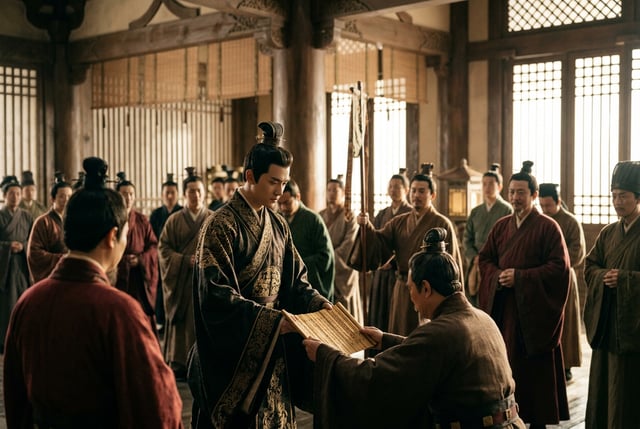
Sun He Designated Crown Prince
Relationship timeline8 entries ▸
History · vol. 53
- Sun Deng§26
Student
In the fifth year of Chiwu, was appointed Grand Tutor to the Crown Prince
Novel · ch. 46
- Huang Gai§57
Friend
At night entered the bedchamber, saw through the Bitter-Flesh Stratagem, and gladly agreed to present Huang Gai’s false-surrender letter.
Novel · ch. 47
Friend
At Huang Gai's request, readily agreed to take a letter of feigned surrender to the north bank for him; they were as close as flesh and blood
- Cao Cao§2
Witnessed
went to the north bank by night and presented a false surrender letter; Cao Cao initially suspected deception, but he countered him with eloquent arguments, and Cao Cao changed countenance, left his seat, and apologized
- Gan Ning§10
Friend
After returning from Cao Cao’s camp, went to Gan Ning’s camp and feigned lamenting that Gan Ning had been humiliated by Zhou Gongjin for saving Huang Gai, drawing the Cai clan into the open
- Cao Cao§13
Witnessed
Composed a secret letter at Gan Ning’s camp and sent a messenger to secretly inform Cao Cao that Huang Gai’s arriving ships would use blue-toothed flags as their signal
Novel · ch. 66
- Sun Quan§5
Advised
At Duan 5, advised, “Guan Yunchang is a tiger general of this age”; feared things would not go smoothly
Novel · ch. 83
- Lu Xun§24
Advised
Strongly recommended Lu Xun as Grand Commander and was willing to stake his entire family on him
Inner monologues · AI-generated3 monologues ▸
- Looking back on my life at this moment, I often think of how poor my family was when I was young. For generations we had
- By the wavering lamplight in the tent, Cao Cao turned Huang Gongfu’s letter over and over more than ten times. Suddenly
- I remember that when I was young, my family lived in Shanyin, Kuaiji. We were of humble status and had little to spare f