Overview
Chibi is a place along the Yangtze River in Jiangxia, Jing Province, during the Eastern Han dynasty. It is generally identified with the south bank of the river at Chibi Town, northwest of present-day Chibi City in Hubei Province. In the thirteenth year of Jian’an (208), after Cao Cao marched south into Jing Province, he advanced eastward along the river and met the allied forces of Sun Quan and Liu Bei at Chibi. He was soundly defeated and retreated north, allowing Liu Bei to take control of the commanderies south of the Yangtze in Jing Province. After this battle, the division of the realm into three powers began to take shape.
History
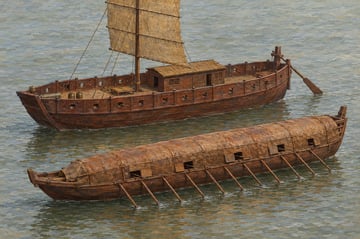
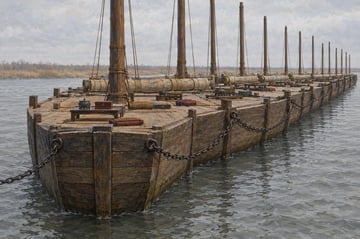
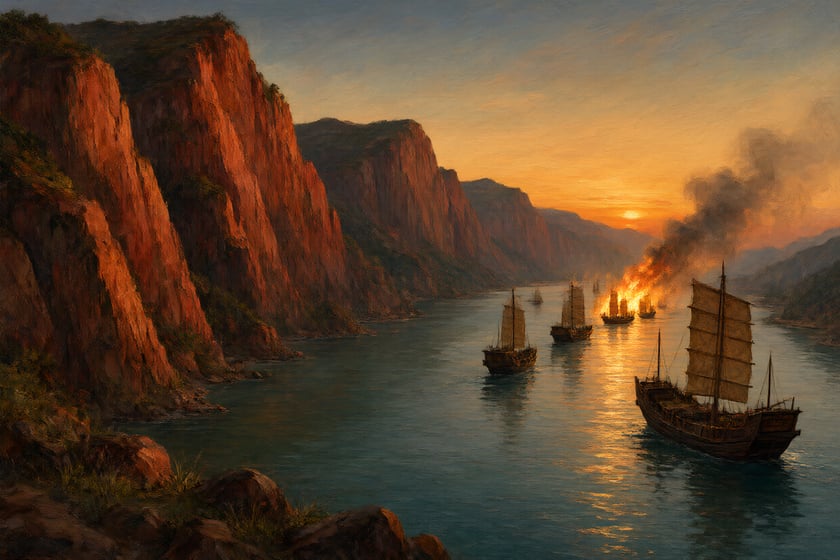
In the thirteenth year of Jian’an (208), Cao Cao seized Jing Province, and Liu Bei retreated south to Xiakou, sending Zhuge Liang to meet Sun Quan. Sun Quan appointed Zhou Yu and Cheng Pu as left and right commanders, each leading ten thousand men, and they advanced together with Liu Bei to meet Cao Cao’s army at Chibi. At the time, disease had already broken out among Cao Cao’s troops. They were defeated in their first engagement and withdrew to the north bank of the Yangtze, while Zhou Yu and the others encamped on the south bank. Zhou Yu’s subordinate Huang Gai observed that Cao Cao’s ships were linked together bow to stern and proposed a fire attack. He took several dozen mengchong and doujian ships, loaded them with firewood and soaked them in oil, then first wrote to Cao Cao pretending to surrender. When the time came, the ships set off together; driven by a fierce wind, the flames spread all the way to the shore camps. Many of Cao Cao’s men and horses burned or drowned, and his forces had no choice but to retreat and hold Nan Commandery. The Pei commentary, citing the Jiangbiao zhuan, says that on the day of battle a strong southeast wind was blowing. Huang Gai’s ships were more than two li from the northern army when they all set fire at once and sped toward it like arrows, burning the northern fleet to the ground.
Cao Cao’s side gives a different account: the Records of the Three Kingdoms, “Biography of Emperor Wu,” says only that he reached Chibi, fought Liu Bei without success, and then suffered a major epidemic in which many officials and soldiers died, so he withdrew his army. The Pei commentary, citing the Shanyang gong zaiji, says that after Cao Cao’s ships were burned, he retreated on foot via Huarong Road. The road was muddy, and cavalry could pass only after weak soldiers carried grass to fill it. In a letter to Sun Quan afterward, Cao Cao said that the battle at Chibi had been caused by disease in his army; he had burned his own ships and withdrawn, allowing Zhou Yu to win fame for nothing. Pei Songzhi’s assessment of the defeat was that it was mainly caused by a severe epidemic, with the southern wind helping the fire. After the battle, the Sun-Liu allied forces advanced by both land and water and pursued Cao Cao’s army to Nan Commandery. Cao Cao left Cao Ren and others to defend Jiangling, then returned north himself.
People
- Zhou Yu: The commander-in-chief appointed by Sun Quan and the leader of the forces at Chibi.
- Cheng Pu: Served alongside Zhou Yu as left and right commander. His biography says that he “defeated Cao Cao at Wulin,” then attacked Nan Commandery and drove out Cao Ren.
- Huang Gai: A subordinate of Zhou Yu who proposed the fire attack and pretended to surrender to Cao Cao. The Pei commentary, citing the Wu shu, says that he was struck by a stray arrow during the battle and fell into the water. When Wu troops rescued him, no one recognized him; he shouted with all his strength for Han Dang, and was then recognized and saved.
Differences Between History and Fiction
The Romance of the Three Kingdoms elaborates on the Battle of Red Cliffs and adds many episodes not recorded in the Records of the Three Kingdoms. In the novel, Zhuge Liang promises to make one hundred thousand arrows in three days, then takes twenty straw boats through the fog toward Cao Cao’s camp to “borrow arrows”. The Pei commentary to the Records of the Three Kingdoms, “Biography of the Wu Ruler,” citing the Weilüe, describes a different incident: during the Battle of Ruxu in the eighteenth year of Jian’an (213), Sun Quan went out in a large ship to observe Cao Cao’s army. When arrows struck one side of the ship and made it list, he turned it around so the other side would take the arrows; once the ship was level again, he returned. The novel also says that Zhuge Liang built an altar on Nanpingshan to perform a rite and summon a southeast wind for three days and nights, and has Liu Bei send Zhao Yun to meet him on the south bank. The Records of the Three Kingdoms says only that the wind was fierce at the time; the Pei commentary, citing the Jiangbiao zhuan, says that a strong southeast wind was blowing. The wind-summoning rite is a fictional episode. Huang Gai’s beating as part of the Bitter-Flesh Stratagem appears only in the novel; in the Records of the Three Kingdoms, Huang Gai simply writes a letter pretending to surrender. The novel also says that during the fire attack, Han Dang and Jiang Qin attacked Cao Cao’s forces from the west of Chibi, while Zhou Tai and Chen Wu attacked from the east.
Today
Chibi is generally identified with the south bank of the Yangtze at Chibi Town, northwest of present-day Chibi City in Xianning, Hubei Province. In 1998, Puqi City was renamed Chibi City. The local Three Kingdoms Chibi Ancient Battlefield scenic area has the characters “Chibi” engraved on a riverside cliff. Other proposed locations include Jiayu and Wuchang. “Dongpo Chibi” in Huanggang, Hubei, was named after Su Shi’s poetry and writings and was not the battlefield of that time.