Overview
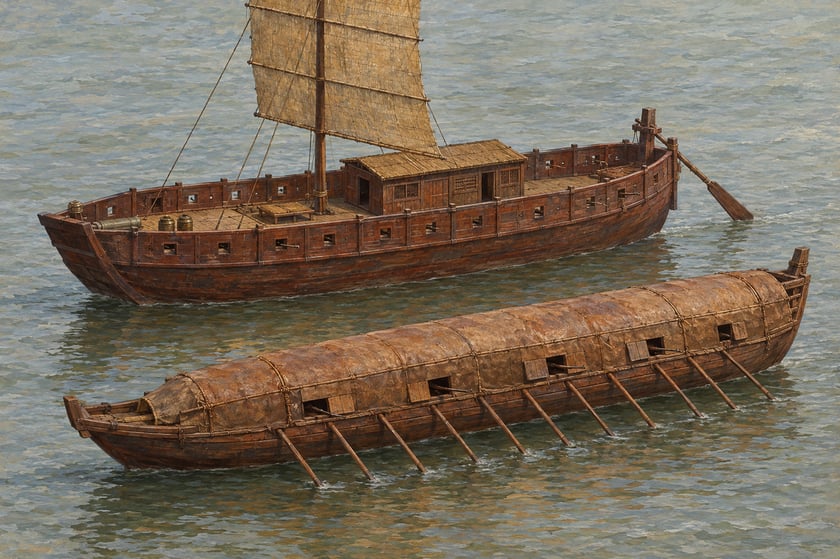
Mengchong and Doujian Warships were types of warship used in river warfare in the late Han, rather than a single vessel. The Records of the Three Kingdoms calls them “Mengchong” and “Doujian,” often referred to together as “Mengchong and Doujian Warships”. Romance of the Three Kingdoms generally writes the name as “mengchong (艨艟),” as seen in chapters 38, 44, 45, 47, 48, and 49. The Mengchong appearing in the two works are used by commanders on different sides and do not belong to any one individual.
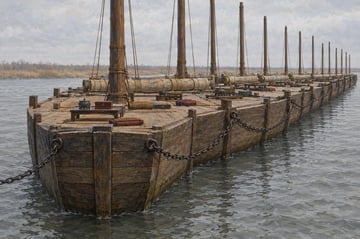
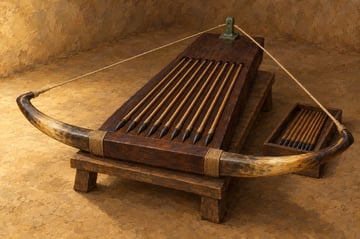
According to the Records of the Three Kingdoms, the two Mengchong with which Huang Zu defended Miankou were anchored with stones secured by thick palm-fiber ropes, and carried a thousand men who fired crossbows in intersecting volleys; the Mengchong and Doujian Warships and other vessels commanded by He Qi “looked like mountains from afar”. Romance of the Three Kingdoms describes each Mengchong at Miankou as equipped with more than a thousand powerful bows and heavy crossbows.
Notable Episodes
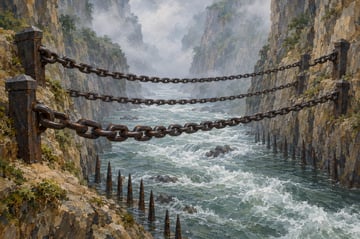
In Jian'an 13 (208), Sun Quan campaigned against Huang Zu, who stationed two Mengchong across Miankou to defend it. Dong Xi and Ling Tong led the vanguard between the Mengchong, and Dong Xi personally cut their mooring ropes. Sun Quan called this “the merit of cutting the mooring ropes,” an episode recounted in Dong Xi Cuts the Chain and Breaks the Mengchong.
In the ninth month of Jian'an 13 (208), Cao Cao entered Jing Province. When Sun Quan's subordinates debated surrender, they said that the naval forces governed by Liu Biao had numbered thousands of Mengchong and Doujian Warships, all of which Cao Cao had launched onto the river, advancing by both water and land.
During the standoff at Chibi, Huang Gai, a subordinate of Zhou Yu, took several dozen Mengchong and Doujian Warships, filled them with firewood and dry grass, doused them with oil, covered them with curtains, and raised command flags above them for a feigned surrender and fire attack. This episode forms part of the Battle of Red Cliffs. He also prepared zouge, another type of small, swift boat, and tied them behind the large ships.
When the Wei army advanced in force from Hengjiang, Xu Sheng sailed out in a Mengchong to engage it. A violent wind drove his ship beneath the enemy-held bank. The other commanders were afraid, but Xu Sheng alone led his troops ashore to attack, and the enemy retreated.
He Qi's fleet presented such an imposing spectacle that Cao Xiu and the others grew fearful and withdrew their troops.
In Romance of the Three Kingdoms, when Zhang Zhao advocates surrender, he says of Cao Cao's fleet, “His Mengchong warships number far more than hundreds or thousands”. Pang Tong accompanies Cao Cao to inspect the naval camp and sees twenty-four gates facing south, all lined with Mengchong warships forming walls, with small boats concealed within. Standing on a hilltop, Zhou Yu looks across at the neatly arrayed Mengchong warships on the river to the north. In chapter 49, on the night of the fire attack at Chibi, Zhou Yu and Cheng Pu direct the fighting from a large Mengchong.
History and the Romance
The two works agree on the broad course of the battle at Miankou but differ in detail. The Records of the Three Kingdoms recorded that Dong Xi and Ling Tong led the vanguard, and that Dong Xi personally cut the two mooring ropes with his blade. In chapter 38 of Romance of the Three Kingdoms, Huang Zu's vanguard commanders Chen Jiu and Deng Long each lead a squadron of Mengchong to block Miankou, securing them on the water with thick ropes. Gan Ning selects more than a hundred small boats, each carrying fifty picked soldiers, and heads straight for the Mengchong to cut the thick ropes, leaving the Mengchong swinging across the water. The men who cut the ropes are unnamed soldiers rather than Dong Xi; Gan Ning then leaps aboard a Mengchong and kills Deng Long. In the novel, this episode belongs to the Battle of Jiangxia.
Scholarship
According to the Eastern Han writer Liu Xi's Shiming, “A vessel narrow and long in its outer form is called a chong, for it charges into enemy ships.” Du You's Tongdian, in its section on military affairs, states that Mengchong had their upper hulls covered with raw oxhide, with oar ports on both sides and crossbow windows and spear openings at the front, rear, left, and right, so that enemies could not approach and arrows and stones could not damage them.