Overview
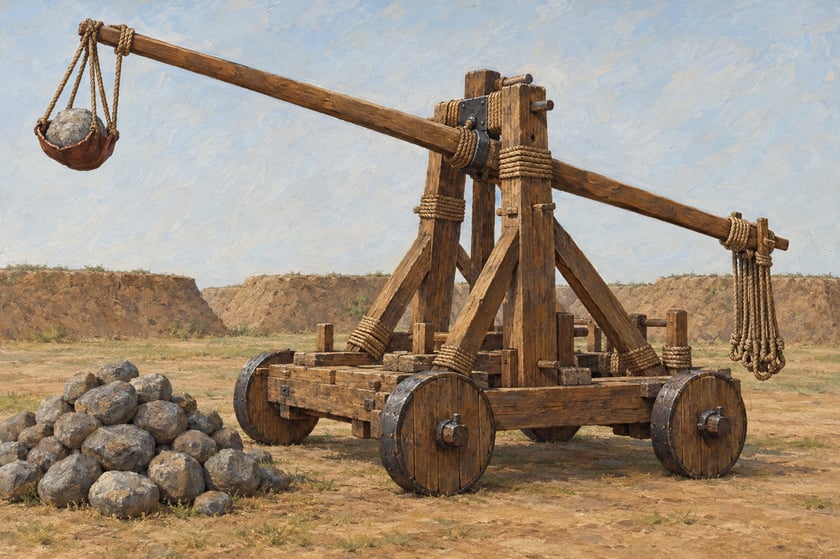
The Thunder Carriage was a device for hurling stones at the enemy, originally called a stone-throwing carriage. Records of the Three Kingdoms records that Cao Cao built stone-throwing carriages during his standoff with Yuan Shao at Guandu. They smashed Yuan Shao’s siege towers, and Yuan Shao’s troops called them “Thunder Carriages”. Chapter 30 of Romance of the Three Kingdoms also recounts this episode, with Yuan Shao’s troops likewise naming them “Thunder Carriages”.
Origins
According to Records of the Three Kingdoms, Yuan Shao’s army advanced on Guandu, built tall siege towers, and raised earthen mounds from which to shoot arrows into Cao Cao’s camp. The officers and soldiers in the camp all held shields over their heads and were greatly afraid, so Cao Cao built stone-throwing carriages. Pei Songzhi’s commentary quotes Weishi chunqiu as saying that ancient texts spoke of arrows and stones, and also contained the phrase “When the kuai moves, beat the drums.” Since Shuowen defined “kuai” as a stone-hurling device, stone-throwing carriages were built.
In Romance of the Three Kingdoms, Yuan Shao follows a plan to build more than fifty earthen mounds topped with tall siege towers from which to shoot into the camp—the stratagem of firing on the camp from earthen mounds—and Shen Pei’s archers and crossbowmen cover the key routes through Cao Cao’s camp. Cao Cao gathers his advisers to seek a plan, and Liu Ye proposes building stone-throwing carriages and presents a design. Following this design, Cao Cao has several hundred built overnight and positions them inside the camp walls, directly opposite the earthen mounds.
Notable Episodes
During the Battle of Guandu, Cao Cao’s stone-throwing carriages struck Yuan Shao’s siege towers and destroyed them all, thwarting Yuan Shao’s plan to fire into the camp from earthen mounds and tall towers. In Romance of the Three Kingdoms, the stone-throwing carriages inside the camp are hauled into action together, sending stones flying through the air. The archers on the earthen mounds have nowhere to hide, and countless men are killed.
In Jingchu 2 (238), when Sima Yi (called “Prince Xuan of Sima” in this passage) campaigned against Gongsun Yuan, the Wei army besieged Xiangping. After the rain stopped, they raised earthen mounds and built siege towers, then fired stones and repeating crossbows into the city, leaving Gongsun Yuan in desperate straits.
In Ganlu 3 (258), Zhuge Dan, Wen Qin, and Tang Zi built large numbers of siege engines and attacked the Wei army’s southern siege lines day and night. From their elevated positions along the lines, the Wei troops used stone-throwing carriages and fire arrows to burn and destroy the attackers’ siege engines.
Pei Songzhi’s commentary quotes Fu Xuan’s “Preface,” which records that Ma Jun found fault with stone-throwing carriages because their stone projectiles could be blocked and knocked down by wet oxhides hung beside enemy towers, and because they could not fire continuously. He conceived of suspending several dozen large stones from a single wheel and using a mechanism to turn it and launch them in succession. He only tested the idea by suspending tiles and bricks from a cartwheel, sending them flying several hundred bu. Cao Shuang (called “Marquis of Wu’an” in this passage) paid it no attention, and no prototype was ever built.
History and the Romance
The two books agree that the carriages were built at Guandu, but differ over who proposed them: Romance of the Three Kingdoms has Liu Ye suggest the plan and present a design, while the main text of Records of the Three Kingdoms says only, “Taizu then built stone-throwing carriages”. The Records does not record the episode in which Liu Ye proposes the plan and presents a design. In chapter 10 of the Romance, the thunder in “A thunderclap bursts open his coffin” is actual thunder and has no connection with this carriage.
Scholarship
According to later scholarship, a traction trebuchet used people pulling ropes attached to one end of a lever to launch a stone projectile from a sling at the other end. The Mohists probably used such devices as early as the fourth century BCE, and they are described in Mozi.