Overview
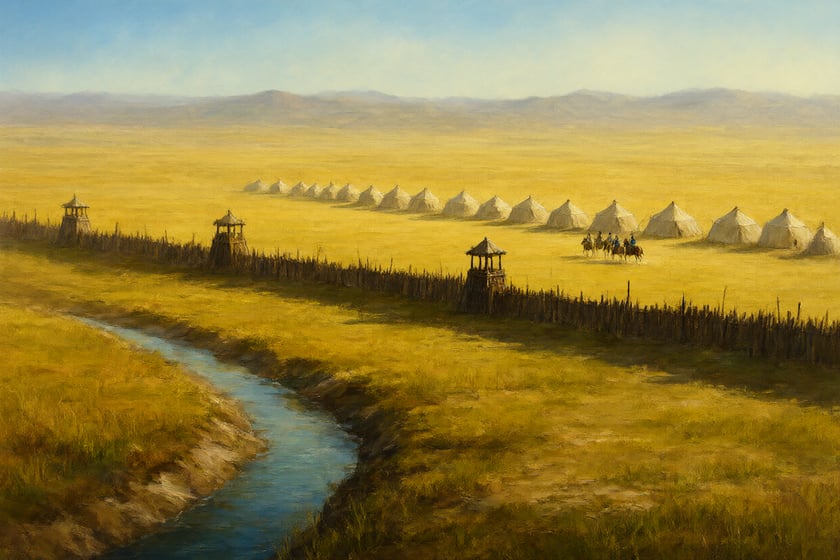
Guandu was an important crossing south of the Yellow River and north of Xu County in the late Eastern Han. Its former site lies in the area around present-day Guandu Town, northeast of Zhongmu County, Zhengzhou, Henan Province, and the place name remains in use today. In the fourth year of Jian’an (199), after Yuan Shao annexed Gongsun Zan’s territory and took control of four provinces, he prepared to march south and attack Xu. Cao Cao accordingly divided his forces to defend Guandu, and in the twelfth month personally led a large army to take up position there. The following year, the two armies faced off at Guandu. The confrontation ended in a great victory for Cao Cao and is known to history as the Battle of Guandu.
History
Beginning in the second month of the fifth year of Jian’an (200), Yuan Shao first sent Yan Liang to attack Baima. Cao Cao rode north to its relief and successively killed Yan Liang and Wen Chou at Baima and Yanjin, then returned with his army to Guandu, while Yuan Shao advanced and fortified his position at Yangwu. Before Yuan Shao crossed the river, Ju Shou urged him to remain stationed at Yanjin and send only part of his forces to Guandu, but Yuan Shao would not listen.
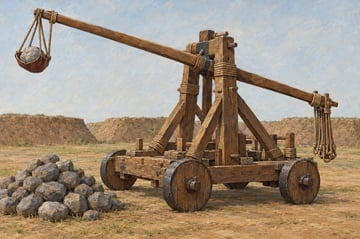
In the eighth month of that year, Yuan Shao’s encampments gradually advanced, following the sand dunes and stretching for dozens of li from east to west. Cao Cao likewise established opposing camps, but the fighting went against him. Yuan Shao pressed close to Guandu, built earthen mounds and dug tunnels, and shot arrows down into Cao Cao’s camp from elevated positions, forcing everyone moving about inside to carry shields overhead. Cao Cao’s forces also built earthen mounds and dug deep trenches inside their camp to counter them, and constructed stone-throwing engines that destroyed the tall watchtowers of Yuan Shao’s army, which called them “thunderclap carts”. At the time, Cao Cao had fewer than ten thousand troops, two or three out of every ten of them wounded, and little food. He once wrote to Xun Yu, intending to retreat to Xu County. Xun Yu argued that Yuan Shao had concentrated his entire army at Guandu, making this a crucial moment for deciding the fate of the realm, and urged him to hold fast. Cao Cao followed his advice. During the fighting, Ren Jun oversaw military equipment and grain transport. Because Yuan Shao’s forces repeatedly raided the supply routes, Ren Jun organized the transport carts into units of a thousand, sent them forward along ten separate routes, and protected them with two rows of encampments, keeping the enemy at a distance.
In the tenth month, Yuan Shao sent Chunyu Qiong and others with more than ten thousand men north to meet the grain transport carts, and they camped at Wuchao. Cao Cao adopted Xu You’s plan, leaving Cao Hong to defend the main camp at Guandu while he personally led five thousand infantry and cavalry on a night raid against Wuchao. They burned all the grain and killed Chunyu Qiong and the others. Yuan Shao took the opportunity to send Zhang He and Gao Lan to attack the main camp defended by Cao Hong. When the two heard that Wuchao had fallen, they led their men over to Cao Cao. Yuan Shao’s army promptly collapsed, and Yuan Shao and his eldest son Yuan Tan abandoned the army and fled north across the river. Cao Cao seized all their baggage, documents, and valuables. Afterward, many commanderies in Jizhou surrendered, city by city.
Figures
- Cao Cao: He personally led his troops to Guandu in the winter of the fourth year of Jian’an, then faced off against Yuan Shao there for nearly a year before ultimately defeating him.
- Cao Hong: When Cao Cao launched his night raid on Wuchao, Cao Hong remained behind to defend the main camp at Guandu. Zhang He and Gao Lan attacked, but came over to Cao Cao after hearing that Wuchao had fallen.
- Xun Yu: From the rear, he wrote back to dissuade Cao Cao from retreating.
- Ren Jun: He oversaw military equipment and grain transport, preserving the supply line to the main camp at Guandu.
- Ju Shou: A strategist serving Yuan Shao, he repeatedly advised him to favor a prolonged campaign rather than rushing into battle, but Yuan Shao never took his advice.
Differences in Historical and Fictional Accounts
In Romance of the Three Kingdoms, when Cao Cao returned to Xu, he ordered Cao Ren to take overall command of the army and station it at Guandu. The Records of the Three Kingdoms merely states that Cao Cao returned to Xu and divided his forces to defend Guandu; it does not say that Cao Ren led them. The novel also says that after Yan Liang and Wen Chou were killed, Cao Cao ordered Xiahou Dun to hold the pass at Guandu while he returned in triumph to Xu to celebrate. The Records of the Three Kingdoms, by contrast, says that Cao Cao returned with his army to Guandu at this point. The novel attributes the strategy of building earthen mounds and shooting into Cao Cao’s camp to Shen Pei, and describes Guandu as a pass on the route to Xu Chang; the Records of the Three Kingdoms only records that Yuan Shao built earthen mounds. The novel also says that in the first month of spring in the eighth year of Jian’an (203), Cao Cao again led a large army to encamp at Guandu. The “Annals of Emperor Wu” in the Records of the Three Kingdoms instead records that Cao Cao advanced to Guandu in the spring of the seventh year of Jian’an (202), when Yuan Shao was still alive. The novel further says that when Cao Cao turned his forces toward Jing Province, he ordered Cao Hong to lead troops to defend Guandu.