Cao Wei · General of Swift Cavalry
Cao Hong
courtesy name 子廉 · –232
Not to be confused with Cao Hong (曹宏) — Cao Hong was a Xu Province official appointed by Tao Qian; the Records of the Three Kingdoms calls him a slanderous petty man, but the Romance omits him.
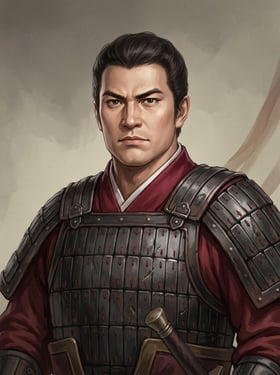
Cao Hong was practiced with horse and troops and accomplished in the martial arts. He once risked his own life to shield his lord, saying, "The realm may do without Hong, but it cannot do without you, my lord." Cao Hong was impatient by temperament; Cao Ren once appraised him, saying, "Hong is hasty by nature—I truly fear he will botch the matter."

Life
In the novel: 28 chapters · In the Records: 10 volumes
Life?–232
189 CE (Zhongping 6)
196 CE (Jian'an 1)
201 CE (Jian'an 6)
- Battle of CangtingCangtingWarrior
4 more events
208 CE (Jian'an 13)
- Battle of JianglingJianglingWarrior
- Burning of XinyeXinyeWarrior
209 CE (Jian'an 14)
- Gan Ning Holds YilingYilingWarrior
210 CE (Jian'an 15)
211 CE (Jian'an 16)
220 CE (Huangchu 1)
Allegiance
- Cao Wei
- Hatched: dated by chapter
- Life event
List all 9 stops
- Chenliu189Cao Cao Raises an Army
- Xuchang196Cao Cao Escorts the Emperor and Moves the Capital to Xu
- Cangting201Battle of Cangting
- Xinye208Burning of Xinye
- Jiangling208Battle of Jiangling
- Yiling209Gan Ning Holds Yiling
- Ye210Bronze Bird Terrace Inauguration Ceremony
- Tong Pass211Xu Chu Fights Ma Chao Bare-Chested
- Luoyang220Cao Cao Dies and Emperor Wen of Wei Ascends the Throne
On the boards
Compare with someone →Where this person ranks on each board.
10 more boards
- Most Executions Ordered: #23of 42Romance
- Most Foes Defeated: #23of 78Romance
- Most Advisors: #31of 98Records
- Most Battles: #32of 230Both
- Plans That Worked: #55of 159Romance
- Best Connected: #60of 1005Romance
- Novel Embellished: #63of 2137Both
- Master Strategists: #79of 220Romance
- Most Talkative: #88of 607Romance
- Overlooked by the Novel: #800of 2137Both
Who they were
Character profile
- Character
- Cao Hong was practiced with horse and troops and accomplished in the martial arts. He once risked his own life to shield his lord, saying, "The realm may do without Hong, but it cannot do without you, my lord." Cao Hong was impatient by temperament; Cao Ren once appraised him, saying, "Hong is hasty by nature—I truly fear he will botch the matter."
- Life
- Cao Hong was Cao Cao's younger cousin, who in his early years raised troops and joined up with Cao Cao. He repeatedly followed the army on campaign, was appointed Colonel Who Displays Hawk-like Might, promoted to General of the Household Who Displays Martial Prowess, and later rose to General of Agile Cavalry. Though his household was wealthy, Cao Hong was miserly by nature, and was once imprisoned when a retainer he had sheltered broke the law, after which he was dismissed from office and stripped of his title. After Emperor Ming ascended the throne, Cao Hong was reinstated as General of Agile Cavalry, and died in the sixth year of Taihe with the posthumous title Marquis Gong.
- Weapons
- saber
- Anecdotes
- Cao Hong was Cao Cao's younger cousin, and at the defeat at Xingyang he yielded his horse to save Cao Cao. He was left to guard Guandu, and at first doubted Zhang He when he came to surrender. Cao Hong was a noble kinsman of the imperial house; when his retainer broke the law, Man Chong once arrested and prosecuted him.
Historical Record
Cao Hong, courtesy name Zilian, was a younger cousin of Cao Cao. When Cao Cao Raises an Army to campaign against Dong Zhuo, he was defeated at Xingyang. His horse was injured, and pursuers were closing in. Cao Hong dismounted and offered him his horse. Cao Cao declined, but Cao Hong replied, “The world can do without Hong, but it cannot do without you.” He then followed on foot, found a boat along the Bian River, and crossed the river with Cao Cao to escape danger. Afterward, he recruited troops and joined Cao Cao with his forces. When Zhang Miao welcomed Lü Bu into his rebellion, Cao Hong first occupied Dongping and Fan, gathering provisions to supply the army. He later fought in many places and, for his achievements, was appointed positions including Commandant of the Eagle’s Yang and General of the Martial Yang.
Cao Hong repeatedly took on military duties. When Cao Cao went to receive Emperor Xian of Han, he once sent Cao Hong west with troops to welcome the emperor, but Chang Nu, a subordinate of Yuan Shu, blocked his advance by holding a strong position. During the Battle of Guandu, Cao Cao left Cao Hong to guard the camp while he launched a night raid on Wuchao. When Zhang He and Gao Lan surrendered, Cao Hong was initially suspicious, but accepted the two after heeding Xun You’s advice. Later, when Liu Bei sent Zhang Fei, Ma Chao, and Wu Lan to garrison Xiabian, Cao Hong was ordered to resist them. He defeated Wu Lan and killed his general Ren Kui and others, after which Zhang Fei and Ma Chao withdrew to Hanzhong.
Cao Hong was wealthy but miserly. When Cao Pi was young, he once asked Cao Hong to lend him silk, and held a grudge when his request was not granted. After Cao Pi took the throne, Cao Hong was imprisoned for harboring guests who had committed crimes, and Cao Pi at one point sentenced him to death. Empress Dowager Bian pleaded forcefully on his behalf, and Cao Hong was spared, but stripped of office and title; his property was also confiscated for a time. After the Ming Emperor took the throne, Cao Hong was reinstated as General of the Rear and later appointed General of the Agile Cavalry. He died in the sixth year of the Taihe era and was posthumously given the title Marquis Gong. Cao Hong’s name was also included among the meritorious officials later enshrined alongside the Grand Ancestor.
In the Novel
The Romance of the Three Kingdoms portrays Cao Hong as a brave, battle-ready kinsman and general in Cao Cao’s service. The novel says that he and Cao Ren each brought more than a thousand troops to aid Cao Cao, describing the two as “skilled in commanding troops and proficient in martial arts.” Such praise of their talent and courage is characteristic of the novel; the historical accounts contain no comparable generalization. In the episode of the retreat from Xingyang, the novel recasts the historical account of Cao Hong giving up his horse, following on foot, and finding a boat to cross the river, turning it into a more perilous ordeal: Cao Cao falls from his horse and is captured, and Cao Hong fights his way to his rescue before offering him his horse and carrying him across the water. This emphasizes his willingness to risk his life to protect his lord. The words “The world can do without Hong, but it cannot do without you” accord with the historical account, but the novel adds the details of fighting to the rescue and carrying Cao Cao across the river.
The novel also has Cao Hong use the “dragging saber” tactic to kill the Yellow Turban general He Man, using the duel to display his martial skill. This battle and stratagem are unique to the novel. In its Guandu story, the novel has Cao Hong remain behind to guard the main camp with Xun You and Jia Xu, then depicts him confronting Zhang He and Gao Lan on the road inside the camp. The Records of the Three Kingdoms only records Cao Hong’s guarding the camp and accepting the surrender of the two generals; it does not describe these specific battle maneuvers from the novel. In the Battle of Xinye, Cao Hong accompanies Cao Ren’s army into an empty city and, after misjudging the situation, suffers a setback in a fire attack. This, too, is a plot device in the novel’s depiction of Cao Wei’s defeat; the historical accounts contain no corresponding record.
Key Relationships
Cao Cao was both Cao Hong’s younger cousin and the lord whom Cao Hong followed for many years and once saved at the risk of his life. The incident at Xingyang, when Cao Hong gave him his horse, is the clearest historical record of their relationship. In the army, Cao Hong had a significant direct interaction with Xun You: before accepting Zhang He and Gao Lan’s surrender at Guandu, he was doubtful. Xun You explained that the two had come over in anger because their strategy had not been adopted, and Cao Hong then accepted them. Cao Xiu also took part in Cao Hong’s campaign to pacify Xiabian. Cao Cao instructed Cao Xiu to take actual command of military affairs, so Cao Hong entrusted the duties to him. This shows that Cao Hong could work with colleagues and follow his superiors’ arrangements.
Cao Hong’s relationship with Cao Pi was marked by conflict. The historical account traces its cause to Cao Pi’s unsuccessful request to borrow silk when he was young. Later, Cao Hong was imprisoned for an offense, and was spared only after Empress Dowager Bian intervened. This episode shows that even meritorious members of the imperial clan could face severe treatment from a new ruler. The novel separately depicts Cao Hong and Cao Ren leading troops together and taking part in numerous battles, but their specific battlefield deployments and scenes of individual valor should be regarded as the novel’s inventions, not conflated with historical fact.
Signature Scenes
The scene that best captures Cao Hong’s early image is the retreat from Xingyang: Cao Cao loses his horse as pursuers close in, and Cao Hong gives him his own, declaring, “The world can do without Hong, but it cannot do without you.” The historical account goes on to say that Cao Hong followed on foot, found a boat, and eventually crossed the Bian River with Cao Cao. The novel expands this into a series of dangers in which Cao Cao falls from his horse and is captured, and Cao Hong fights to rescue him before carrying him across the water.
Another important scene is the night raid on Wuchao at Guandu. Cao Hong was ordered to guard the main camp while Cao Cao led the troops out to attack. Zhang He and Gao Lan of Yuan Shao’s army subsequently surrendered, but Cao Hong initially hesitated to accept them. Only after Xun You explained the situation did he take the two generals in. The historical account thus portrays him not charging into battle, but holding the camp and carefully handling the surrender of enemy generals at a critical point in the campaign.
His imprisonment in later life contrasts with his earlier image as a brave general. Cao Hong was jailed for harboring guests who had broken the law, and Cao Pi wanted him executed. He was ultimately spared after Empress Dowager Bian pleaded forcefully on his behalf, though he lost his office and title. He was later employed again by the Ming Emperor, and after his death was posthumously given the title Marquis Gong and included among the meritorious officials enshrined alongside the Grand Ancestor. This shows that the twists and turns of his career did not erase his standing among the founding meritorious officials of Cao Wei.
Quotes
17 lines in the books · 3 featured
「勿傷吾主!曹洪在此!」
This line shows Cao Hong loyally and bravely shielding his lord, a classic portrayal of his character.
「袁熙、袁尚兵敗將亡,勢窮力盡。遠投沙漠。我今引兵西擊,倘劉備、劉表乘虛襲許都,我救應不及,為禍不淺矣。請回師勿進為上。」
These words reflect Cao Hong's strategic vision, exerting an important influence on Cao Cao's decisions.
「巴西守將張飛,非比等閒,不可輕敵。」
In this line Cao Hong warns Zhang He not to underestimate the enemy, showing his clear-eyed assessment of the opposing general.
- Family
- Lord & vassal
- Friends
- Enemies
- Other
Who is Cao Hong connected to?
Pick someone to see how many steps lie between them and Cao Hong.
History vs. novel
8 points · 5 novel-only
| History | Novel |
|---|---|
| Rescuing the Lord at XingyangNovel embellishes | |
Cao Cao was defeated by Xu Rong at Xingyang, and his horse was injured. Cao Hong gave his own horse to Cao Cao and followed on foot. Later, he found a boat, and the two crossed the Bian River. vol. 9 | The novel depicts Cao Hong wielding his blade to save Cao Cao, then removing his armor and escorting him on foot, before finally carrying Cao Cao across the river, heightening the drama of the rescue. ch. 6 |
| Welcoming the Emperor and Defeating the EnemyNovel only | |
| — | The novel depicts Cao Hong and Xiahou Dun splitting their forces to fight Li Jue and Guo Si. After defeating the enemy, they escort Emperor Xian back to Luoyang. ch. 14 |
| Killing Yuan TanNovel only | |
| — | The novel depicts Cao Hong charging into the enemy ranks during the Battle of Nanpi and personally killing Yuan Tan. ch. 33 |
| The Fall of Tong PassNovel only | |
| — | Cao Hong was ordered to defend Tong Pass with Xu Huang, but after Ma Chao insulted him, he rashly went out to fight and fell for a ruse, losing the pass. Cao Cao reproached him for failing to hold it for ten full days. ch. 58 |
| Female Musicians at the BanquetHistory only | |
At a banquet hosted by Cao Hong, he had female performers wear thin gauze robes and beat drums for entertainment, prompting laughter from everyone present. After military supervisor Yang Fu sternly rebuked him, Cao Hong immediately dismissed the female musicians and invited him to take a seat. vol. 25 | — |
| Borrowing Silk and ImprisonmentNovel embellishes | |
Cao Hong was wealthy but stingy. When Cao Pi was young, he once asked to borrow silk from him but was refused. Later, Cao Pi had him imprisoned and sentenced to death on the grounds that one of his retainers had broken the law. After Empress Dowager Bian pleaded for him, he was spared execution but removed from office and stripped of his title. vol. 9 | The novel gives more detail about the old grievance over Cao Pi borrowing silk, and depicts Cao Hong as being imprisoned because one of his retainers broke the law, ultimately escaping execution thanks to pleas from Empress Dowager Bian and Cao Zhen. ch. 57 |
| Entrusting His Final InstructionsNovel only | |
| — | The novel depicts Cao Cao, gravely ill, summoning Cao Hong and others to his bedside, entrusting them with family affairs and instructing them to support Cao Pi as his successor. ch. 78 |
| Pressuring the Emperor to Abdicate at SwordpointNovel only | |
| — | The novel depicts Cao Hong and Cao Xiu entering the palace with swords to urge Emperor Xian to attend court as Cao Pi pressed him to abdicate. Empress Cao denounced them as traitors. ch. 80 |
- Rescuing the Lord at XingyangNovel embellishes
- History
Cao Cao was defeated by Xu Rong at Xingyang, and his horse was injured. Cao Hong gave his own horse to Cao Cao and followed on foot. Later, he found a boat, and the two crossed the Bian River.
vol. 9
- Novel
The novel depicts Cao Hong wielding his blade to save Cao Cao, then removing his armor and escorting him on foot, before finally carrying Cao Cao across the river, heightening the drama of the rescue.
ch. 6
- Welcoming the Emperor and Defeating the EnemyNovel only
- Novel
The novel depicts Cao Hong and Xiahou Dun splitting their forces to fight Li Jue and Guo Si. After defeating the enemy, they escort Emperor Xian back to Luoyang.
ch. 14
- Killing Yuan TanNovel only
- Novel
The novel depicts Cao Hong charging into the enemy ranks during the Battle of Nanpi and personally killing Yuan Tan.
ch. 33
- The Fall of Tong PassNovel only
- Novel
Cao Hong was ordered to defend Tong Pass with Xu Huang, but after Ma Chao insulted him, he rashly went out to fight and fell for a ruse, losing the pass. Cao Cao reproached him for failing to hold it for ten full days.
ch. 58
- Female Musicians at the BanquetHistory only
- History
At a banquet hosted by Cao Hong, he had female performers wear thin gauze robes and beat drums for entertainment, prompting laughter from everyone present. After military supervisor Yang Fu sternly rebuked him, Cao Hong immediately dismissed the female musicians and invited him to take a seat.
vol. 25
- Borrowing Silk and ImprisonmentNovel embellishes
- History
Cao Hong was wealthy but stingy. When Cao Pi was young, he once asked to borrow silk from him but was refused. Later, Cao Pi had him imprisoned and sentenced to death on the grounds that one of his retainers had broken the law. After Empress Dowager Bian pleaded for him, he was spared execution but removed from office and stripped of his title.
vol. 9
- Novel
The novel gives more detail about the old grievance over Cao Pi borrowing silk, and depicts Cao Hong as being imprisoned because one of his retainers broke the law, ultimately escaping execution thanks to pleas from Empress Dowager Bian and Cao Zhen.
ch. 57
- Entrusting His Final InstructionsNovel only
- Novel
The novel depicts Cao Cao, gravely ill, summoning Cao Hong and others to his bedside, entrusting them with family affairs and instructing them to support Cao Pi as his successor.
ch. 78
- Pressuring the Emperor to Abdicate at SwordpointNovel only
- Novel
The novel depicts Cao Hong and Cao Xiu entering the palace with swords to urge Emperor Xian to attend court as Cao Pi pressed him to abdicate. Empress Cao denounced them as traitors.
ch. 80
Combat
On the field
Duels, kills and executions as the texts tell them, counted separately for the Records and the Romance.
Duel them- RecordsJuan 1Struck downRen KuiWon「曹洪破吳蘭,斬其將任夔等」
- RomanceCh. 11DuelZhang LiaoZang BaLost「操使呂虔、曹洪戰之,不利」
- RomanceCh. 12DuelHe ManWon40 bouts「砍中何曼,再復一刀殺死」
- RomanceCh. 33Struck downYuan TanWon「舉刀亂砍,譚竟被曹洪殺於陣中」
- RomanceCh. 51DuelGan NingBroken off20 bouts「戰有二十餘合,洪敗走」
- RomanceCh. 51DuelHan DangLost30 bouts「戰到三十餘合,洪敗走」
All encounters (9)
Loading…
Battles in command
Battles this person commanded in, with the outcome as each text tells it.
- Romance
- 0W 1L 0D 0 undecided
- Romance208Burning of XinyeLostvs Liu Bei's armyCh. 40「又衝殺一陣,曹仁大敗,奪路而走」
Stratagems
Plans this person devised or saw through, as the texts tell them.
- Romance
- 1 carried out · 1 worked · 0 turned down · 0 seen through
- RomanceDragging-Blade StratagemLureWorkedagainst Yellow TurbansCh. 12「洪用拖刀背砍計,轉身一跳,砍中何曼」
Events
Events (25)
Battles and events the texts place this person in, by date.
Battles
- 190Campaign against Dong Zhuo
- 197Battle of Wancheng
- 200Battle of Guandu
- 201Battle of CangtingWarrior
- 208Cao Cao's Southern Campaign Against Jing Province
- 208Battle of JianglingWarrior
- 208Burning of XinyeWarrior
- 208Battle of Red Cliffs
All 11
Other events
- 184Zhang Yan and the Black Mountain Army
- 189Cao Cao Raises an ArmyWarrior
- 194Lü Bu's Seizure of Yanzhou
- 194Fire Attack at Puyang
- 195The Emperor's Return to the East
- 196Cao Cao Escorts the Emperor and Moves the Capital to XuWarrior
- 208Zhao Yun Rescues His Lord on a Single Horse
- 209Zhou Yu Is Wounded by an Arrow and Feigns Death
All 14
Famous objects
Places
- Was at
- GuanduRecords
Continue
Battle of Jiangling
Relationship timeline13 entries ▸
History · vol. 1
- Cao Cao§7
Kin
A younger paternal cousin gave horses to Taizu
History · vol. 9
- Cao Cao§37
Friend
At the defeat at Xingyang, dismounted and handed the horse to Taizu, saying, '"The world can do without Hong, but not without you"'
- Cao Pi§38
Rival
When Emperor Wen was young, he made false requests beyond his station and often resented him; later, because a house guest broke the law, he was imprisoned and sentenced to death
Novel · ch. 5
- Cao Cao§4
Kin
A younger agnatic cousin of the Cao clan; brought over a thousand troops to help
Novel · ch. 6
- Cao Cao§8
Commands
Rescued his wounded lord Cao Cao, gave him his horse, and escorted him across the water
Novel · ch. 12
- He Man§15
Fights
used the feigned-retreat-and-strike-with-the-back-of-the-sword stratagem to behead He Man beneath his horse
Novel · ch. 14
- Cao Cao§13
Kin
Called Cao Cao “my elder brother”; summoned Li Dian and Yue Jin, who hastened by forced marches to come to the ruler’s aid.
Novel · ch. 22
- Cao Cao§20
Witnessed
Reported the source of Chen Lin’s proclamation
All 13
Loading…
Inner monologues · AI-generated3 monologues ▸
- I am Cao Hong, courtesy name Zilian. Now, in my twilight years, as I look back on my life, I often think of how, in my y
- I am Cao Hong, courtesy name Zilian, a younger cousin of the Grand Ancestor. I remember when our army was defeated at Xi
- My courtesy name was Zilian. My family had lived for generations in Qiao County, and in my youth, all I heard about were