

Background
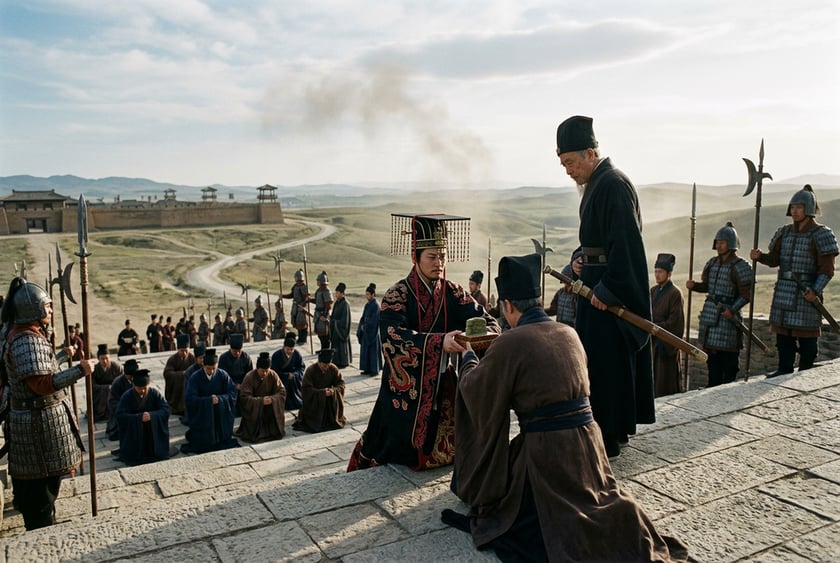
Romance of the Three Kingdoms places Cao Pi Supplants the Han within a carefully orchestrated abdication ceremony. The officials ask Emperor Xian of Han to attend court; Cao Pi first receives an edict but does not immediately accept the throne, instead submitting a memorial to decline it. Emperor Xian then issues a second edict, and Cao Pi finally changes the era name and proclaims himself emperor at the abdication ceremony. The change from the Yuan’kang era to the Huangchu era, and the adoption of the name Great Wei, mark the transfer of power. What is depicted here is not victory or defeat on the battlefield, but the old imperial authority handing nominal rule to a new ruler through edicts, investiture, and ceremony.
Yet the outward appearance of the abdication process does not match the actual balance of power. Fearing that the officials will coerce him, Emperor Xian dares not leave the palace hall. Empress Cao, meanwhile, denounces the Cao family as “rebels,” pointing out that Cao Cao had not usurped the throne, while Cao Pi had begun seeking to replace the Han not long after succeeding him. By setting the fear and protest within the palace alongside the ritual language of modesty, the novel shows readers that this supposedly voluntary transfer took place against a backdrop of coercion: the stronger party determined the form the transfer would take.
Key Figures
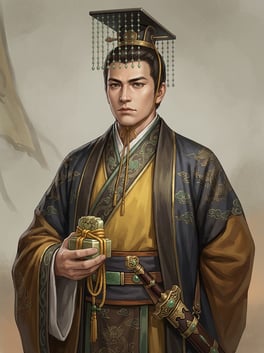
Cao Pi directs the transfer of power. Following Sima Yi’s advice, he first declines the throne in a memorial, citing his “meager virtue,” and then ascends in accordance with a second edict. This back-and-forth is not simply an expression of personal modesty; in the story, it forms a political performance. Cao Pi must secure the throne while minimizing the risk that the realm will see him as actively usurping it. After ascending, he immediately changes the era name, grants a general amnesty, and posthumously honors Cao Cao, showing how quickly the new regime must turn succession into an established order of rule.
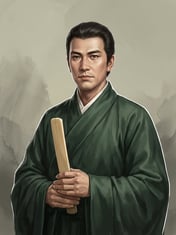
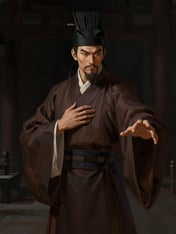
Hua Xin, Wang Lang, and Sima Yi serve different roles in the political mechanics of the transition. Sima Yi advises Cao Pi to submit a memorial declining the throne; Wang Lang is ordered to draft it; and Hua Xin invokes precedent from earlier dynasties to recommend that Emperor Xian issue another edict. Together, they package the intention to seize power as a procedure conducted in accordance with ritual. Empress Cao and Emperor Xian, by contrast, bear witness to the other side of this process: she denounces the Cao family openly, while he weeps and gives thanks when he is made the Duke of Shanyang and ordered to leave that very day. Jia Xu guides the officials in paying court. Chen Qun, Chen Jiao, and Zhang Yin appear on the list of related figures, but the cited passages do not show what they specifically do, so their personal positions should not be inferred from them.
Central Issues
The first issue is how legitimacy is constructed. The novel does not have Cao Pi simply proclaim himself emperor by force. Instead, it arranges a series of steps: Emperor Xian issues an edict, Cao Pi declines the throne, the officials are present, the proclamation is read, and the ceremonial rites are performed. These steps translate an actual transfer of power into the traditional political language of “abdication,” while the change of era name and state title fixes a new political chronology. Yet ceremony can confer legitimacy without proving that the transfer was freely chosen. Emperor Xian’s fear of attending court and Empress Cao’s denunciation of the Cao family expose the coercion that the ceremonial account cannot fully conceal.
The second issue is the continuity and rupture between the old and new regimes. Cao Pi inherits the foundation of power laid by Cao Cao and posthumously honors his father as Emperor Taizu Wu. At the same time, changing the state and era names and installing a new emperor declare the end of the Han’s political legitimacy. Through the saying “There cannot be two suns in the sky or two kings among the people,” the novel depicts Emperor Xian’s demotion to the Duke of Shanyang. The new regime needs the former emperor to complete the abdication, yet must also limit his continuing political significance. Hua Xin’s use of a sword to hurry Emperor Xian away thus brings formal ennoblement and actual expulsion together.
Political Consequences
As depicted in the novel, once the abdication is complete, Cao Wei swiftly establishes a new order through a change of era name, a general amnesty, court audiences, and official appointments. Hua Xin is made Minister over the Masses and Wang Lang Minister of Works, showing how the officials who took part in the transfer ceremony are incorporated into the new court’s hierarchy. Emperor Xian, meanwhile, is installed as the Duke of Shanyang and ordered to leave that very day. The new regime thus preserves the former emperor’s title while stripping him of real power and isolating him geographically. This arrangement serves both to conciliate and to control: sparing the former ruler can demonstrate benevolence, while barring him from court prevents him from becoming a political center around which opponents might rally.
The text also describes a sudden sandstorm, the extinguishing of the candles, and Cao Pi collapsing during the ceremony in which he gives thanks to Heaven and Earth after accepting the abdication. It then recounts how, after falling ill, Cao Pi moved to Luoyang and built extensive palaces. These episodes carry literary intimations of ill omen, but cannot by themselves serve as historical evidence of the political consequences. Their narrative function is to cast a shadow over a legitimacy ceremony that appears to have gone smoothly: the new court has received the public support of the officials, yet the novel uses omens, the body, and relocation to suggest the anxiety and moral doubts that may accompany a transfer of power.
Counterfactual Scenarios
If Cao Pi had dispensed with the rituals of declining the throne, receiving a second edict, and accepting the abdication, and had simply declared the Han deposed and himself emperor, he might have avoided a cumbersome process in the short term. But this would have weakened the presentation of legitimacy emphasized by the novel and made the new regime appear more openly to have seized the throne. Conversely, even if every ritual step were observed, the abdication could be credibly regarded as voluntary only if Emperor Xian were free to refuse, Empress Cao were not suppressed, and the officials could express dissent openly. The cited passages instead show Emperor Xian in fear and Empress Cao being restrained, revealing a clear gap between the completeness of the procedure and the freedom of the participants’ will.
Another possibility would have been for the new regime to let Emperor Xian remain at the political center or to grant him fuller public honors. Such an arrangement might have softened the impression left by his forcible expulsion, but it could also have allowed the former emperor to remain a symbol of the Han’s legitimacy and made the consolidation of power more uncertain. The novel’s solution is to make him a duke and send him away: it deals with the former ruler under the milder guise of an ennoblement while using prohibitions to prevent his return to court. Thus, Cao Pi Supplants the Han is not presented in the text as merely a “successful abdication,” but as a political transition that seeks legitimacy through ritual and consolidates new power through personnel and spatial arrangements. The specific historical process and the true intentions of those involved cannot be determined solely from these passages in Romance of the Three Kingdoms.