Background
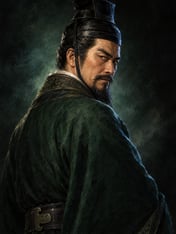
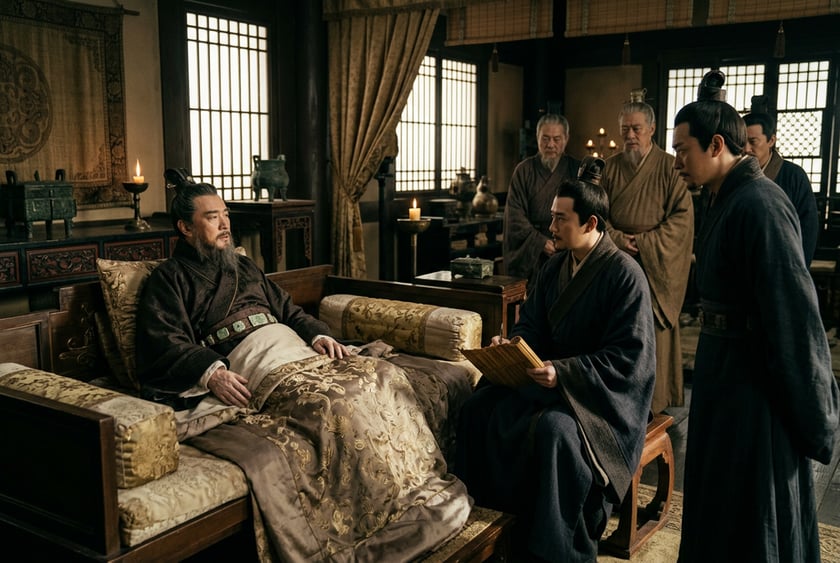
Romance of the Three Kingdoms depicts Death of Cao Cao as a crisis in which a private deathbed instruction swiftly becomes a struggle over the succession to power. As Cao Cao lay gravely ill, he summoned Cao Hong, Chen Qun, Jia Xu, Sima Yi, and others to his bedside, assessed the merits of his sons, and explicitly declared that Cao Pi “can carry on my work,” charging the assembled officials to support him. The scene presents the succession arrangement as Cao Cao’s own decision, backed by a joint commitment from his ministers. But this is a fictional narrative, and the dialogue alone cannot be treated as a verbatim, historically reliable record.
The novel also uses a series of final arrangements to highlight the personal dimension of Cao Cao’s rule: he bestows incense, instructs his concubines to learn needlework so they can support themselves, arranges for sacrifices at the Bronze Sparrow Terrace, and orders decoy tombs built to deter grave robbers. The narrative then brings his life to a close with the month of the first lunar month, his age of sixty-six, and the words “his breath stopped, and he died.” This account makes the transfer of power not merely a change of office, but a moment in which family property, posthumous reputation, and the continuation of the regime intertwine.
Key Figures
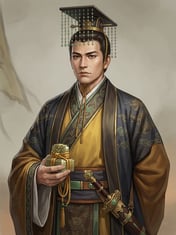
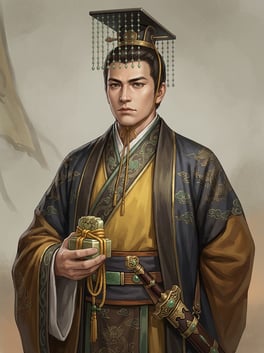
In the text, Cao Pi is both the designated heir and the figure who must swiftly turn his claim into effective control. When news of his father’s death arrives, he first weeps bitterly and goes to meet the coffin; after the ministers confer, he accepts the throne. By placing grief alongside accession, the novel presents him in two roles: as a son, he must mourn his father; as a political heir, he is also expected to provide order and authority without delay.
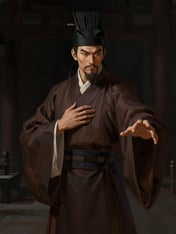
Chen Jiao’s role is to frame the succession dispute as a matter of state security. He fears that if Cao Cao dies away from the capital and the sons each rally supporters of their own, upheaval will follow and endanger the state. He therefore urges that Cao Pi be installed immediately as heir, and tears his robe as a warning. Chen Qun, meanwhile, is named among those charged with supporting the new ruler in the deathbed scene, underscoring the new sovereign’s need to rely on the existing bureaucracy. The two figures represent crisis management and administrative support, respectively, though the novel says little about Chen Qun’s subsequent actions.
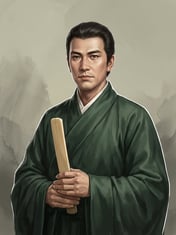
Cao Hong, Jia Xu, and Sima Yi are placed among the witnesses to Cao Cao’s final instructions, while Cao Zhen is also included in the list of participants in this episode. However, the passage provided does not describe Cao Zhen’s specific words or actions during the succession, so his influence should not be inferred from it. Jia Xu is later appointed Grand Commandant, indicating his place in the new court’s official order. Cao Zhang, meanwhile, is a potential military rival; in the end, after Jia Kui persuades him, he withdraws his troops, enters the city to mourn, and hands over his forces.
Central Issues
The foremost issue is how succession legitimacy is established in an emergency. At first, the ministers fear that without an imperial edict they cannot hastily proclaim a new ruler; Chen Jiao, by contrast, stresses that delay could lead to internal disorder. The novel then has Hua Xin arrive with an edict, giving Cao Pi’s accession three sources of support: family inheritance, the ministers’ endorsement, and the authority of the Han emperor. Yet the text also reveals that Hua Xin drafted the edict and forced Emperor Xian to issue it. Legitimacy is therefore not merely a matter of ceremonial confirmation, but is inseparable from control of power and political coercion.
A second issue is the tension between military strength and the claims of hereditary succession. Cao Zhang arrives with troops, and those around him fear that he may contest the throne. Jia Kui draws a clear boundary around the proper order of succession with the words, “A family has its eldest son; a state has its heir apparent,” then asks Cao Zhang why he has come. Cao Zhang says that he has come to mourn, dismisses the troops around him, and ultimately hands over his forces. This turn of events shows that the novel attributes stability to a combination of persuasion, the established order of status, and control of the army—not merely to Cao Cao’s deathbed instructions.
At a deeper level, the succession arrangements reflect the new ruler’s effort to manage uncertainty. Cao Pi’s accession does not dispel the potential suspicions among Cao Cao’s sons; Cao Zhang’s arrival with an army makes that risk immediately visible. Meanwhile, the edict Hua Xin brings provides authorization in name, while Chen Jiao emphasizes the need to prevent local and imperial-clan forces from splitting apart. The novel thus presents a logic of crisis politics: first establish a center of authority, then deal with potential rivals who might form independent military power bases.
Political Consequences
In the novel’s account, Cao Pi takes the throne that very day. He subsequently changes the era name to the first year of Yankang and appoints Jia Xu Grand Commandant, Hua Xin Chancellor, and Wang Lang Grand Minister of Justice, while promoting and rewarding other officials. Succession is thus not just an inheritance within the family; through the era name, appointments, and rewards, it also reshapes the political alliance. Cao Zhang’s retreat to Yancheng to hold his position and his surrender of the army reduce the risk of armed confrontation in the new ruler’s early days on the throne.
But this stability is marked by coercion and remains fragile. The novel says that Hua Xin used threats to induce Emperor Xian to issue the edict, and that Chen Jiao drew his sword to intimidate opponents. The new order was therefore not established naturally, without dissent, but through swift decisions that overrode procedural debate. Cao Pi’s successful accession, as presented in the text, is a victory in crisis management; it does not prove that controversy had vanished or that all political forces genuinely accepted the new ruler.
Counterfactual Analysis
If Cao Pi had not ascended the throne swiftly after Cao Cao’s death, then, following the logic that concerned Chen Jiao, the arrival of an edict, who would preside over the funeral rites, and whether the sons would each gather their own supporters could all have become focal points of competition in a power vacuum. Cao Zhang’s later entry into the city with troops shows that the novel treats military mobilization as a real threat. If he had refused Jia Kui’s counsel, or if the ministers had failed to reach agreement, the situation might have escalated from a succession ceremony into a confrontation between the imperial clan and the bureaucracy. This is only an inference based on the narrative, however, not an account of events that actually took place.
Conversely, if Cao Pi had relied solely on Cao Cao’s deathbed instructions and had not obtained an edict in the name of the Han emperor, he might still have gained the support of the clan and some senior officials, but would have lacked the public political warrant emphasized by the novel. And if an edict had been issued while Cao Zhang retained his army, legitimacy in name might not have been enough to avert a military challenge. These possibilities show that a secure accession depended on several conditions being met at once: a clearly designated heir, swift coordination among the ministers, completion of the authorization ceremony, and the abandonment of armed opposition by potential rivals. As for the text provided, neither the precise historical outcome nor the actual details of each step should be determined on the basis of the novel alone.