Romance
Shu army won
- Commanders
Ch. 86「曹真屯兵於斜谷道,不能取勝而回」
223 CE (Huangchu 4) · Chengdu
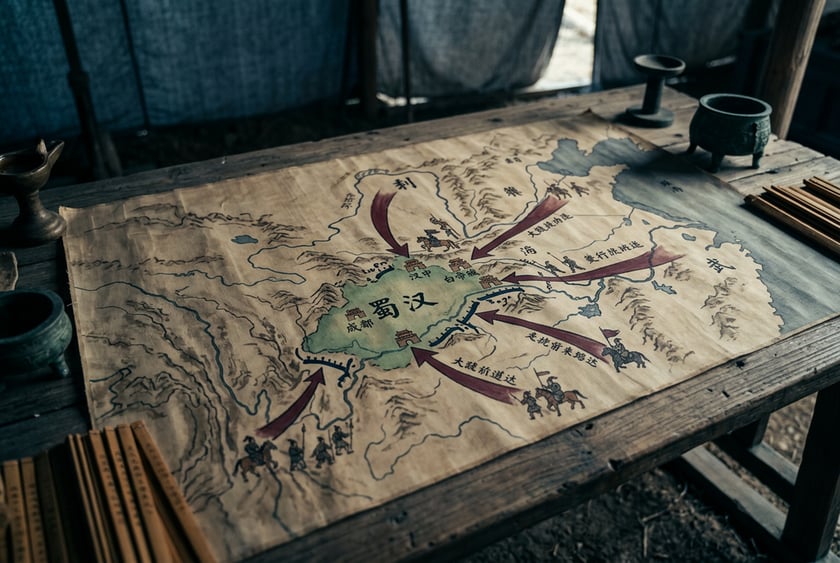
According to Chapters 85 and 86 of the Romance of the Three Kingdoms, after Liu Bei died at Baidicheng in the third year of Shu Han's Zhangwu era (223), Cao Pi, ruler of Wei, sought to invade Shu while it was leaderless, and Sima Yi offered the strategy of "advancing along five routes": he would arrange for the Xianbei chieftain Kebineng of Liaodong to come out through Xiping Pass, the southern Man leader Meng Huo to attack the four commanderies of Yi Province, Sun Quan of Eastern Wu to take Fucheng, and the surrendered general Meng Da to march out from Shangyong against Hanzhong, while Cao Zhen, as Grand Commander, would enter Shu through Yangping Pass—a combined force of five hundred thousand attacking from four sides. Zhuge Liang, as Chancellor, made his dispositions with composure, sending Ma Chao, Wei Yan, Zhao Yun, and others to guard the key passes along each route, and dispatching an envoy to ally with Wu and defuse the third route. As it turned out, the western tribes withdrew without a fight at the sight of Ma Chao, Meng Huo was driven back by a ruse of false troops, Meng Da feigned illness along the way, Cao Zhen was blocked at the Xie Valley, and Sun Quan, on Lu Xun's advice, held his troops and watched; the five armies disintegrated one after another, and Shu Han defused the gravest military crisis of its founding years.
 Cao PiInstigatorTalk to me
 Sima YiAdvisorTalk to me
 Jia XuAdvisorTalk to me
 Cao ZhenCommanderTalk to me
 Meng DaWarriorTalk to me
 Sun QuanCommanderTalk to me
 Meng HuoWarriorTalk to me
 KebinengWarriorTalk to me
Who won, as each book tells it; commanders as the text names them.
Scene
A map shows five armies attacking Shu Han from different directions, with each army’s route and target clearly marked and Shu Han’s defenses briefly indicated.

Continue
At his birth a cloudlike vapor, shaped like a canopy over a carriage, covered the room, and those who read the vapors declared it the aura of a Son of Heaven.
2204 people in common
2203 people in common
2232 people in common
2222 people in common
2242 people in common
2212 people in common
2202 people in common
2192 people in common
In Romance of the Three Kingdoms, the Five-Route Invasion of Shu takes place after Liu Bei’s devastating defeat at Yiling and his death at Baidicheng—the moment when Shu Han is at its weakest. Cao Pi concludes, “Liu Bei is dead; I have nothing to worry about,” and intends to seize the opportunity to annex Shu while its new ruler is young and public sentiment unsettled. The plan follows the basic logic of a war of conquest: launch an all-out offensive while the opposing regime is changing hands and its military has been weakened. But the novel also presents the opposing view through Jia Xu: Liu Bei will surely entrust his heir to Zhuge Liang, who, out of gratitude for Liu Bei’s recognition of his abilities, will do everything in his power to support the young ruler. A hasty campaign against Shu may not succeed. Cao Pi ignores this cautious assessment and is instead drawn to Sima Yi’s more aggressive proposal, setting the tone for a campaign that is “grand in scale, but shaky at its foundations.”
Sima Yi’s “five-route” plan is carefully layered: lure the Xianbei leader Kebineng from Liaodong through Xiping Pass with gold and silk; spur the southern tribesman Meng Huo to attack the four commanderies of Yi Province with official titles and rewards; entice Sun Quan of Eastern Wu to seize Fucheng by promising him territory; persuade the surrendered general Meng Da to turn against Shu and advance from Shangyong through their old ties; and finally send Cao Zhen with the main force to attack through Yangping Pass. The aim of the 500,000-strong army is to encircle Shu from all sides and prevent Zhuge Liang from responding to one front while attending to another. This is a classic strategy of “tying down the enemy on multiple fronts and dispersing its defenses.” Zhuge Liang, by contrast, deals with each route in turn: he sends Ma Chao, long stationed in the west and feared by the Qiang and Hu peoples, to block Xiping Pass; uses Wei Yan’s feints to confuse the southern tribes; stations Zhao Yun to guard the perilous approaches at Yangping; and judges that Meng Da, ever fickle, will not fight to the death. Only the Eastern Wu front cannot be stopped by force and must be neutralized through diplomacy. The difference between the two plans is that Sima Yi wagers on “simultaneous pressure,” while Zhuge Liang assesses the strength of “each individual route.”
The most delicate maneuvering takes place with Eastern Wu. Sun Quan hesitates when Wei envoys try to win him over with promises of territory. Lu Xun’s assessment proves decisive: Cao Pi is based in the Central Plains and cannot be dealt with hastily. An open rejection of Wei now would only create enmity, so it is better to agree in public and wait in private until the results on the other four fronts become clear. If they prevail, Wu can take advantage of the chaos and seize Chengdu first; if they fail, Wu can reconsider its options. This is cool-headed opportunism: Eastern Wu consistently puts its own interests ahead of those of Wei and Shu, and has no intention of serving as Cao Pi’s unpaid enforcer. Zhuge Liang understands this well, so he sends Deng Zhi to Wu and uses diplomacy to remove the most difficult front to defend. The decisive move is Zhuge Liang’s ability to break down a five-front military crisis into four military problems and one diplomatic problem.
All five routes come to nothing: the western tribes see Ma Chao and withdraw without fighting; Wei Yan’s feints drive Meng Huo back into his caves; Meng Da “falls ill” halfway there and holds his troops back; Cao Zhen is blocked at Xie Valley and returns without success; and Sun Quan, following Lu Xun’s advice, never sends a single soldier. Afterwards, Sun Quan remarks, “Lu Boyan truly has the gift of prophecy,” and is relieved that he did not act rashly and incur enmity with Shu. In the novel, this campaign is the moment of triumph in “Zhuge Liang Repels the Five Armies,” shaping his image as a leader who remains composed in a crisis and plans far ahead. It also leads into the subsequent storyline of Deng Zhi’s mission to Wu and the renewed alliance between Wu and Shu.
It is important to note that the Records of the Three Kingdoms contains no account of a single, coordinated campaign corresponding to the Five-Route Invasion of Shu; it is a highly structured fictional episode designed to showcase Zhuge Liang’s strategic ability. Even within the novel’s premise, however, the outcome might have been far more perilous if Sun Quan had trusted the Wei envoys and truly sent 100,000 troops to seize Fucheng, leaving Shu Han to face pressure on all five fronts at once. The Eastern Wu force was the only one capable of striking at Shu Han’s heartland. This is precisely why Zhuge Liang’s decision to prioritize diplomacy over military action was so crucial. Conversely, the fundamental flaw in Cao Pi’s plan was its excessive reliance on “borrowed strength” from allies and foreign peoples. Each had its own interests and was not truly under his command. Once the plan’s central binding force—the cooperation of Eastern Wu—fell away, the 500,000-strong army collapsed like a sandcastle.