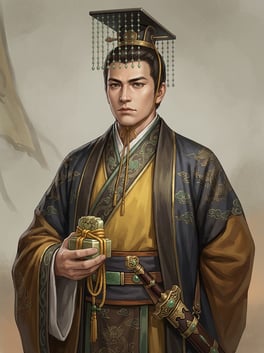
Background
Sun Quan Invested as King of Wu should not be viewed merely as a promotion in noble rank; it should also be understood in the context of the struggle for power between the late Han and the Three Kingdoms. According to the premise, the event took place in the second year of Huangchu (221): Cao Pi, as emperor of Wei, granted Sun Quan the title of king, and Sun Quan had to decide how to handle this investiture from the northern power. It brought two contradictory realities into view: Sun Quan had an independent military and political base in Jiangdong, yet still had to contend with the order of titles and legitimacy represented by the Wei court. The investiture could therefore be seen both as recognition of the balance of power and as submission to a superior. What mattered was not the title itself, but how each side used it. It should be noted that the cited passage from chapter 82 of Romance of the Three Kingdoms focuses on welcoming the Wei envoy and the ensuing dispute over dignity; it is not a complete record of the investiture document and its procedures. Judgments about the details of the event should therefore be distinguished from the political implications presented in the novel.
This arrangement also took place against the backdrop of Sun Quan facing pressure from Shu Han. In the account in chapter 82, Eastern Wu is discussing plans to defend against Shu when news arrives that Wei has made Sun Quan a king. Chapter 86 then depicts a Wei envoy proposing an alliance to conquer Shu and divide its territory. Sun Quan consults Zhang Zhao, Gu Yong, and Lu Xun, provisionally agrees, and waits to see how events unfold. Together, the two episodes portray not a stable Wei–Wu alliance, but Sun Quan seeking room to maneuver under pressure from several sides: the Wei court’s investiture and military cooperation could serve as tools, but did not necessarily mean that Wu would give up its independent judgment.
Principal Figures
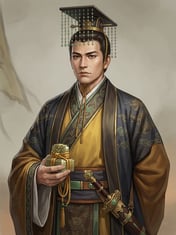
Sun Quan is at the center of this political performance. He first accepts the royal title conferred by the Wei emperor and leads his officials out of the city to welcome the envoy. This shows a response to the Wei court in ceremonial terms, but does not prove that, in matters of policy, he was entirely under Wei control. Chapter 82 also compares him with Liu Bang, who accepted investiture from Xiang Yu, and has Sun Quan explain his own acceptance as an act of “acting according to the times.” Whether or not this speech can be treated as authentic, it reveals the rationale the novel gives Sun Quan in his defense: accepting a title for the time being could be a way of weighing the situation, not a surrender of his ultimate aims.
In the premise, Cao Pi is the one who drives the investiture. The episode in which Zhao Zi is sent to the Wei court, meanwhile, fills out the picture of how Wu actively managed the relationship. In response to Cao Pi’s probing, Zhao Zi calls Sun Quan’s “humbling himself before Your Majesty” a stratagem, while also emphasizing Wu’s military strength, the barriers of the Yangtze and Han rivers, and its ability to defend itself independently. This diplomatic language conveys deference and warning at once: Wu could acknowledge Wei as its superior in ceremony, but it was no small state incapable of defending itself. The investiture was therefore not merely an honor bestowed unilaterally by the Wei emperor; it also gave Wu an occasion to demonstrate its political maturity and negotiating skill.
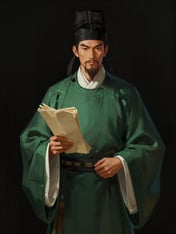
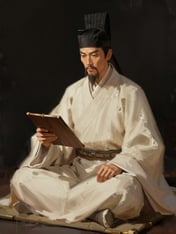
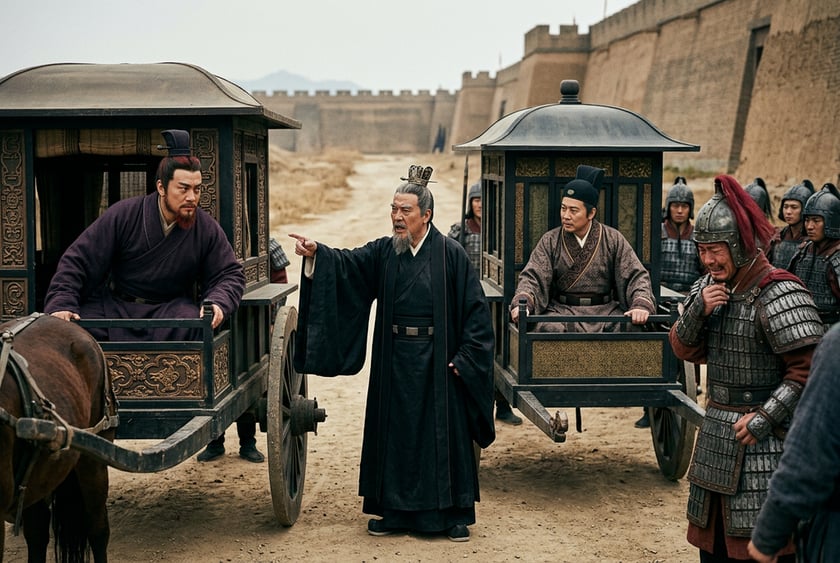
Zhang Zhao and Xu Sheng represent two different reactions within Wu. When Xing Zhen enters the city without getting out of his carriage, Zhang Zhao insists on proper etiquette and dignity, demanding that the Wei envoy dismount. Xu Sheng, by contrast, weeps over Sun Quan’s acceptance of the title, bluntly lamenting that they had failed to devote themselves to joining forces with Wei to swallow up Shu, and that their lord had instead received a title from another—an occasion for shame. Zhang Zhao upholds the baseline of mutual respect in diplomatic protocol; Xu Sheng voices anxiety about political autonomy and ambitions of expansion. Xing Zhen’s response is also significant: at first he adopts the air of an “envoy of the great state,” but changes his manner after the Wu officials protest, and remarks that Jiangdong’s generals and ministers “will not remain beneath others for long.” The novel thus presents the reception of the envoy as a public contest over the balance of power.
The premise also lists Hu Zong and Shi Yi as participants, but the three cited passages do not describe what they said or did in the investiture negotiations. It would therefore be unwarranted to assign them any particular decision or position on the basis of the available quotations alone. A more cautious approach is to place them within Wu’s decision-making and administrative network while acknowledging that these materials do not establish their individual roles. By contrast, the conflict and interactions among Zhang Zhao, Xu Sheng, Xing Zhen, and Sun Quan are clearly described in chapter 82, making them suitable for analyzing how the novel portrays political tensions within Wu’s court.
Central Issues
The first central issue is the disconnect between “legitimacy” and “power.” The Wei court could confer a royal title, asserting its claim to inherit the legitimate order of the late Han; but Wu had its own army, bureaucracy, and territorial base, and Sun Quan did not rule Jiangdong solely by virtue of authorization from the Wei court. The investiture thus had a dual effect: for Wei, it could bring a powerful neighbor into a hierarchy; for Wu, accepting the title might yield practical benefits, but could also allow its rival to portray Wu as a subject state. Zhao Zi’s description of Sun Quan as “humbling himself” before the Wei court, alongside his emphasis on Wu’s military strength, shows these two meanings coexisting rather than presenting a simple choice between loyalty and humiliation.
The second issue is whether ceremony can be turned into political submission. Xing Zhen’s refusal to dismount as he rode through the gate turns the investiture ceremony, in the narrative, into a test of Wu’s standing by the Wei envoy. Zhang Zhao’s intervention, by contrast, recasts the protocol for welcoming an envoy as a set of rules both sides must observe. Xing Zhen eventually dismounts, meaning that the Wu court preserves a measure of equal dignity at the ceremonial scene, without overturning the fact that the Wei emperor granted the title. Through the words “In matters of ritual, none must fail to show respect; in matters of law, none must fail to be strict,” the novel places respect for order alongside resistance to disrespect. It suggests that ritual can serve hierarchy, but can also provide the weaker party with a means of defending its boundaries.
The third issue is how a ruler handles disagreements within his own ranks. Xu Sheng’s lament treats the investiture as a sign of unfinished military ambitions and frustrated purpose; Sun Quan responds by invoking the times and the need for expediency. This is not simply a dispute between loyalty and disloyalty. Xu Sheng warns the ruler that accepting the title may carry costs for morale and autonomy, while Sun Quan’s decision reflects the practical need to avoid an immediate break with Wei amid competition on several fronts. Zhang Zhao’s defense of Wu’s dignity during the envoy’s reception, and his later advice alongside Gu Yong in chapter 86 to change the reign title, show that officials could play different roles on different issues. The Wu court cannot be reduced to a single camp of submission or resistance to Wei.
Political Consequences
In the immediate term, the investiture gave Sun Quan the higher political title of King of Wu and established a formal framework for dealings between Wei and Wu. However, the available materials do not prove that the investiture secured a stable alliance, nor do they justify concluding that Sun Quan accepted the Wei court’s full control over Wu. In chapter 86, when the Wei envoy invites Wu to join in conquering Shu, Sun Quan does not commit without consideration. He consults his officials, listens to Lu Xun, and provisionally agrees while watching how the situation develops. This later episode suggests that ceremonial expressions of subordination remained distinct from specific military decisions, and that Wu retained the ability to choose its course according to circumstances.
At the symbolic level, the investiture also forced Wu’s court to address the question of its autonomy openly. Zhang Zhao prevents the Wei envoy from behaving disrespectfully, while Xu Sheng weeps over the investiture. Together, they show readers that even when the ruler chooses an expedient course, there are people at court who fear it will be interpreted as accepting a subordinate position. At the same time, Xing Zhen’s remark about Jiangdong’s generals and ministers acknowledges in turn that Wu is not a political force to be slighted. The novel thus portrays the consequences of the investiture as an ongoing tension, not a question of allegiance settled by a single ceremony. The cited passages do not provide enough information to determine how the investiture ultimately changed relations between Wei and Wu, so the outcome should be judged cautiously.
Counterfactual Analysis
If Sun Quan had refused the investiture, this might in the short term have strengthened the symbolism of Wu’s autonomy and fulfilled the call for dignity represented by Xu Sheng. But given the pressure to defend against Shu depicted in chapter 82, an open refusal might also have driven Wei and Wu into conflict sooner, narrowing Sun Quan’s room to maneuver between two fronts. This is not an outcome directly recorded in the materials, but a possibility supported by the narrative’s account of Sun Quan accepting the title on the grounds of the times, and Zhao Zi’s statement at the Wei court that “humbling himself” was a stratagem. It shows that refusal would not necessarily have meant greater independence: if it cost Wu a buffer and channels for negotiation, it could instead have diminished its freedom of action.
Conversely, if Sun Quan had accepted the title but acted entirely as the Wei court wished, Wu might have damaged its strategic autonomy through excessive reliance on the investiture relationship, and come into conflict with the political expectations of figures such as Xu Sheng. Chapter 86 offers another possible course: Wu provisionally agrees to the Wei envoy’s proposal and waits until the situation surrounding the four-pronged attack on Shu becomes clearer. This means neither immediately rejecting the title nor treating it as a commitment to send troops unconditionally. The crucial question in Sun Quan Invested as King of Wu was therefore not the moral judgment of whether he “accepted” or “refused,” but whether he could turn ceremonial recognition into a diplomatic resource he could control while retaining the freedom to make military choices. The novel does not reveal the ultimate success or failure of this strategy, so the event is better understood as the beginning of an ongoing contest than as a settled declaration of submission or independence.