
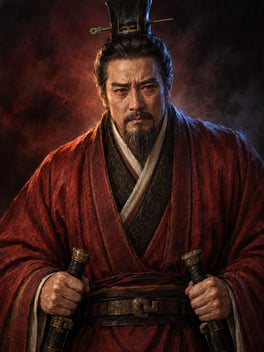
Background
The narrative of Liu Bei Proclaims Himself Emperor unfolds after Cao Pi Supplants the Han, at a crucial moment when the Shu Han regime needed to explain the legitimacy of its rule. Volume 80 of Romance of the Three Kingdoms relates that, upon learning that Cao Pi had proclaimed himself emperor and hearing that Emperor Xian of Han had been killed, Liu Bei wept bitterly, ordered all the officials to wear mourning, and held a distant memorial rite, posthumously naming the dead emperor “Xiaomin.” These measures framed Liu Bei’s political actions as mourning for and continuing the Han house, rather than as a seizure of power to establish a new regime. The text also says that Liu Bei fell ill from grief and was unable to attend to affairs of state, which he entrusted to Zhuge Liang. This suggests that the imperial accession was not simply an expression of personal will, but also an institutional arrangement advanced by regents while the center of power was temporarily weakened.
The limits of the historical evidence must be made clear: the material cited here comes from Romance of the Three Kingdoms, a literary narrative, not an independent verification of the ceremony’s historical details. It recounts how Zhuge Liang, Xu Jing, and Qiao Zhou argued for Liu Bei’s accession, and describes Liu Bei’s initial refusal and subsequent persuasion. But the passage provided does not fully depict the procedures and outcome of the entire investiture ceremony. We can therefore analyze how the novel constructs political legitimacy, but should not treat auspicious signs, dialogue, or dramatic turns as undisputed historical fact.
Main Figures
Liu Bei is the nominal center of power and the agent who “accepts persuasion and becomes emperor” in the narrative. At first, he rebukes the officials, saying that their proposal could make him guilty of disloyalty and unrighteousness. He then stresses that, although he is descended from Emperor Jing of Han, he has not accumulated enough virtue to benefit the people. This is not mere modesty; it makes the moral threshold for becoming emperor explicit. Liu Bei’s eventual acceptance can thus be interpreted as a response to the severance of Han rule, the people’s expectations, and the duty to punish rebels—not as a personal bid to seize the throne. Yet his refusal gives way to acceptance after repeated entreaties, also revealing the power script of political ceremony: ministers petition, and the ruler grants permission.
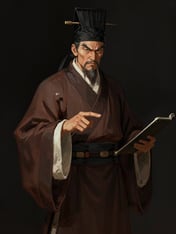
Zhuge Liang and Xu Jing are the main political forces driving the process. Zhuge Liang links Cao Pi’s usurpation of the Han with Liu Bei’s succession to the throne and organizes the officials to submit a memorial. Xu Jing argues that if Liu Bei does not immediately assume the imperial title and punish the rebel, he can hardly claim to be loyal and may lose the people’s support. Their arguments serve both dynastic succession and practical political mobilization: the former provides a principle of order, while the latter casts refusal to become emperor as a failure of political responsibility. Qiao Zhou, meanwhile, invokes auspicious signs and celestial portents to show that the time has come, cloaking the political choice in signs of Heaven’s mandate.
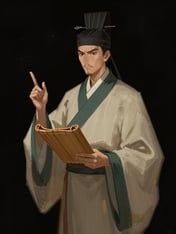
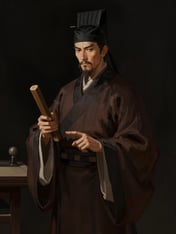
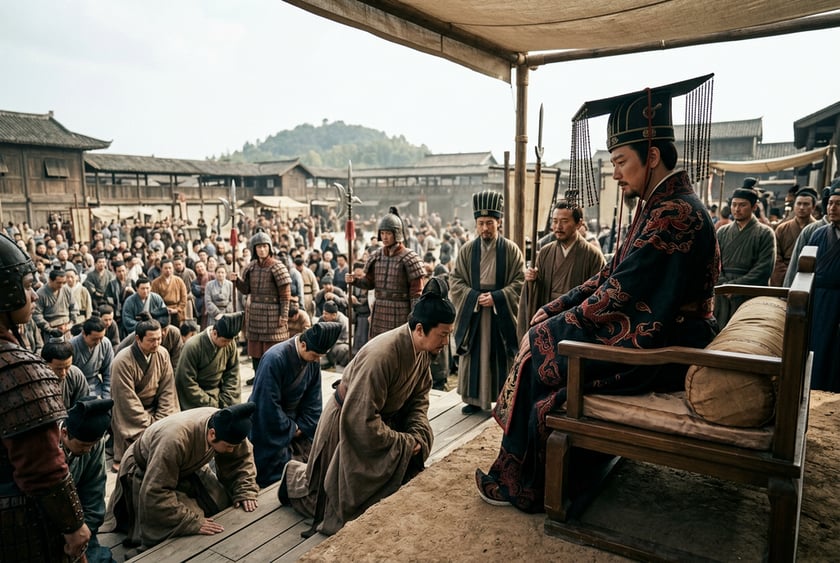
Xu Ci and Meng Guang are responsible for carrying out the rites, serving as masters of ceremony. Mi Zhu, Huang Quan, Lady Wu, Liu Shan, Zhang Fei, and others are listed as participants or witnesses. Their presence suggests that the accession involved bureaucratic, dynastic, and military networks, but the passage at hand does not present their individual speeches or specific roles in the petitioning, so their motives should not be invented. The central sequence explicitly described is that Zhuge Liang and Xu Jing lead the officials in submitting a memorial, after which Xu Ci and Meng Guang oversee the rites, an altar is built south of Wudan in Chengdu, and Qiao Zhou reads the sacrificial address.
Core Issues
The first central issue is the source of legitimacy. The argument for accession combines bloodline, the continuation of the Han house, the duty to punish Cao Pi, and auspicious signs. Liu Bei is presented as a descendant of the Han house, while Cao Pi is branded a usurper. If no one carries on the Han line, the regime in Shu must answer why it can claim to represent “Han.” The auspicious signs have a dual effect in particular: they recast the officials’ political judgment as Heaven’s will and lessen the moral burden of Liu Bei’s active pursuit of the throne. But auspicious signs cannot replace institutions and power; they function more as symbolic resources for political communication than as the sole basis of legitimacy.
The second issue is the dramatic structure of “refusal” and “acceptance.” Liu Bei defends himself by saying he does not wish to imitate a rebel, while Zhuge Liang and the others recast refusal to become emperor as an inability to avenge the Han emperor and respond to the people’s expectations. Zhuge Liang’s feigned illness and refusal to appear is a pivotal turn in the novel: the absence of the regent becomes a source of pressure, suggesting that government may lose its support, until Liu Bei accepts amid the officials’ entreaties. This presentation depicts a political performance in which ruler and ministers validate one another: the ministers show that the ruler has not taken the position for himself, while the ruler’s reluctant consent conveys restraint and a sense of duty. It also reveals the organizational pressure behind the petitioning.
The third issue is how ritual turns a political claim into a visible order. The memorial, construction of the altar, selection of an auspicious day, ascent to the altar, and reading of the sacrificial address translate an abstract claim of succession into a public ceremony. The ceremony is not merely a celebration; it confirms to the officials and the political community that the center of power has changed. Who presides over the rites, who reads the address, and who attends as a witness all help produce a new political order. However, the material at hand only describes Liu Bei being invited to ascend the altar and make offerings, followed by the introduction of the sacrificial address; it does not justify filling in the details of the ceremonies that followed. The safer conclusion is that the novel portrays the accession as a collective act confirmed through bureaucratic deliberation and ritual.
Political Consequences
In the novel’s narrative logic, the accession first completes the Shu Han regime’s change in status: Liu Bei is no longer merely King of Hanzhong, but the heir to the Han line. This change helps unite his supporters, clarify the regime’s self-definition, and frame its war against Cao Wei as “punishing rebels” rather than ordinary competition between regimes. At the same time, becoming emperor strengthens the institutional center of the Shu court, bringing ritual officials, ministers, and military commanders within a shared new hierarchy. It should be noted that these are the political functions presented in the text; the novel passage provided alone cannot establish how widely they were accepted in society at the time.
But unity of status does not mean unity of strategic aims. Volume 81 turns to Liu Bei’s Eastern Campaign (Battle of Xiaoting): Zhao Yun argues that Cao Pi is the true enemy of the state and that they should first move against Guanzhong, distinguishing the public duty of avenging the Han’s enemy from the private desire to avenge Guan Yu. Liu Bei, however, stresses that Sun Quan harmed his younger brother and insists on attacking Wu. This shows that becoming emperor did not automatically resolve internal disagreements over priorities. A public commitment to the Han line could be constrained by the ruler’s personal desire for revenge, military judgment, and relations with allies. Thus, accession supplied a higher-level political language, but also made whether actions conformed to the goal of “punishing rebels” a new test.
From the perspective of political communication, becoming emperor brought both benefits and risks. Claiming to continue the Han line could strengthen internal cohesion, but it also made it harder to avoid the question of why Cao Wei should not be attacked first. If military efforts instead turned toward Wu, the public language of orthodoxy could come into tension with strategic realities. Zhao Yun explicitly points out this tension in the cited text, while Liu Bei responds by invoking his brother’s death. This conflict does not prove that accession necessarily led to the eastern campaign, nor can the novel alone establish its ultimate success or failure. It does, however, suggest that political status could not replace resources, alliances, or strategic choices.
Counterfactual Scenarios
If Liu Bei had refused to become emperor, the regime in Shu might still have maintained its rule under the title of King of Hanzhong, but the novel’s constructed line of succession would have been more ambiguous. Cao Pi had already proclaimed himself emperor; if Liu Bei did not take up the Han succession, he would have had to explain the political grounds for attacking Cao Wei and how he would maintain the rites of the Han house. Refusal might also have appeared as moral restraint, but, as Xu Jing suggests, it could have been used to argue that Liu Bei risked losing the people’s support and to question his sense of responsibility. Conversely, if Liu Bei had postponed accession and first concentrated his forces on attacking Wei, the goal of “punishing rebels” might have aligned more closely with his military aims. Yet the material at hand offers no evidence about the basis for such a choice, the officials’ response, or conditions on the battlefield, so this can only be treated as a possible course, not a certain outcome.
If Zhuge Liang, Xu Jing, and Qiao Zhou had failed to act in concert, the accession process might have lacked three complementary resources: Zhuge Liang’s organizational and administrative authority, Xu Jing’s appeal to legitimacy and popular support, and Qiao Zhou’s interpretation of auspicious signs. Given the narrative background in which Liu Bei falls ill and entrusts Zhuge Liang with government, the continued progress of the petitioning was closely tied to the stability of the regency. But the novel presents the process as a collective petition by the officials, suggesting that accession was not driven by a single strategist alone. Without the officials’ participation, even if Liu Bei had made the claim himself, it would have been harder to frame it as a ceremonial fact recognized by the community.
Finally, if Liu Bei had accepted the imperial title but prioritized attacking Wei rather than Wu, his claim to continue the Han line might have aligned more closely with his military actions, perhaps reducing the conflict between public and private aims that Zhao Yun identified. But this would not guarantee a more favorable outcome, because the material provided does not offer enough information to compare the forces, logistics, or diplomatic circumstances of the two courses. What can be established is that the text poses a structural dilemma: becoming emperor established a claim to orthodoxy, but did not resolve how Liu Bei should allocate his military objectives or reconcile private feelings with public duty. The actual outcome of the events cannot be determined from these passages alone.}