







Background to the Meeting
In 223, the first year of the Jianxing era in Shu, Shu Han was at its most vulnerable point since its founding. After suffering a crushing defeat at the Battle of Xiaoting, Liu Bei retreated to Yongan and died there. His successor, Liu Shan, was only seventeen. Rebellions broke out one after another in the Nanzhong commanderies, while Cao Wei watched menacingly from the north. The east posed an even greater problem: Wu and Shu had only just fought each other, and relations between the two states were burdened by the loss of Jing Province, Guan Yu’s death, and the defeat at Yiling.
Yet the two sides had not been entirely out of contact. According to the Biography of Deng Zhi in the Records of the Three Kingdoms, Sun Quan had already taken the initiative to seek peace while Liu Bei was still alive. Liu Bei had sent Song Wei and then Fei Yi to respond. The question was whether the situation would change after Liu Bei’s death. Zhuge Liang feared that Sun Quan might have other plans once he learned of Liu Bei’s passing, and at first could not find a suitable envoy. Deng Zhi volunteered, arguing that with a young ruler newly on the throne, Shu should send a senior envoy to reaffirm friendship with Wu. Zhuge Liang replied that he had been considering this for a long time and had only now found the right person: Deng Zhi himself. This exchange shows that restoring relations between Wu and Shu was the foremost diplomatic priority at the beginning of Zhuge Liang’s regency.
Sun Quan, too, was in a delicate position. In 221, he had accepted the title of King of Wu conferred by Cao Pi. Relations between Wei and Wu then deteriorated rapidly, and Wei launched a three-pronged campaign south. Sun Quan withstood the pressure, but needed to redefine his long-term strategy. In Chapter 86 of Romance of the Three Kingdoms, Sun Quan has already learned that the five Wei armies sent to attack Shu in coordination with other forces have all been driven back without success. Zhang Zhao concludes that Deng Zhi is a persuasive envoy sent by Zhuge Liang, reflecting the Wu court’s wariness about Shu’s motives.
The Course of the Conversation
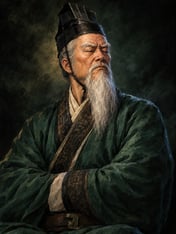
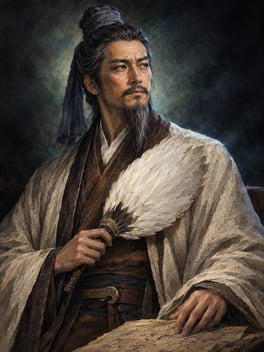
According to the Biography of Deng Zhi, Sun Quan was initially suspicious and did not receive Deng Zhi promptly. Deng Zhi submitted a memorial on his own initiative, saying that he had come on behalf of Wu as well as Shu. Only then did Sun Quan grant him an audience. This declaration deftly reframed a mission to seek peace as a discussion of shared interests, opening the way for dialogue.
At the meeting, Sun Quan stated his concerns frankly: he was indeed willing to form a marriage alliance with Shu, but feared that Shu’s ruler was young and its state small and weak, leaving it unable to defend itself if Wei took advantage of its vulnerability. Deng Zhi’s reply had three parts. First, he spoke of the two states’ strength: Wu and Shu together controlled four provinces; Sun Quan was an outstanding ruler of his generation, and Zhuge Liang was a foremost talent of the age. Shu had the protection of its mountains and rivers, while Wu was shielded by the Three Rivers, so the two could rely on each other as lips and teeth. Second, he described the strategic possibilities: united, they could advance to conquer the realm or retreat to stand as a tripod with Wei. Third, he outlined the consequences of the alternative: if Sun Quan submitted to Wei, Wei would surely demand that he attend court and that he send his heir as a hostage. If he refused, Wei would raise an army to punish him, while Shu would move downstream and seize an opportunity to advance. By then, the lands south of the Yangtze would no longer belong to Sun Quan. Not a word of this argument was a plea; it rested entirely on Wu’s own interests. Its final point also implied that Shu had the power to bring pressure to bear.
Romance of the Three Kingdoms sets the conversation against a highly dramatic scene. Zhang Zhao proposes placing a great cauldron of boiling oil in front of the hall and lining up a thousand warriors, intending to frighten the envoy by recalling the old story of Li Yiji being boiled alive. Unfazed, Deng Zhi bows with clasped hands but refuses to kneel, taunting Sun Quan: “People say Eastern Wu is full of worthy men, yet it turns out they fear a mere scholar”. After setting out the advantages and dangers, he even makes as if to leap into the cauldron to prove his sincerity. Sun Quan hastily stops him and receives him as an honored guest. The Records of the Three Kingdoms makes no mention of the cauldron, the warriors, or the attempted leap. In the Biography of Deng Zhi, Deng Zhi persuades through the force of his argument, not by putting life and death on the line.
The Decision
According to the Biography of Deng Zhi, Sun Quan remained silent for a long time, then admitted that Deng Zhi was right. He therefore broke off relations with Wei, made peace with Shu, and sent Zhang Wen to Shu to return the courtesy. In the novel, Sun Quan declares before his court that Shu has Deng Zhi, who has not failed in his mission, and Zhang Wen volunteers to go as envoy. The novel also relates how Zhang Wen debates Qin Mi about the heavens in Shu and is bested (the episode is recorded in the Biography of Qin Mi in the Records of the Three Kingdoms, though the novel elaborates on it). Zhuge Liang smooths things over with tactful words, then sends Deng Zhi with Zhang Wen to Wu to return the visit.
When Deng Zhi went to Wu for the second time, Sun Quan said that if the realm were at peace, the rulers of the two states could divide it between them—would that not be a happy outcome? Deng Zhi replied bluntly that once Wei had been destroyed, if Sun Quan still failed to recognize Heaven’s mandate, the rulers and ministers of both states would each do their utmost out of loyalty, and the war would only just be beginning. Sun Quan laughed aloud and praised his honesty. This exchange reveals the nature of the Wu–Shu alliance: it was an expedient arrangement against a common enemy, not a lasting peace, and both sides understood this without saying so. Deng Zhi’s candor won Sun Quan’s trust; in a letter to Zhuge Liang, Sun Quan wrote that Deng Zhi alone could bring the two states into harmony.
Historical Impact
Deng Zhi’s mission to Wu was the first cornerstone of Zhuge Liang’s strategy for governing Shu. Through Zhuge Liang, the novel explains the reasoning: once Wu and Shu made peace, Wei would not dare attack Shu lightly. With the east secure, Zhuge Liang could first pacify the south and then turn to the northern campaigns. The historical course broadly followed this pattern: Zhuge Liang campaigned in the south in 225, advanced to Hanzhong in 227, and began the northern campaigns in 228. No large-scale conflict broke out on the eastern front during this period.
The Wu–Shu alliance lasted for forty years thereafter. Although the two sides continued to harbor suspicions about each other, they never again went to war. When Sun Quan proclaimed himself emperor in 229, Shu Han sent Chen Zhen to offer congratulations and conclude an agreement dividing the realm; this can be seen as a continuation of Deng Zhi’s mission. In Chapter 105, the novel also relates that after Zhuge Liang’s death, Wu forces assembled around Baqiu, causing alarm among the Shu Han court. They sent Zong Yu to Wu to announce the death and gauge the situation, showing that the alliance required constant tending by envoys.
From the perspective of diplomatic history, Deng Zhi succeeded because he understood the other side’s central concern. Sun Quan was not most worried about Shu Han’s sincerity, but about its strength. Deng Zhi therefore focused his argument on what the two states could achieve together and what they would face if divided, while openly acknowledging the alliance’s limits. An alliance founded on interests rather than sentiment proved more stable than the relationship in Liu Bei’s time, which had rested on marriage ties and the lending of territory.