



Background
After Deng Zhi’s mission to Wu in 223, Wu and Shu renewed their alliance, and for the next several years the two states maintained frequent diplomatic exchanges. Chen Zhen himself was once dispatched to Wu after being promoted to Director of the Secretariat. By 228, the situation had changed: Zhuge Liang began his northern campaigns from Hanzhong, while Sun Quan decisively defeated the Wei general Cao Xiu at Shiting. In Chapter 96 of Romance of the Three Kingdoms, Lu Xun, after his victory, advises Sun Quan to send a letter to Shu and urge Zhuge Liang to advance while Wei’s forces are demoralized. Chapter 97 then depicts a Wu envoy bringing news of Cao Xiu’s crushing defeat to Chengdu, displaying Wu’s prestige while also strengthening the two states’ reconciliation. Though embellished, these episodes broadly reflect the pattern of military coordination between the two states around 228.
The victory at Shiting brought Sun Quan’s prestige to its peak. In the fourth month of 229, the first year of Wu’s Huanglong era, Sun Quan ascended the throne as emperor at Wuchang. This posed a thorny problem for the Wu–Shu alliance: Shu Han claimed to uphold the legitimate line of the Han dynasty, and in its ideology there could be only one rightful Son of Heaven. Sun Quan Proclaims Himself Emperor thus amounted to an open declaration that he stood on equal footing with Shu Han.
Key Figures
Sun Quan initiated this undertaking. His proclamation as emperor was the result of long-term planning. To consolidate the legitimacy of his new throne, he needed recognition from a neighboring state, and Shu Han was the only state that might grant it.
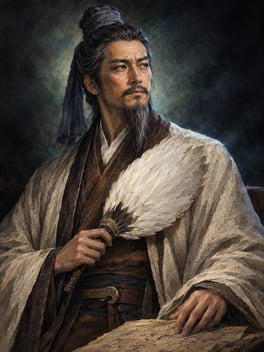
Zhuge Liang was the decision-maker on Shu Han’s side. According to the annotation by Pei Songzhi to “Biography of Zhuge Liang” in the Records of the Three Kingdoms, which cites the Spring and Autumn Annals of Han and Jin, many at the Shu Han court at the time believed relations with Wu should be severed. Zhuge Liang, however, argued that the larger interests should take precedence and sent an envoy to offer congratulations. His assessment of Chen Zhen in a letter to Zhuge Jin shows that what he valued was the envoy’s ability to preserve harmony between the two states.
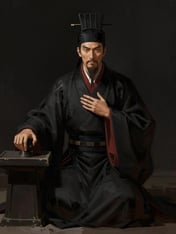
Chen Zhen was the one who carried out the mission. A native of Nanyang, he had followed Liu Bei for many years and had experience serving as an envoy to Wu. The court specifically conferred on him the title of Commandant of the Guards, sending an official of the rank of the Nine Ministers and demonstrating Shu Han’s regard for the congratulatory mission.
The Central Issue
The central question of the mission was how to balance legitimacy and interest. If Shu Han refused to recognize Sun Quan Proclaims Himself Emperor, the alliance might collapse, forcing Zhuge Liang to guard against the east while campaigning north. Yet recognition would contradict Shu Han’s own claims to legitimacy. Zhuge Liang chose pragmatism: preserve the alliance first and set aside the question of titles for the time being.
According to the “Biography of the Lord of Wu” in the Records of the Three Kingdoms, Chen Zhen arrived in the sixth month, and Sun Quan immediately proposed dividing the Central Plain between Wu and Shu: Yu, Qing, Xu, and You Provinces would go to Wu; Yan, Ji, Bing, and Liang Provinces to Shu; and Sili would be split in two along Hangu Pass, with the two sides entering into an alliance. The plan was carefully conceived in geographical terms: Wu would receive the eastern provinces adjoining its defense line along the Yangtze and Huai Rivers, while Shu would receive the western and northern provinces bordering Guanzhong and Longyou. Hangu Pass formed the natural boundary between these two great regions. Dividing Sili, the heartland of Wei, in two meant that both states would take part in the struggle for the area around Luoyang.
In essence, this pact divided in advance territory that neither side had yet secured. Politically, however, it had practical significance: in written form, it affirmed the two states’ shared goal of destroying Wei and enshrined their equal status in its terms.
Political Consequences
The most immediate result was that the Wu–Shu alliance was consolidated on a new basis of mutual legitimacy. Chen Zhen was rewarded upon his return, and the alliance endured for more than thirty years, until the Conquest of Shu by Wei. Militarily, although the two states repeatedly agreed to coordinate their northern campaigns, their actual cooperation was limited. Wu launched several attacks on Hefei and Xiangyang, while Shu made several advances from Mount Qi and Xie Valley, but the two sides often fought separately.
Ideologically, the mission established a distinctive diplomatic model: two regimes that both claimed the title of Son of Heaven entered into an equal alliance in the face of a common enemy. This plainly conflicted with the traditional belief that “there cannot be two suns in the sky.” Deng Zhi’s earlier remark to Sun Quan—that the two states would truly go to war only after Wei had been destroyed—remained the unspoken limit understood by both sides.
At this stage, Romance of the Three Kingdoms focuses less on the alliance pact than on the differing agendas of the two states. Chapter 98 identifies the envoy sent to Wu with congratulations as Grand Commandant Yang Zhen. It also depicts Lu Xun realizing that Zhuge Liang’s request for Wu to send troops was meant to tie down Sima Yi; he advocates feigning a military mobilization, then waiting until Shu and Wei are locked in a stalemate before seizing the Central Plain. This portrayal highlights the maneuvering within the alliance, in contrast to the Records of the Three Kingdoms account of the two states solemnly entering into a pact.
Counterfactual Analysis
Had Zhuge Liang followed the majority opinion at court and refused to recognize Sun Quan Proclaims Himself Emperor, the likeliest outcome would have been a cooling or even severing of relations between Wu and Shu. Sun Quan might not have immediately allied with Wei, but he would very likely have stopped putting pressure on Wei along the eastern front, allowing Wei to concentrate its forces against Zhuge Liang. Given that Zhuge Liang’s later northern campaigns were consistently hampered by supply transport and limited troop strength, losing the eastern front’s pressure on Wei would have made Shu Han’s position even more difficult.
Another possibility is that, had Wu and Shu truly coordinated their campaigns according to the pact and launched major offensives against Wei’s eastern and western fronts at the same time, Wei would have faced pressure on two fronts. In 234, during Zhuge Liang’s final northern campaign, Sun Quan did indeed send troops against Hefei at the same time, but soon withdrew without success. This shows the enormous gap between the pact’s blueprint and the two states’ actual military capabilities: the agreement to divide the realm was more a political gesture than a practical plan.