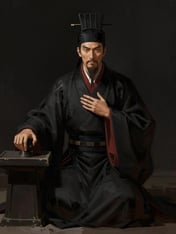
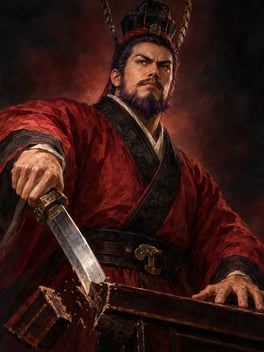
In the sixth month of 229 (the seventh year of Jianxing under Shu Han and the first year of Huanglong under Eastern Wu), Shu Han sent Chen Zhen, Commandant of the Palace Garrison, to Wu to congratulate Sun Quan on ascending the imperial throne. Sun Quan and the Shu Han delegation agreed on a border: Yu, Qing, Xu, and You would belong to Wu; Yan, Ji, Bing, and Liang would belong to Shu; and Sili would be divided at Hangu Pass. They also concluded an alliance. This clearly defined the respective spheres of influence of Wu and Shu, showing how the two states coordinated their relations through an alliance and laying a political foundation for maintaining their partnership and cooperating during the Three Kingdoms period.
The Records of the Three Kingdoms records that in the seventh year of Jianxing, Shu sent its Commandant of the Guards, Chen Zhen, to Wu to congratulate Sun Quan on taking the throne. Sun Quan mounted the altar and swore an oath together with Chen Zhen, specifying in detail that Yu, Qing, Xu, and You belonged to Wu; Yan, Ji, and Liang belonged to Shu; and Si Province was divided at Hangu Pass. It was a formal treaty with specific territorial boundaries.
Romance
The novel condenses the event into a scene in which the Lord of Shu summons his ministers to discuss the news that Sun Quan has proclaimed himself emperor. Jiang Wan suggests consulting Zhuge Liang, who advocates sending Grand Commandant Yang Zhen to Wu to offer congratulations and arranging with Lu Xun to attack Wei. The details of the borders set out in the oath, the ceremony on the platform, and Chen Zhen’s specific role are largely omitted.
In a palace of Eastern Wu, Shu Han envoy Chen Zhen sits opposite Sun Quan, with a treaty spread before them and wine vessels on the table. The atmosphere is solemn yet fervent.
In 229 CE, Sun Quan Proclaims Himself Emperor, raising a new question about the political status of relations between Wu and Shu. The surviving records in the Records of the Three Kingdoms state that Shu Han sent Chen Zhen, Commandant of the Guards, to Wu to congratulate Sun Quan on “assuming the throne.” Sun Quan then proposed “dividing the realm into three” and, in the form of an oath, demarcated the spheres of influence of the two sides. This shows that the oath was not merely a ceremonial congratulation, but also a restatement of the relationship between the two states and their shared strategic space: Sun Quan had taken the imperial title, while Shu Han chose to respond through diplomatic recognition and negotiation rather than immediately severing ties.
To understand this event, we must distinguish between the layers presented in historical records and in fiction. The excerpt from the Records of the Three Kingdoms briefly records Chen Zhen’s mission, Sun Quan’s division of the regions, and the making of an oath, but the quoted text does not provide the full oath or explain the negotiations, the specific conditions for fulfilling it, or the results of its subsequent implementation. Romance of the Three Kingdoms, by contrast, adds debate within the Shu court, Zhuge Liang’s plans, and Wu’s calculations, shaping the episode into a strategic contest centered on the campaign against Wei. The novel can show how later generations imagined this diplomacy, but it cannot serve as a direct substitute for historical evidence.
Main Figures
Sun Quan was the principal initiator of this affair. The historical record states that after proclaiming himself emperor, he received congratulations from a Shu envoy and proposed dividing the realm into regions: Yu, Qing, Xu, and You would belong to Wu; Yan, Ji, Bing, and Liang would belong to Shu; and Sili would be divided at Hangu Pass. This arrangement publicly defined the spheres of influence of Wu and Shu, while also expressing Sun Quan’s political claim to preside, as an emperor, over negotiations between states. However, the source records only the proposed division and the making of an oath; it does not justify concluding that control of these regions changed as a result, or that all the parties concerned accepted this division.
Zhuge Liang’s role differs between the two sources. The passage quoted from the Records of the Three Kingdoms does not say that he took part in negotiating the oath. Romance of the Three Kingdoms, however, portrays him as the central decision-maker on the Shu side: when the ministers argue that Sun Quan has usurped the title and that Shu should break with Wu, Zhuge Liang advocates sending congratulations, while using the possibility of Wu forces tying down Wei to create an opportunity for Shu’s army to advance. Thus, the Zhuge Liang of the novel embodies a political logic of sustaining an alliance through a common enemy while seeking strategic initiative—not a specific statement that can be independently verified from this historical account.
Chen Zhen is the Shu envoy explicitly named in the historical source. His mission to Wu to offer congratulations in his capacity as Commandant of the Guards shows that Shu Han chose to address the question of status raised by Sun Quan’s proclamation through formal diplomatic channels. The envoy’s role was both to convey congratulations and to maintain relations and gauge the other side’s intentions. By contrast, Romance of the Three Kingdoms identifies the envoy as “Grand Commandant Yang Zhen” and has him travel to Wu bearing gifts. This name and episode belong to the novel’s account and should not be conflated with the Chen Zhen recorded in the Records of the Three Kingdoms.
Key Issues
The first issue is the tension between the imperial title and the alliance. Sun Quan’s proclamation as emperor may have forced Shu Han to decide how to handle Wu’s status: recognizing Sun Quan’s position might be interpreted as accepting his political claim, while refusing contact could damage the scope for cooperation against Wei. The Records of the Three Kingdoms states that a Shu envoy went to offer congratulations, showing that at least in this instance the Shu side did not allow the dispute over status to immediately override diplomatic engagement. The novel dramatizes this tension as a debate over “usurpation” and “breaking the alliance,” further highlighting the choice between pragmatic diplomacy and adherence to ritual norms.
The second issue is how to turn an alliance into a workable spatial order. Sun Quan’s proposed division set imagined boundaries for the strategic directions of Wu and Shu; the division of Sili at Hangu Pass in particular shows that the two sides sought to address the area where their spheres met. But “dividing the realm into three” was not an objective description of an already completed system of national governance; it was a political arrangement and claim to rights expressed in an oath. The excerpt gives no details about surveying the boundaries, arbitrating disputes, or penalizing breaches, so it is better understood as an expression of intent to coordinate than as an administrative boundary agreement demonstrably effective over the long term.
The third issue is whether cooperation implied mutual trust. Romance of the Three Kingdoms has Zhuge Liang plan to use Wu forces to tie down Wei, while Lu Xun suspects Shu’s intentions and considers responding with a show of force while waiting for an opportunity to benefit. The two sides therefore do not simply share a goal: they coordinate temporarily in the face of a common adversary while retaining their own calculations of interest. This portrayal reveals the structural fragility of the alliance: a common threat can foster cooperation, but is not enough to dispel suspicion about a partner’s intentions. However, this depiction of Wu’s thinking comes from the novel and cannot serve as direct evidence of Lu Xun’s actual decisions at the time.
Political Consequences
The most cautious conclusion supported by the historical sources is that Wu and Shu continued formal relations after Sun Quan proclaimed himself emperor and established a public arrangement concerning their spheres of influence, along with an oath. Chen Zhen’s mission to Wu to offer congratulations allowed diplomatic relations to continue; Sun Quan’s proposed division provided a political vocabulary for cooperation between the two sides. The source does not record how the oath was actually fulfilled, or whether it changed the military deployments of Wu, Shu, or Wei. Therefore, “forming an alliance” cannot be equated outright with lasting, stable, or fully effective military coordination.
The novel goes further, depicting this negotiation as the beginning of Shu’s attempt to encourage Wu to campaign against Wei, while Wu weighed its actions according to its own interests. In the narrative, the political consequence is that the alliance is instrumental: Shu Han expects Wu forces to tie down Wei, but Wu may not be willing to take risks as Shu envisions. This interpretation helps analyze Luo Guanzhong’s view of alliances—cooperation is a strategic means, not a promise to end competition—but it cannot fill the gaps in the historical record concerning actual plans to send troops or the details of the oath’s implementation.
Counterfactuals
If Shu Han had refused to offer congratulations and immediately broken its alliance with Wu because Sun Quan proclaimed himself emperor, its position on status might have been more consistent, but it could have weakened its ability to maintain communication with Wu and coordinate relations against Wei. Conversely, if Shu Han had unconditionally accepted Sun Quan’s proposed division, it might have mistaken unverified claims to spheres of influence for stable boundaries and become more dependent on its ally’s promises. From this perspective, Chen Zhen’s congratulations and the arrangement made by oath can be understood as a compromise: preserving the possibility of diplomatic cooperation without having to settle every disagreement over status. This, however, is an inference from the choices presented in the source, not a motive explicitly recorded in the historical material.
Another counterfactual is that if the oath had established a clear, enforceable mechanism for joint military action, coordination between Wu and Shu over the timing of operations, troop commitments, and the distribution of gains might have been more stable. Without such a mechanism, the oath may have served mainly as a declaration and a means of testing each other. The surviving Records of the Three Kingdoms provides no terms sufficient to judge this question, whereas the novel magnifies the uncertainty inherent in cooperation by depicting the calculations of both Zhuge Liang and Lu Xun. Any summary of The Wu-Shu Alliance Oath to Divide the Realm in Three should therefore remain cautious: it marks diplomatic coordination and claims to spheres of influence after Sun Quan’s proclamation as emperor, but on its own it does not prove the existence of a three-part division of the realm with clear outcomes and successful implementation.