Records
No victor stated
- Commanders
- Shu armyZhuge Liang
- Wei's armySima Yi
Vol. 3「會亮卒,其軍退還」
234 CE (Qinglong 2) · Wuzhang Plains
In 234 CE (the twelfth year of Jianxing under Shu Han), Zhuge Liang led his forces out through the Xie Valley and encamped at Wuzhang Plains in Wugong, where they faced off against the Wei army under Sima Yi south of the Wei River. Zhuge Liang dispatched troops to farm the land to secure provisions, and the two sides remained deadlocked for more than a hundred days. In the eighth month of that year, Zhuge Liang died of illness; Jiang Wei and the others withdrew the Shu army according to plan. No decisive battle took place. This campaign marked the end of the last northern expedition commanded by Zhuge Liang. After the Shu army withdrew, the stalemate between Wei and Shu in the Guanzhong region continued.
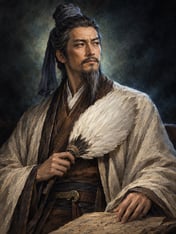 Zhuge LiangLivedCommanderTalk to me
 Sima YiCommanderTalk to me
 Jiang WeiWarriorTalk to me
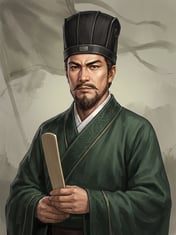 Yang YiAdvisorTalk to me
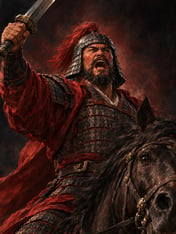 Wei YanWarriorTalk to me
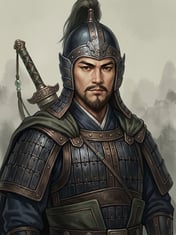 Ma DaiWarriorTalk to me
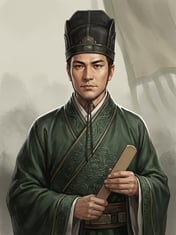 Fei YiAdvisorTalk to me
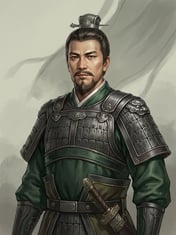 Guo HuaiCommanderTalk to me
1 more: Sun Quan
Famous objectsSeven-Star LampFour-Wheeled Carriage
Ask those who were there →Zhuge Liang, Sima Yi, Jiang Wei and others answer you togetherWho won, as each book tells it; commanders as the text names them.
Records
No victor stated
Vol. 3「會亮卒,其軍退還」
Romance
No victor stated
Ch. 104「蜀兵已盡退矣」
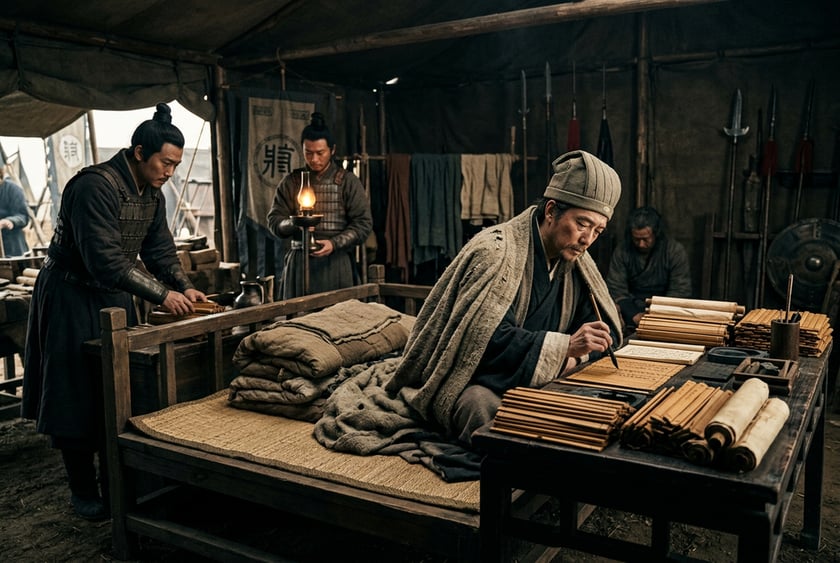
Scene
In the Shu army camp at Wuzhang Plains, Zhuge Liang lies ill in bed, his face haggard. Official documents are piled on the table before him, yet he is still reviewing them.
Featured people: Zhuge Liang
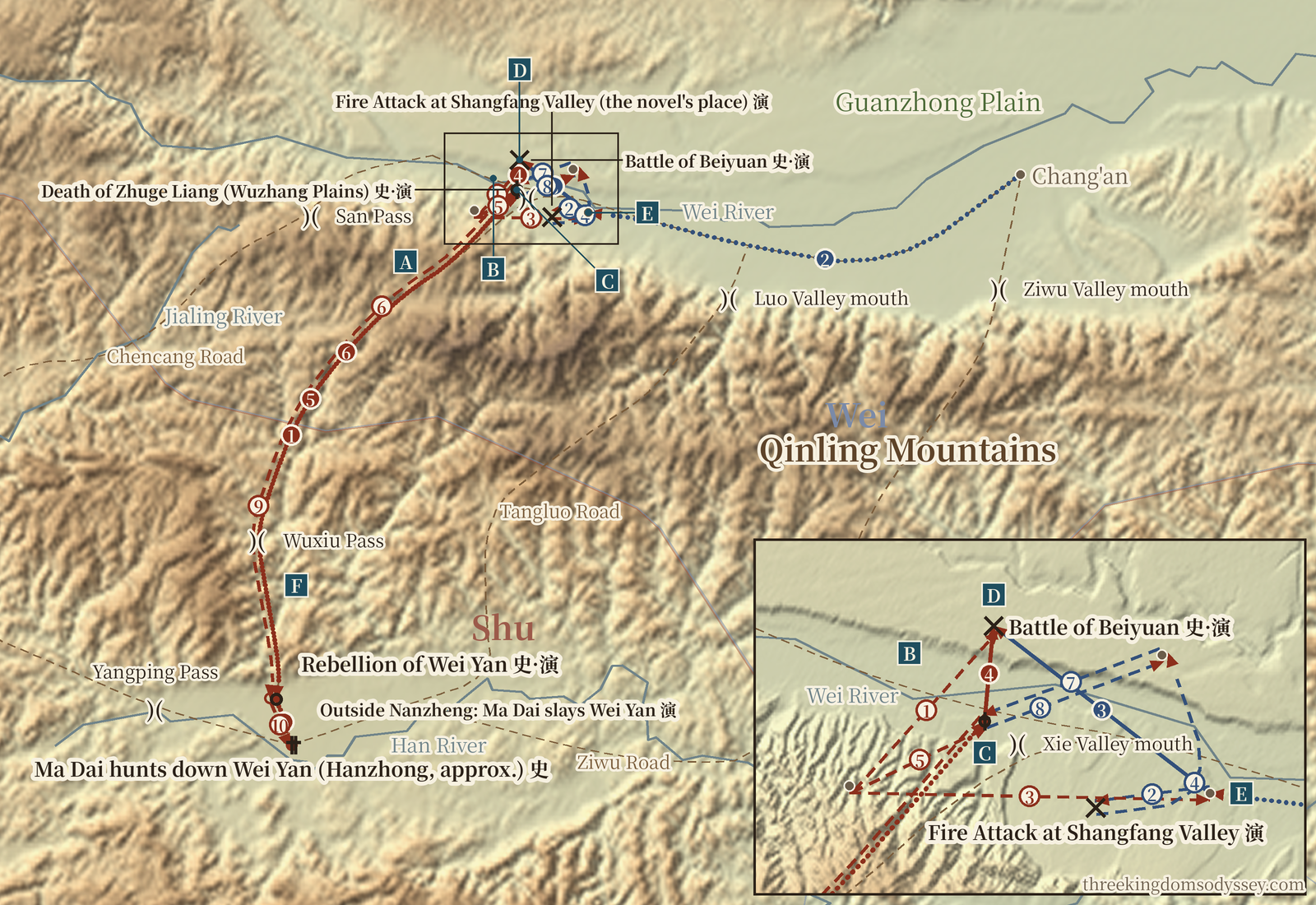
Swipe to see the whole map
The novel first camps at 'Qishan', moves to Wuzhang later, and adds Shangfang Valley, the star prayer and the wooden statue.
The books mostly say only where an army set out and arrived: a Records line is solid between the places they name and dotted where it follows a reconstructed road between them; an open ring marks an end the books don't give.
Base map: Natural Earth; terrain: AWS Terrain Tiles (SRTM and others). Roads and marches reconstructed from the sources listed; positions approximate.
Replay the battles on this map in 3D, phase by phase:▶ Battle of Wuzhang Plains
Continue
Replay the Battle of Wuzhang Plains phase by phase on real terrain: troop strengths, movements and turning points at a glance, each marked as coming from the Records of the Three Kingdoms or the Romance.
2317 people in common
2314 people in common
2314 people in common
2284 people in common
2293 people in common
2283 people in common
2283 people in common
2283 people in common
The Battle of Wuzhang Plains was not a decisive engagement defined by the capture of cities or the destruction of an enemy’s main force. Rather, during Zhuge Liang's Fifth Northern Expedition, Shu Han sought to turn sustained military pressure into gains in Guanzhong, while Wei sought to avoid a decisive battle under unfavorable conditions. In the spring of 234, Zhuge Liang led his forces out through Xie Valley, advanced to Wuzhang Plains in Wugong, and faced Sima Yi across the Wei River. The Shu army used oxen carts to transport supplies and cultivated fields along the Wei’s banks, showing that its aim went beyond a brief offensive: it sought to establish a supply base for a long-term deployment.
Shu Han’s structural weakness was its fragile supply line. Zhuge Liang had repeatedly been unable to fully pursue his strategic aims because food supplies failed to keep pace. Cultivation during this campaign was a direct response to that constraint. But farming took time and required the army to maintain its camps, transport routes, and fields under enemy pressure. Wei, by contrast, was in a position to wear down the Shu army by holding its ground and waiting for its supply difficulties to emerge. The two sides were therefore contesting not only territory, but also which of them could turn time to its advantage.
The main Shu army occupied Wuzhang Plains, advanced toward the south bank of the Wei, and cultivated fields along the river. Zhuge Liang used fortified camps and farming to sustain a prolonged presence, while repeatedly issuing challenges in an effort to force Sima Yi to fight. The Records of the Three Kingdoms does not provide complete troop numbers or precise lines of deployment, so later novelistic accounts of camps, pontoon bridges, and large-scale troop dispositions should not be treated as direct descriptions of battlefield conditions. What can be established is that Shu was advancing on its own initiative, while Wei held its ground and responded defensively.
On the Wei side, Sima Yi stationed his forces south of the Wei River and faced the Shu army. Guo Huai judged that Zhuge Liang might cross the Wei, occupy the northern plateau, link up with the northern hills, and threaten the road to Longyou. He advised occupying the northern plateau first, and Sima Yi accepted his proposal. The Shu army once made a show of moving west, then launched a night attack on Yangsui, but failed because the Wei forces were prepared. This shows that Wei was not simply waiting passively: it used assessments of key terrain, forward defenses, and the preservation of its main force to reduce the risk of a surprise attack.
The first key decision was whether Wei should go on the offensive. The historical record states that Zhuge Liang issued challenges repeatedly, but Sima Yi remained behind his fortifications and refused to engage. Emperor Ming of Wei issued an order to hold the walls and blunt the Shu army’s advance, then wait until its provisions ran out and it withdrew before pursuing it with rested troops. Xin Pi was given imperial authority to restrain the commanders, showing that “avoiding a decisive battle” was not merely Sima Yi’s personal judgment but a policy institutionally backed by the Wei court. This sacrificed the chance of a quick victory but made Shu’s supply pressure part of Wei’s campaign plan.
The second decision concerned how Shu could break the deadlock. Cultivation prolonged the time the Shu army could remain in the field, but could not by itself force Wei to change its strategy. Challenges, feints, and operations around the northern plateau and Yangsui were all attempts to create situations that Wei would have to answer. Guo Huai’s correct prediction and Wei’s preparedness at Yangsui reflect the effectiveness of Wei’s reconnaissance and deployment. But the failure of one surprise attack does not prove that Shu had lost all capacity to act, and the Records of the Three Kingdoms does not provide a complete account of the subsequent fighting between the two sides.
The third decision—and the change most decisive for the course of the campaign—was the transfer of command after Zhuge Liang’s death. During his lifetime, Zhuge Liang arranged the order of withdrawal with Yang Yi, Fei Yi, Jiang Wei, and others, assigning Wei Yan to bring up the rear. After Zhuge Liang died, Wei Yan argued that the army should continue campaigning, while Yang Yi withdrew according to the established plan. Their dispute escalated into armed conflict. Wei Yan was defeated and fled, and Yang Yi ordered Ma Dai to pursue and kill him. The Shu army thus shifted from fighting Wei to maintaining internal order and withdrawing safely, making it effectively impossible to continue pursuing the campaign’s objectives.
As far as the military outcome is concerned, the surviving sources are insufficient to determine that the engagement at Wuzhang Plains ended in a clear victory for either side. After Zhuge Liang died, the Shu army withdrew. Wei had not forced it into a decisive battle during his lifetime, and there is no evidence that Shu captured any key location in Guanzhong. Sima Yi later inspected the Shu army’s camps and called Zhuge Liang “a rare genius under heaven.” The more cautious conclusion is that Shu failed to achieve a strategic breakthrough in its northern expedition, while Wei successfully held the line and waited for its opponent to withdraw. This does not mean, however, that the campaign can simply be classified as a crushing victory.
The withdrawal showed that continuity of command was itself part of an army’s fighting strength. Yang Yi and the others organized the withdrawal, while Wei Yan burned the plank roads and held a valley entrance to block the way. The Shu army briefly faced the danger of its retreat route being cut off. He Ping rebuked Wei Yan, after which Wei Yan’s followers deserted him and the internal conflict quickly ended. The Death of Wei Yan was not the result of his being killed by Wei forces on the battlefield, but of an internal power struggle within Shu. The episode exposed the fragility of the arrangements for succession after Zhuge Liang’s death, and showed that although advance orders for a withdrawal were militarily necessary, they could not fully dispel suspicion among the commanders.
Later novels dramatized the stand-off, the challenges, star-gazing, prayers for divine aid, and the episode in which Wei Yan trampled out Zhuge Liang’s main lamp. These stories are useful for studying how traditional narratives shaped the images of Zhuge Liang and Sima Yi, but they cannot replace the limited account of the campaign found in the historical sources. In particular, stories such as “the dead Zhuge Liang drove away the living Zhongda” must be distinguished from the withdrawals, pursuit, and standoff that can be confirmed from the Records of the Three Kingdoms. In analyzing this campaign, verifiable facts, alternative accounts cited in Pei Songzhi’s annotations, and fictional episodes must be treated separately.
Had Sima Yi gone against the policy of holding his position and launched an attack, he might have disrupted Shu’s farming and camp arrangements. But the Wei court explicitly ordered him to hold his defenses and wait for the enemy precisely because Shu’s momentum had not yet faded; a rash decision to fight might have staked Wei’s advantages in manpower and terrain on a single high-risk engagement. The surviving sources cannot show that an offensive by Wei would necessarily have ended in victory or defeat. A more reasonable inference is that if Wei had gone on the offensive, the outcome of the campaign would have depended more heavily on local conditions around the Wei River and the northern plateau, rather than necessarily changing Shu Han’s overall logistical disadvantage.
Had Zhuge Liang remained in command, or had the Shu army avoided the conflict between Wei Yan and Yang Yi, it might have withdrawn in better order and perhaps maintained pressure along the front for some time. But turning a prolonged presence into a breakthrough would still have required resolving the problems of supply, Wei’s refusal to engage, and control of key terrain. Conversely, even if Wei Yan advocated continuing the campaign, his determination alone does not prove that Shu was capable of sustaining an offensive. The sources closely link Zhuge Liang’s death with the withdrawal of the entire army, but do not provide enough information to establish that a different command arrangement would have changed the strategic outcome.
The most important aspect of Wuzhang Plains, then, is not a definitive label of victory or defeat, but the encounter between two approaches to warfare: Shu Han used cultivation and active challenges in an effort to prolong the campaign and find a way to break the deadlock, while Wei sought to control risk through anticipating the enemy’s use of terrain, carefully limiting its engagements, and waiting for the enemy to be worn down. Zhuge Liang’s death ended the stalemate before Shu had achieved a breakthrough; the Rebellion of Wei Yan then turned an external strategic setback into an internal crisis of power. The outcome is unclear not because the campaign had no military consequences, but because the question of “who won the engagement” cannot capture its limited progress, withdrawal, and political-military upheaval.