Shu Han · General
Jiang Wei
courtesy name 伯约 · 202–264
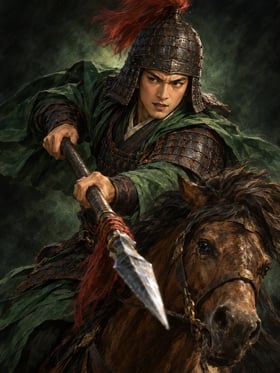
Jiang Wei was a youthful general, leveling his spear and spurring his horse.

Life
In the novel: 27 chapters · In the Records: 15 volumes
Life202–264
228 CE (Taihe 2)
12 more events
229 CE (Taihe 3)
231 CE (Taihe 5)
234 CE (Qinglong 2)
238 CE (Jingchu 2)
249 CE (Jiaping 1)
- Battle of QuchengMount QuCommander
253 CE (Jiaping 5)
255 CE (Zhengyuan 2)
- Battle of TaoxiTaoxiCommander
256 CE (Ganlu 1)
- Battle of DuanguDuanguCommander
261 CE (Jingyuan 2)
262 CE (Jingyuan 3)
263 CE (Jingyuan 4)
- Jiang Wei's Retreat to JiangeJiangeCommander
263 CE (Jingyuan 4)
264 CE (Xianxi 1)
- Zhong Hui's RebellionChengduInstigator
List all 12 stops
- Jicheng202–228BirthplaceTianshui Revolts
- Wudu229Zhuge Liang's Third Northern Expedition
- Mount Qi231Zhuge Liang's Fourth Northern Expedition
- Wuzhang Plains234Battle of Wuzhang Plains
- Nanzheng234Rebellion of Wei Yan
- Mount Qu249Battle of Qucheng
- Mount Qi253Jiang Wei's Later Northern Expeditions
- Taoxi255Battle of Taoxi
- Duangu256Battle of Duangu
- Tazhong262Jiang Wei's Agricultural Garrison at Tazhong to Avoid Trouble
- Jiange263Jiang Wei's Retreat to Jiange
- Chengdu264Died hereZhong Hui's Rebellion
On the boards
Compare with someone →Where this person ranks on each board.
- Most Battles Lost: #3Records
- Saw Through the Most: #4Romance
- Master Strategists: #4Romance
- Most Advisors: #5Romance
- Plans That Worked: #5Romance
- Best Duel Record: #7Romance
- Most Battles: #7Both
- Most Duel Wins: #8Romance
- Best Connected: #9Romance
- Most Betrayed: #10Records
- Most Battles Won: #11Records
- Most Foes Defeated: #11Romance
- Most Talkative: #11Romance
- Most Defections: #13Records
- Novel Embellished: #14Both
- Stratagem Success Rate: #20Romance
Who they were
Character profile
- Appearance
- Jiang Wei was a youthful general, leveling his spear and spurring his horse.
- Character
- Jiang Wei was eager to establish merit and fame, sharp in military matters, endowed with both daring and integrity, tireless in study, and pure and frugal. From boyhood he read widely, mastering both the art of war and the martial arts; he served his mother with utmost filial devotion, was fully furnished with wisdom and courage, deeply grasped Kongming's methods, was skilled in the variations of battle formations, unshaken in the face of change, undaunted through repeated campaigns, upright, loyal, and brave.
- Manner of speech
- Jiang Wei spoke with a grave, forthright manner, dissecting matters point by point, first tearing down and then building up; before the ranks he would announce his name and lineage and set out military reasoning cleanly. At times he was proud and composed, given to irony when discussing formations; at times he decided in clipped phrases, drew analogies in analyzing the enemy, sighed at Heaven's will in peril, was concise and firm, took responsibility gravely, was spirited and full of strategy, and cited ancient precedents in remonstrance.
- Life
- Jiang Wei was a native of Ji in Tianshui; his father Jiang Jiong had served as a commandery meritorious officer and died on the field of battle. He served as a Gentleman of the Palace and took part in his home commandery's military affairs, then submitted to Zhuge Liang, holding in succession the offices of Right Army Supervisor and General Who Assists the Han, Grand General Who Guards the West and concurrently Inspector of Liang Province, General of the Guard, and General-in-Chief, directing the western campaigns. After Shu fell, he sought to feign surrender to Zhong Hui in a scheme to restore the state; the plot failed and he was killed.
- Weapons
- Jiang Wei chiefly used the spear, also the bow and arrow, and once employed the repeating-crossbow method (with poisoned bolts) transmitted by the Marquis of Wu, as well as the sword.
- Anecdotes
- Jiang Wei was the chief commander of Shu Han's northern campaigns, directing military affairs until Shu's fall. He built the two forts of Qushan, repeatedly harassed the Wei frontier, later fell back to defend Jiange Pass, and in the end feigned submission to Zhong Hui in a bid to restore the Han.
Historical Record
Jiang Wei, courtesy name Boyue, was a Shu Han general. He successively held the posts of General of the Household Who Assists the Army and General of the Guards, and was later promoted to General-in-Chief, commanding the army for many years while bearing responsibility for the northern expeditions and frontier defense. He once received the surrender of the Liang Province Hu chieftains Baihuwen, Zhi Wudai, and their followers, and settled them in Fan County; he also put down a revolt by the Pingkang tribes of Wenshan. His northern expeditions met with both success and failure: he was unable to win when campaigning against Yong Province and Xiping; in the seventeenth year of Yanxi, he led an army into Longxi, captured Didao, He Guan, and Lintao counties, and moved the local population to Mianzhu and Fan County.
In the eighteenth year of Yanxi, Jiang Wei routed Wang Jing, Inspector of Yong Province in Wei, at Taoxi. Wang Jing retreated to Didao, while Jiang Wei was stationed at Zhongti. The following year, Jiang Wei arranged to rendezvous with Hu Ji at Shanggui, but Hu Ji failed to arrive at the appointed time. Jiang Wei was subsequently defeated by Deng Ai and withdrew to Chengdu. He later advanced through Luogu to Mangshui, and returned to Chengdu in the first year of Jingyao. In the fifth year of Jingyao, he sent troops to Houhe, where he was again defeated by Deng Ai, and withdrew to Dazhong.
In the fourth year of Jingyuan, Wei forces invaded Shu. Jiang Wei withdrew from Dazhong and, after reaching Yinping, joined forces with Zhang Yi, Liao Hua, and others to defend Jianmen Pass against Zhong Hui. After Liu Shan surrendered to Wei, he ordered Jiang Xian to convey the command to Jiang Wei; Jiang Wei ultimately fell with the Shu Han regime. Wei accounts repeatedly portray Jiang Wei as a formidable opponent in the northern campaigns: Chen Tai once besieged the two fortresses Jiang Wei had built at Qushan. Jiang Wei came from Niutou Mountain to relieve them, but withdrew when the situation turned against him; during the siege of Didao, he also withdrew after Wei reinforcements arrived.
In the Novel
The Romance of the Three Kingdoms introduces Jiang Wei as a rare young military talent. He came from Jixian in Tianshui, and the novel describes him as widely read, knowledgeable in military strategy and martial arts, and deeply filial to his mother. After seeing through a Shu army ruse, he laid an ambush and engaged Zhao Yun, drawing Zhuge Liang’s attention to his abilities. Zhuge Liang then exploited news that Jiang Wei’s mother was in Jixian, as well as the mutual suspicions among the three Tianshui cities, trapping Jiang Wei between Wei forces who distrusted him and Shu forces closing in. After Jiang Wei defected to Shu, the novel has Zhuge Liang take his hand in welcome and regard him as the successor to whom he could pass on all he had learned. This complete tale of recognizing his talent, sowing discord, and winning his surrender is the novel’s creation, not something recorded in the historical accounts cited above.
After joining Shu, Jiang Wei becomes a strategist trusted by Zhuge Liang in the novel, often ordered to lead troops, set ambushes, or carry out surprise attacks. He helps lure Wei forces into traps and seize San Pass, and also divides his forces with Wang Ping to capture Wudu and Yinping. Acting on Zhuge Liang’s secret instructions, he and Liao Hua also attack Sima Yi’s camp. These episodes emphasize his resourcefulness, courage, and trust in Zhuge Liang; the specific battles and stratagems should be understood as the novel’s inventions, not confused with the historical campaigns.
Key Relationships
- Zhuge Liang: The historical accounts present Jiang Wei’s long northern campaigns and clashes with Wei forces, but the cited passages do not depict the novel’s teacher-disciple scenes. In the novel, Zhuge Liang recognizes his talent, engineers his defection to Shu, and then regards him as a candidate to inherit his military learning. (Novel-only)
- Wang Jing and Deng Ai: Jiang Wei’s defeat of Wang Jing at Taoxi was an important victory; he was later defeated by Deng Ai in battles at Shanggui, Houhe, and elsewhere. Wei’s efforts to defend against and pursue him ran throughout the later part of his military career.
- Zhong Hui and Liu Shan: When Wei forces entered Shu, Jiang Wei withdrew to Jianmen Pass to resist Zhong Hui. After Liu Shan surrendered to Wei, he sent someone to convey his command, and the Shu Han military and political system collapsed thereafter.
- Jiang Wei’s mother and Zhao Yun: In the novel, Jiang Wei’s mother becomes the key concern that leads him to leave Wei; Zhao Yun encounters Jiang Wei at Tianshui, fights him, and marvels at his spear skills. (Novel-only)
Signature Scenes
- Great Victory at Taoxi: Jiang Wei led his army out from Didao and routed Wang Jing at Taoxi. Wei suffered heavy casualties, and Wang Jing retreated to hold Didao. This is a prominent victory explicitly recorded in the historical accounts, showing that Jiang Wei’s northern campaigns were not uniformly unsuccessful.
- Retreat to Dazhong: Jiang Wei was defeated by Deng Ai at Houhe and withdrew to Dazhong. When Wei forces attacked in the fourth year of Jingyuan, he again withdrew from Dazhong and made his way back to defend Jianmen Pass. The shifts between victory and defeat reflect his increasingly difficult military position.
- Recognition and Defection at Tianshui: The novel has Jiang Wei see through a stratagem and ambush Zhao Yun, then fall out of favor with the local garrison because of Zhuge Liang’s schemes, ultimately surrendering in the mountains. Zhuge Liang gets down from his carriage and takes his hand in welcome, a scene that crystallizes the novel’s theme of “recognizing a hero and gaining a fine general.” (Novel-only)
- Holding Jianmen Pass against Zhong Hui: The Shu Han generals Jiang Wei, Zhang Yi, and Liao Hua joined forces to defend Jianmen Pass and block Zhong Hui’s advance; this was a key defensive stand before Shu’s fall in the historical accounts. The novel later depicts Jiang Wei carrying out a surprise attack on a camp under secret instructions, emphasizing his strategic abilities, but these specific events belong to the novel. (The camp attack is novel-only)
Quotes
117 lines in the books · 3 featured
「不然。昔丞相未出茅廬,已定三分天下,然且六出祁山以圖中原;不幸半途而喪,以致功業未成。今吾既受丞相遺命,當盡忠報國以繼其志,雖死而無恨也。今魏有隙可乘,不就此時伐之,更待何時?」
Jiang Wei carried on Zhuge Liang's unfinished will, launching northern campaigns into the Central Plains, reflecting his loyalty.
「望陛下忍數日之辱,維將使社稷危而復安,日月幽而復明,必不使漢室終滅也。」
Jiang Wei stayed composed in crisis, seeking to restore the House of Han, displaying his loyal courage and cunning.
「吾計不成,乃天命也!」
Jiang Wei, defeated and dying, laments the will of Heaven-a portrayal of his tragic end.
- Family
- Lord & vassal
- Friends
- Enemies
- Other
History vs. novel
8 points · 2 novel-only
| History | Novel |
|---|---|
| Seeking refuge with Zhuge LiangNovel embellishes | |
Suspecting that Jiang Wei and the others harbored treacherous intentions, the Administrator of Tianshui fled to Shanggui by night. Jiang Wei and the others could not enter the city, and were also turned away when they went to Jixian, so they all went to seek refuge with Zhuge Liang. vol. 44 | The novel has Jiang Wei first see through Zhuge Liang’s feigned-surrender ploy, then set an ambush to capture him. After Jicheng fell and Ma Zun refused to take him in, Jiang Wei had nowhere else to turn and surrendered; Zhuge Liang even came out to welcome him in person. ch. 93 |
| Clashing with Zhao YunNovel only | |
| — | Jiang Wei fought Zhao Yun for several bouts, prompting Zhao Yun to marvel that such a remarkable figure could be found here. This highlights Jiang Wei’s martial prowess when he first appears. ch. 93 |
| Esteemed by Zhuge LiangNovel embellishes | |
Zhuge Liang praised Jiang Wei as loyal and diligent, with a keen and discerning mind. He considered him a leading scholar of Liang Province and commended his quick grasp of military affairs and deep understanding of the art of war. vol. 44 | The novel portrays Zhuge Liang’s admiration for Jiang Wei as a personal welcome, with Zhuge Liang taking him by the hand and saying that after searching everywhere for worthy men, he had finally found someone to whom he could impart all he had learned in his lifetime. ch. 93 |
| Driving Sima Yi back in terrorNovel only | |
| — | After Zhuge Liang’s death, Jiang Wei withdrew with the army. The novel has Sima Yi pursue them into an empty camp, where he sees Kongming’s banners and carriage effigy and retreats in panic. Jiang Wei also shouts from the rear that the Wei army has fallen into a trap. ch. 104 |
| Great victory at TaoxiNovel embellishes | |
Jiang Wei defeated Wang Jing at Taoxi, and tens of thousands of Wang Jing’s troops died in the Tao River. Jiang Wei later besieged Didao but failed to capture the city. vol. 45 | The novel depicts Jiang Wei luring the enemy into a desperate position with his back to the river, while Zhang Yi and Xiahou Ba attack from both sides. The Wei army is routed with heavy casualties, after which Jiang Wei presses on with the attack on Didao. ch. 110 |
| Defeat at ShangguiSources disagree | |
The official histories record that Jiang Wei arranged to rendezvous with Hu Ji at Shanggui, but Hu Ji failed to keep the appointment. Jiang Wei was defeated by Deng Ai at Duangu, suffering heavy losses, and retreated to Chengdu. vol. 44 | The novel has Jiang Wei fight his way out after being trapped at Duangu. He also shoots Guo Huai dead and defeats Sima Shi, eventually retreating to Yangping Pass and ending on a victorious note. ch. 111 |
| The two forts at QushanNovel embellishes | |
Jiang Wei ordered Ju An and Li Xin to defend the two forts at Qushan. The Wei army cut off their supply routes and the water source outside the forts. When Jiang Wei came to their aid, Chen Tai and the others found a way to cut off his retreat. Jiang Wei withdrew, and Ju An and the others surrendered. vol. 22 | The novel has Jiang Wei and Xiahou Ba use the two forts at Qushan as mutually supporting positions. Jiang Wei is then blocked by Chen Tai at Niutou Mountain, while Guo Huai cuts off his supplies. Though he breaks through and withdraws, the novel says he escapes after defeating Sima Shi. ch. 107 |
| A secret plot in ChengduNovel embellishes | |
During Zhong Hui’s rebellion, Jiang Wei urged him to execute the Wei generals and sent Liu Shan a secret letter saying that he was willing to endure humiliation in order to restore Shu. Rebels killed both Zhong Hui and Jiang Wei, and Jiang Wei’s wife and children were also put to death. vol. 28 | The novel elaborates on Jiang Wei citing the examples of Han Xin and Wen Zhong to urge Zhong Hui to retire, and secretly informing Liu Shan to endure humiliation for a few days while plotting to restore Shu Han. Jiang Wei and Zhong Hui were ultimately both killed. ch. 119 |
- Seeking refuge with Zhuge LiangNovel embellishes
- History
Suspecting that Jiang Wei and the others harbored treacherous intentions, the Administrator of Tianshui fled to Shanggui by night. Jiang Wei and the others could not enter the city, and were also turned away when they went to Jixian, so they all went to seek refuge with Zhuge Liang.
vol. 44
- Novel
The novel has Jiang Wei first see through Zhuge Liang’s feigned-surrender ploy, then set an ambush to capture him. After Jicheng fell and Ma Zun refused to take him in, Jiang Wei had nowhere else to turn and surrendered; Zhuge Liang even came out to welcome him in person.
ch. 93
- Clashing with Zhao YunNovel only
- Novel
Jiang Wei fought Zhao Yun for several bouts, prompting Zhao Yun to marvel that such a remarkable figure could be found here. This highlights Jiang Wei’s martial prowess when he first appears.
ch. 93
- Esteemed by Zhuge LiangNovel embellishes
- History
Zhuge Liang praised Jiang Wei as loyal and diligent, with a keen and discerning mind. He considered him a leading scholar of Liang Province and commended his quick grasp of military affairs and deep understanding of the art of war.
vol. 44
- Novel
The novel portrays Zhuge Liang’s admiration for Jiang Wei as a personal welcome, with Zhuge Liang taking him by the hand and saying that after searching everywhere for worthy men, he had finally found someone to whom he could impart all he had learned in his lifetime.
ch. 93
- Driving Sima Yi back in terrorNovel only
- Novel
After Zhuge Liang’s death, Jiang Wei withdrew with the army. The novel has Sima Yi pursue them into an empty camp, where he sees Kongming’s banners and carriage effigy and retreats in panic. Jiang Wei also shouts from the rear that the Wei army has fallen into a trap.
ch. 104
- Great victory at TaoxiNovel embellishes
- History
Jiang Wei defeated Wang Jing at Taoxi, and tens of thousands of Wang Jing’s troops died in the Tao River. Jiang Wei later besieged Didao but failed to capture the city.
vol. 45
- Novel
The novel depicts Jiang Wei luring the enemy into a desperate position with his back to the river, while Zhang Yi and Xiahou Ba attack from both sides. The Wei army is routed with heavy casualties, after which Jiang Wei presses on with the attack on Didao.
ch. 110
- Defeat at ShangguiSources disagree
- History
The official histories record that Jiang Wei arranged to rendezvous with Hu Ji at Shanggui, but Hu Ji failed to keep the appointment. Jiang Wei was defeated by Deng Ai at Duangu, suffering heavy losses, and retreated to Chengdu.
vol. 44
- Novel
The novel has Jiang Wei fight his way out after being trapped at Duangu. He also shoots Guo Huai dead and defeats Sima Shi, eventually retreating to Yangping Pass and ending on a victorious note.
ch. 111
- The two forts at QushanNovel embellishes
- History
Jiang Wei ordered Ju An and Li Xin to defend the two forts at Qushan. The Wei army cut off their supply routes and the water source outside the forts. When Jiang Wei came to their aid, Chen Tai and the others found a way to cut off his retreat. Jiang Wei withdrew, and Ju An and the others surrendered.
vol. 22
- Novel
The novel has Jiang Wei and Xiahou Ba use the two forts at Qushan as mutually supporting positions. Jiang Wei is then blocked by Chen Tai at Niutou Mountain, while Guo Huai cuts off his supplies. Though he breaks through and withdraws, the novel says he escapes after defeating Sima Shi.
ch. 107
- A secret plot in ChengduNovel embellishes
- History
During Zhong Hui’s rebellion, Jiang Wei urged him to execute the Wei generals and sent Liu Shan a secret letter saying that he was willing to endure humiliation in order to restore Shu. Rebels killed both Zhong Hui and Jiang Wei, and Jiang Wei’s wife and children were also put to death.
vol. 28
- Novel
The novel elaborates on Jiang Wei citing the examples of Han Xin and Wen Zhong to urge Zhong Hui to retire, and secretly informing Liu Shan to endure humiliation for a few days while plotting to restore Shu Han. Jiang Wei and Zhong Hui were ultimately both killed.
ch. 119
Combat
On the field
Duels, kills and executions as the texts tell them, counted separately for the Records and the Romance.
Duel them- RomanceCh. 93DuelZhao YunBroken off「雲挺槍直取姜維。戰不數合,維精神倍長」
- RomanceCh. 93DuelWei YanBroken off「二將交鋒數合,延詐敗奔走」
- RomanceCh. 93DuelZhang YiWang PingLost「維力窮抵敵不住,奪路歸城」
- RomanceCh. 107DuelChen TaiWon「戰不三合,泰敗走」
- RomanceCh. 107DuelSima ShiWon3 bouts「只三合,殺敗了司馬師」
- RomanceCh. 109Struck downXu ZhiWon「被眾軍亂刀砍死」
All encounters (13)
Loading…
Battles in command
Battles this person commanded in, with the outcome as each text tells it.
- Records
- 1W 3L 0D 1 undecided
- Romance
- 1W 2L 0D 2 undecided
- Records238Jiang Wei's Northern ExpeditionsUndecidedvs Wei's armyJuan 44「維本羈旅托國,累年攻戰,功績不立」
- Romance238Jiang Wei's Northern ExpeditionsUndecidedvs Wei troopsCh. 115「維只得遵命,先令洮陽兵退,次後與張翼徐徐而退」
- Records249Battle of QuchengLostvs Wei's armyJuan 22「维惧,遁走,安等孤县,遂皆降」
- Romance249Battle of QuchengLostvs Wei troopsCh. 108「句安見援兵不至,乃開門降魏。姜維折兵數萬,領敗兵回漢中屯紮」
- Records253Jiang Wei's Later Northern ExpeditionsLostvs Wei's armyJuan 44「維率眾出漢、侯和,為鄧艾所破,還住沓中」
- Romance253Jiang Wei's Later Northern ExpeditionsUndecidedvs Wei's armyCh. 115「維只得遵命,先令洮陽兵退,次後與張翼徐徐而退」
All battles (10)
Loading…
Stratagems
Plans this person devised or saw through, as the texts tell them.
- Records
- 3 carried out · 1 worked · 0 turned down · 0 seen through
- Romance
- 19 carried out · 10 worked · 0 turned down · 4 seen through
- RecordsAmbushAmbushSeen throughagainst Tai's armyJuan 22「泰诡從南道,维果三日施伏」
- RecordsMake a Sound in the East, Strike in the WestFeintSeen throughagainst WeiJuan 28「此維使化持吾,令不得還。維必自東襲取洮城」
- RecordsMake a Sound in the East, Strike in the WestFeintWorkedagainst YongzhouJuan 28「維入北道三十餘里,聞緒軍卻,尋還,從橋頭過」
- RomanceLure the Tiger Out of the MountainLureSaw throughagainst TianshuiCh. 93「汝中吾姜伯約之計,尚然不知耶」
- RomanceAmbushAmbushWorkedagainst Shu troopsCh. 93「候至半夜,忽然四下火光沖天,喊聲震地,正不知何處兵到」
- RomanceSowing DiscordSowing discordWorkedagainst TianshuiCh. 93「當寫密書二封,射入城中,使其內亂,城可得矣」
All stratagems (26)
Loading…
Events
Events (27)
Battles and events the texts place this person in, by date.
Battles
- 228First Northern ExpeditionWarrior
- 228Zhuge Liang's Second Northern Expedition
- 228Battle of Jieting
- 228Zhuge Liang's Northern ExpeditionsWarrior
- 229Zhuge Liang's Third Northern ExpeditionWarrior
- 230Cao Zhen's Invasion of Shu
- 231Zhuge Liang's Fourth Northern ExpeditionWarrior
- 234Battle of Wuzhang PlainsWarrior
All 13
- 238Jiang Wei's Northern ExpeditionsCommander
- 249Battle of QuchengCommander
- 253Jiang Wei's Later Northern ExpeditionsCommander
- 255Battle of TaoxiCommander
- 256Battle of DuanguCommander
Other events
- 228Tianshui RevoltsWarrior
- 228Battle for Chencang
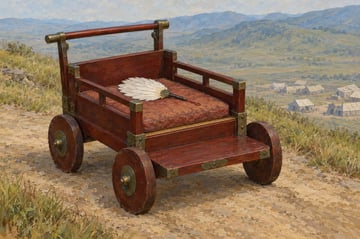
- 231Wooden Ox and Flowing Horse
- 231Zhang He Shot Dead at Mumendao
- 234Fire Attack at Shangfang Valley
- 234Rebellion of Wei YanCommander
- 257Zhuge Dan's Rebellion
- 258Huang Hao's Usurpation of Power
All 14
- 261Great Defeat of Deng Ai at Tanshan ValleyCommander
- 262Jiang Wei's Agricultural Garrison at Tazhong to Avoid TroubleCommander
- 263Jiang Wei's Retreat to JiangeCommander
- 263Conquest of Shu by Wei
- 263Deng Ai's Surprise Attack Through YinpingCommander
- 264Zhong Hui's RebellionInstigator
Famous objects

Places
Continue
The Battle of Wuzhang Plains in 3D
Replay the Battle of Wuzhang Plains phase by phase on real terrain: troop strengths, movements and turning points at a glance, each marked as coming from the Records of the Three Kingdoms or the Romance.
Relationship timeline34 entries ▸
History · vol. 4
- Wang Jing§39
Enemy
Fought at Taoxi and suffered a major defeat
History · vol. 22
History · vol. 28
- Zhong Hui§88
Fights
fought alongside those at the gathering, personally killing five or six men; was later slain by the crowd
History · vol. 33
- Deng Ai§36
Fights
In Yanxi year 19, Jiang Wei was defeated by Deng Ai at Shanggui
History · vol. 40
- Liao Li§33
Witnesses
Later led a detachment through Wenshan to visit Li, saying that his spirit remained undiminished and his speech was as composed as ever
History · vol. 44
All 34
Loading…
Inner monologues · AI-generated3 monologues ▸
- I inherited the Chancellor’s bequest and was ever thinking of using military force to restore the Central Plains. Yet ou
- I was orphaned young and depended on my mother. I once devoted myself to the teachings of the Zheng school. My father, J
- I recall that when I was young, people in my home district already knew me as a native of Jicheng in Tianshui, styled Bo