

Background
Jiang Wei's Retreat to Jiange should not be viewed merely as a tactical withdrawal on the battlefield; it must be understood in the context of the strategic pressure that Shu Han had endured for years. In 263, Wei launched a major invasion of Shu. Zhong Hui attacked toward Hanzhong, while Deng Ai tied down Jiang Wei and chose another route to penetrate deep into Shu. Shu Han had received word that Zhong Hui was assembling his forces, but because Huang Hao trusted divination and the Later Lord set aside the warnings, it failed to make timely preparations to defend Yang’an Pass and the Yinping bridgehead. Only after Wei’s movements became clear were Liao Hua, Zhang Yi, Dong Jue, and others ordered to reinforce the front; by then, the defense system was already being deployed under pressure.
Jiang Wei’s position had both external and internal dimensions. Externally, Wei’s forces were advancing along multiple routes, threatening communications and supply lines. Internally, he faced political conflict with Huang Hao’s faction and a crisis of confidence brought on by years of campaigning without notable success. The Records of the Three Kingdoms relates that Jiang Wei, fearing Huang Hao would form an alliance with Yan Yu and that he himself might be replaced, withdrew to Dazhong. This meant he faced not only a military crisis but also lacked reliable support at court. Jianmen Pass was therefore more than a strategic chokepoint: after the command system had faltered, it became a political and military anchor around which Shu Han sought to rally its defenses.
Key Figures
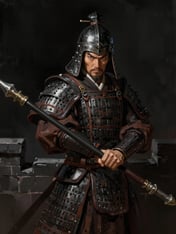
Jiang Wei organized the defensive line, but was also the decision-maker most constrained by the broader circumstances. In Romance of the Three Kingdoms, after meeting up with Zhang Yi and Liao Hua at the bridgehead, he must choose between splitting his forces to engage the enemy and retreating to defend Jiange. He ultimately accepts Liao Hua’s judgment that “if Jianmen Pass falls, there will be no way out.” This portrayal emphasizes Jiang Wei’s caution: with the enemy advancing along multiple routes, the road along the Baishui narrow, and supplies failing to arrive, avoiding a hasty decisive battle, preserving the main force, and using the terrain to resist the enemy offered greater strategic value than contesting a local battlefield.
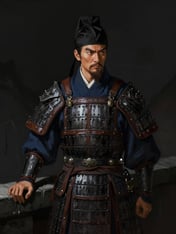
Liao Hua and Zhang Yi offered complementary perspectives on the risks facing the front line. Liao Hua stressed the fate of the roads, supply routes, and passes, while Zhang Yi hurried to the front with troops to provide support, filling the gap left by the court’s delayed dispatch of reinforcements. Zhong Hui was the principal commander of the frontal assault on Jianmen Pass, and his advance forced Jiang Wei to seek a defensible position that could be held over time. But the confrontation before Jianmen Pass was not the only factor that threw Shu’s overall position off balance: the fall of Yang’an Pass was also crucial. Jiang Shu opened the gates and surrendered to Wei, while Fu Qian fought to the death. Their actions show that the same defensive line saw both betrayal and sacrifice, and Shu’s defeat cannot be attributed simply to Jiang Wei’s command.
Dong Jue was also a key commander in the defensive system. He and Zhang Yi were ordered to the area around Yang’an Pass, while Jiang Wei and Liao Hua operated in the direction of Yinping. After the pass fell, the various forces successively withdrew to Jianmen Pass. This suggests that their concentration there was not part of a fully planned set-piece battle, but rather an improvised convergence of scattered forces after communications lagged and strongpoints came under mounting pressure.
Central Issues
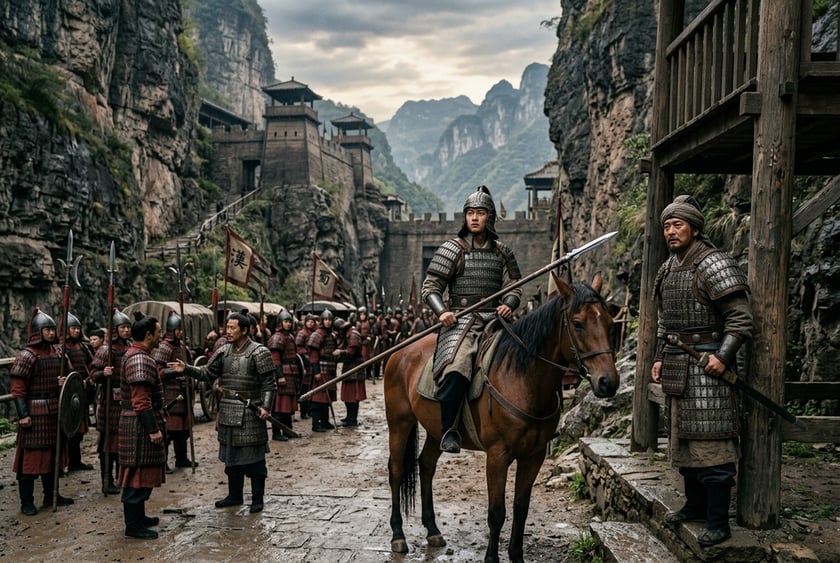
The first issue is whether holding a defensible position could compensate for the loss of strategic depth. The rugged terrain at Jianmen Pass made it difficult for Zhong Hui to break through quickly. The histories state that Jiang Wei established camps and held the pass, which Zhong Hui could not take; with supplies having to travel a great distance, Zhong Hui considered withdrawing. This shows that the pass’s defenses did raise the cost of Wei’s advance and bought time for Shu’s forces. But holding Jianmen Pass was not the same as preserving Shu Han. After Yang’an Pass fell, pressure on the rear and flank of Shu’s forces increased; Deng Ai also opened a route from the direction of Yinping, bypassing the frontal defenses faced by Zhong Hui. The strength of Jianmen Pass thus made it an effective barrier, while also exposing the vulnerability of a defensive system overly dependent on a small number of routes.
The second issue is the relationship between military decision-making and the political information system. Shu Han was not wholly without warning: Jiang Wei had submitted a memorial recommending that Zhang Yi and Liao Hua be sent to defend the passes. The problem was that the warnings did not lead to timely deployment. Huang Hao’s misjudgment of the enemy situation and the Later Lord’s decision to set aside the memorials prevented frontier commanders’ strategic assessments from entering an effective process of state decision-making. From the perspective of modern political history, this is not simply a story of a “loyal minister being obstructed,” but one of failures in decision-making authority, channels of information, and accountability: the commander at the front understood the risks but could not ensure that the central government acted.
The third issue is the difference between the novel’s narrative and the historical record. Romance of the Three Kingdoms portrays the retreat as a split-second decision made by Jiang Wei after he met up with reinforcements at the bridgehead, using Liao Hua’s words to heighten the drama of “preserving a way out.” The Records of the Three Kingdoms, by contrast, places it within the sequence of events in which Yang’an Pass fell, the various armies joined up, and the forces withdrew to Jianmen Pass. The former presents a character’s choice; the latter better explains the systemic context of delayed deployment and fighting on multiple fronts. Any assessment of “Jiang Wei Retreats to Defend Jiange Pass” should therefore distinguish between the tactical wisdom of preserving the main force and the strategic breakdown at the state level.
Political Consequences
The retreat to Jianmen Pass temporarily held up Zhong Hui, but did not restore Shu Han’s defenses as a whole. Zhong Hui’s failure to take Jianmen Pass and the difficulties with supply show that Jiang Wei’s defenses had a real effect. But after Deng Ai advanced from Yinping and defeated Zhuge Zhan at Mianzhu, Chengdu faced a direct threat. The Later Lord surrendered to Deng Ai. Even after learning of this, Jiang Wei and the other commanders tried to confirm the situation, but ultimately received an imperial edict to lay down their arms. In other words, the military resilience of the Jianmen Pass front could not offset the political collapse caused by the fall of the capital and the end of decision-making at court.
The crisis also gave rise to competing narratives of responsibility. Jiang Wei may be regarded as having done all he could to hold the defensive line by standing firm at Jianmen Pass, but he may also be criticized for his years of campaigning and his failure to reverse the defeat. Huang Hao and the central government’s delayed decisions exposed the disorder in internal affairs, while Jiang Shu’s surrender to Wei and Fu Qian’s death in battle made military loyalty and command responsibility central to later assessments. The fall of the state should not be attributed to a single person or one retreat: the historical record shows that failed warnings, the loss of passes, the enemy’s flanking maneuver, and the collapse of the capital together formed the chain of events.
Counterfactual Analysis
If Jiang Wei’s recommendation to assign separate forces to defend Yang’an Pass and the Yinping bridgehead had been acted on promptly, Shu’s forces might have formed a mutually supporting defensive line earlier, reducing the chance that Wei could suddenly seize key strongpoints. Whether Jiang Shu would still have opened the gates, and whether Wei’s forces could still have entered Hanzhong so quickly, might also have changed. But this is only a limited conjecture: even with the passes reinforced, Shu Han still faced Wei’s greater manpower and resources, and the available evidence does not allow us to assert that the deployment would have been sufficient to meet both Zhong Hui’s frontal attack and Deng Ai’s flanking maneuver.
Another possibility is that Jiang Wei might have left Dazhong earlier, concentrated his forces at Jianmen Pass, or repositioned his defenses before Wei advanced. This might have reduced the time needed for the various forces to converge, but it could also have left the Dazhong direction exposed or given the enemy an earlier opportunity to break through. The historical record supports the conclusion that retreating to Jianmen Pass was militarily reasonable under the circumstances, as it preserved the main force and made use of the terrain. But there is insufficient evidence to determine whether the outcome would have changed. Shu Han’s fate depended not only on which route Jiang Wei chose for his retreat, but also on whether the central government could turn warnings into coordinated defense in time and prevent Deng Ai from bypassing the main battlefield.