Fu Qian
–263
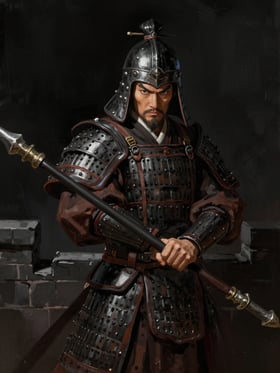
Fu Qian was full of daring and valor; in the fray of battle he feigned an opening to take Wang Zhen alive, and knocked out Li Peng's eyeball with an iron truncheon. He opposed Jiang Shu's plan to hold fast in defense, arguing instead to sally out from the pass and give battle, and swore, 'In life I am a subject of Shu; in death I shall be a ghost of Shu.'

Life
In the novel: 5 chapters · In the Records: 2 volumes
Life?–263
253 CE (Jiaping 5)
261 CE (Jingyuan 2)
263 CE (Jingyuan 4)
- Life event
- Death
List all 3 stops
- Mount Qi253–261Jiang Wei's Later Northern Expeditions+1 more
- Jiange263Jiang Wei's Retreat to Jiange
- Yangping Pass263Died here
On the boards
Compare with someone →Where this person ranks on each board.
10 more boards
- Most Foes Defeated: #29of 78Romance
- Master Strategists: #31of 220Romance
- Plans That Worked: #31of 159Romance
- Most Duel Wins: #33of 54Romance
- Most Generals Slain: #33of 64Romance
- Most Battles: #84of 230Both
- Novel Embellished: #147of 2139Both
- Most Talkative: #179of 607Romance
- Best Connected: #553of 1005Romance
- Overlooked by the Novel: #1411of 2139Both
Who they were
Character profile
- Character
- Fu Qian was full of daring and valor; in the fray of battle he feigned an opening to take Wang Zhen alive, and knocked out Li Peng's eyeball with an iron truncheon. He opposed Jiang Shu's plan to hold fast in defense, arguing instead to sally out from the pass and give battle, and swore, 'In life I am a subject of Shu; in death I shall be a ghost of Shu.'
- Weapons
- The weapons Fu Qian used were a four-edged iron truncheon and a spear.
- Anecdotes
- Fu Qian was a general of Sichuan chosen by Jiang Wei, who once proposed taking the direct route through Luo Valley over Shen Ridge to the Great Wall to burn the enemy's grain and fodder. He once led two thousand troops who had formerly surrendered to Wei to carry grain-transport banners and lure the enemy, crying out, 'Deng Ai, you scoundrel! You have already fallen into my commander's trap.' Fu Qian was Left Palace Gentleman and Commander of Guanzhong of Shu Han; defending Yangping Pass, he died for his country, and men have revered his righteous name for a thousand ages.
Historical Record
Fu Qian was the son of Fu Tong, a general of Shu Han. When Liu Bei was defeated and forced to retreat, Fu Tong held off the enemy and fought to the death after his troops were exhausted. Fu Qian was later appointed Gentleman of the Left and subsequently served as Commander of Guanzhong. In the sixth year of Jingyao (263), Wei forces attacked the passes into Hanzhong. Fu Qian fought inside the fortified pass and ultimately died in battle. The Records of the Three Kingdoms says that he “gave his life in a moment of peril,” and records that commentators praised the generations of loyalty and righteousness shown by the Fu father and son. A passage from the Han-Jin Chunqiu, cited in Pei Songzhi’s commentary, adds that after Jiang Shu left the fortress and surrendered, the Wei general Hu Lie took advantage of the opening to attack it. Fu Qian fought fiercely and died, and the people of Wei also respected his integrity. What the Records of the Three Kingdoms confirms about Fu Qian centers on his office, family background, and death in battle when the fortress fell; it does not record the early campaigns against Wei or the duels described in the novel.
In the Novel
The Romance of the Three Kingdoms portrays Fu Qian as a young, courageous, resourceful commander under Jiang Wei. When Jiang Wei selected Jiang Shu and Fu Qian in Hanzhong to train the troops, Fu Qian proposed crossing Shen Ridge by way of Luo Valley, then making a direct strike on the Great Wall and burning the Wei army’s provisions. His boldness and aggressiveness stand out; both this proposal and Jiang Wei’s praise of it are inventions of the novel, with no corresponding account in the historical records. In the battle at the Great Wall, Fu Qian first lures Wang Zhen into attacking by feigning an opening, then captures him alive and kills Li Peng with a four-edged iron mace. This highlights his bravery and quick thinking in battle; these specific feats, too, appear only in the novel.
The novel also has Fu Qian take part in Jiang Wei’s plan to sow discord among the enemy: he leads two thousand troops disguised as a grain convoy and ambushes Deng Ai in the Tanshan Valley, coordinating with hidden troops to launch the attack using fire signals. The Wei army is routed, though Deng Ai escapes. This episode depicts Fu Qian as a dependable commander capable of carrying out a mission to lure the enemy, but it should not be conflated with the historical account of his last stand in the fortress. Later, Jiang Wei assigns Jiang Shu and Fu Qian to defend the pass together. As the Wei army advances, Fu Qian opposes simply holding the position and urges them to sally forth and attack while the Wei troops are weary from their long march. After Jiang Shu opens the gate and surrenders to Wei, Fu Qian is surrounded and fights on until almost all his troops are lost, then takes his own life in service to his country. The novel brings his image of loyalty and martyrdom to a climax with the vow, “In life I was a Shu subject; in death I shall be a ghost of Shu.” His death accords with the historical account, but the specific dialogue, tactical arguments, and details of his suicide are literary embellishments.
Key Relationships
Fu Tong was Fu Qian’s father. The historical records separately state that Fu Tong died fighting for Liu Bei and that Fu Qian gave his life in a moment of peril in the sixth year of Jingyao; they praise the father and son for their generations of loyalty and righteousness. This is the historical basis for Fu Qian’s family background and image of loyalty. Jiang Shu was Fu Qian’s fellow officer in the defense of the pass and also a key figure in its fall. The passage from the Han-Jin Chunqiu cited in Pei Songzhi’s commentary says that Jiang Shu surrendered, the Wei army took advantage of the opening to attack the fortress, and Fu Qian fought and died. The novel develops their differences into an argument over whether to “hold the pass” or “sally forth,” and has Jiang Shu open the gate and surrender to Wei, leaving Fu Qian surrounded. Jiang Wei was Fu Qian’s superior. The historical records say that Jiang Wei once requested reinforcements to strengthen the defenses against Wei; the novel expands this into Jiang Wei selecting and assigning Fu Qian, and repeatedly entrusting him with attacks, ambushes, and the defense of passes.
Signature Scenes
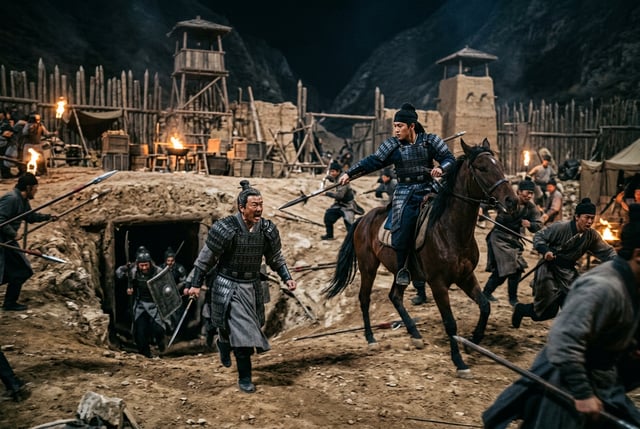
Historical record: Fighting in the fortress and dying in battle. Wei forces attacked the Yangping Pass, and after Jiang Shu opened the gate and surrendered, Fu Qian fought to the death inside the fortress. The account cited in Pei Songzhi’s commentary says that the Wei general Hu Lie took advantage of the opening to attack the fortress, and that Fu Qian stood his ground and fought. The people of Wei respected him for it; this is the most striking episode about Fu Qian in the surviving historical records.
Unique to the novel: A duel at the Great Wall. During the battle at the Great Wall, Fu Qian provokes Wang Zhen into charging at him with his spear, then captures him alive and kills Li Peng with an iron mace, displaying both strength and cunning. This encounter does not appear in the historical records.
Unique to the novel: Ambush in the Tanshan Valley. Fu Qian leads troops disguised as a Wei grain convoy, while Jiang Wei and Xiahou Ba set up a separate ambush. Once Deng Ai enters the valley, they launch their attack with signal fires. The novel uses this episode to emphasize Fu Qian’s ability to carry out Jiang Wei’s plans and to depict a battlefield moment when Shu’s forces briefly gain the initiative.
Historical core and novelistic embellishment: Martyrdom at Yangping Pass. The Records of the Three Kingdoms records that Fu Qian fought and died at the pass. The novel, by contrast, elaborates on his urging the troops to attack, his being betrayed by Jiang Shu, and his desperate fight to break out before finally taking his own life. The former is the outcome recorded in the historical account; the latter’s events and dialogue are the novel’s dramatic portrayal.
Quotes
6 lines in the books · 3 featured
「吾生為蜀臣,死亦當為蜀鬼!」
This line displays Fu Qian's loyal and unyielding devotion to Shu Han, embodying a core trait of his character.
「忘恩背義之賊,有何面目見天子乎!」
This line bitterly denounces the turncoat general Jiang Shu, showing Fu Qian's loyalty and righteousness; together with the previous line it shapes his image as a loyal subject.
「此必有謀也。宜防之。」
This line embodies Fu Qian's military insight, warning Jiang Wei to guard against Deng Ai, and carries strategic significance.
Family, lords and rivals
2 relationships
 Fu TongFamily · KinFu Qian was the son of Fu Rong; in the sixth year of Jingyao, he was again entrusted with a mission in a time of danger
 Jiang WeiOther · Advised · Commandsone of the generals of Shu; proposed a strategy to take Luo Valley by a shortcut, cross Shen Ridge, and burn Changcheng’s provisions
Who is Fu Qian connected to?
Pick someone to see how many steps lie between them and Fu Qian.
Combat
On the field
Duels, kills and executions as the texts tell them, counted separately for the Records and the Romance.
- RomanceCh. 112DuelWang ZhenWon「傅僉閃過,活捉真於馬上」
- RomanceCh. 112Struck downLi PengWon「向李鵬面門只一簡,打得眼珠迸出,死於馬下」
Stratagems
Plans this person devised or saw through, as the texts tell them.
- Romance
- 3 carried out · 2 worked · 0 turned down · 0 seen through
- RomanceFire AttackFire attackFailedagainst Wei troopsCh. 112「先燒糧草,然後直取秦川」
- RomanceShow a VulnerabilityLureWorkedagainst Wei troopsCh. 112「僉賣個破綻,王真便挺槍來刺」
- RomanceFeign Delay Before CounterattackingLureWorkedagainst Wei troopsCh. 112「僉故意放慢,等李鵬將近」
Events
Events (6)
Battles and events the texts place this person in, by date.
Battles
Other events
Places
- Died at
- Yangping PassRecords
Continue
Jiang Wei's Later Northern Expeditions
Relationship timeline3 entries ▸
History · vol. 45
- Fu Tong§179
Kin
Fu Qian was the son of Fu Rong; in the sixth year of Jingyao, he was again entrusted with a mission in a time of danger
Novel · ch. 112
- Jiang Wei§16
Advised
one of the generals of Shu; proposed a strategy to take Luo Valley by a shortcut, cross Shen Ridge, and burn Changcheng’s provisions
Novel · ch. 114
- Jiang Wei§28
Commands
was ordered to lead two thousand former Wei defectors, using the banners of a grain convoy to lure the enemy; burst out from the woods and decisively defeated Deng Ai
Inner monologues · AI-generated1 monologue ▸
- At Yangping Pass, a large Wei force pressed toward us. Zhong Hui raised his whip and ordered us to surrender, warning th