Fu Tong
also called 傅肜 · –222
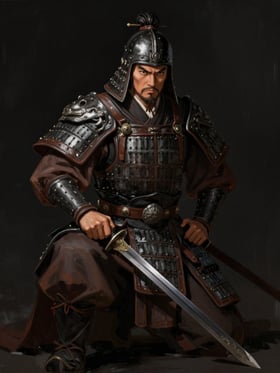
Fu Tong, a Shu Han general, died refusing to surrender as rearguard in the retreat from Wu; the novel has him die protecting the emperor.
Life
In the novel: 3 chapters · In the Records: 2 volumes
Life?–222
Appearances
On the boards
Compare with someone →Where this person ranks on each board.
Historical Record
In historical accounts, Fu Tong’s name is written as “傅肜.” He was from Yiyang and served as a Shu Han general. When Liu Bei launched Liu Bei's Eastern Campaign (Battle of Xiaoting) against Wu and his army retreated, Fu Tong was ordered to bring up the rear and hold off the enemy. After his soldiers had all been killed, a Wu general urged him to surrender. He rebuked him sharply: “Dogs of Wu! When has a Han general ever surrendered?” He then died in battle. The account presents him as a steadfast patriot who gave his life for his state. The Shu Ji, cited in Pei Songzhi’s annotations, also records an imperial edict by Emperor Wu of Jin stating that Fu Tong had died fighting for Liu Bei and praising his loyalty alongside that of his son, Fu Qian. Fu Qian later served as Left Central Gentleman and Inspector of Guanzhong, and was entrusted with a critical mission in the sixth year of Jingyao. Commentators praised the loyalty of father and son across generations.
Fu Tong also appears in accounts of the deployments during the Yiling campaign against Wu. Liu Bei advanced from Wu Gorge and Jianping to the area around Yiling, establishing camps and appointing Feng Xi as chief commander, Zhang Nan to lead the vanguard, and Fu Tong and others as commanders of separate detachments. This indicates that he held command over a separate detachment, but gives no details of his specific actions in battle.
In the Novel
Romance of the Three Kingdoms portrays Fu Tong as a central-army guard in the campaign against Wu, placing him in a continuous sequence of events from Liu Bei’s departure to the defeat at Yiling and Fu Tong’s death while covering the retreat. The novel says that Liu Bei set out on campaign in the first year of Zhangwu, with Fu Tong and Zhang Yi serving as central-army guards. This role and the specific military organization belong to the novel’s narrative and should not be conflated with historical accounts.
The novel first depicts Fu Tong stationed at the fourth camp south of the Yangtze. When Chunyu Dan launched a night raid, Fu Tong met him with his spear and forced him to retreat. Zhao Rong, Shamoke, and other Shu troops then ambushed the Wu army, which escaped only after Xu Sheng and Ding Feng came to its aid. The Records of the Three Kingdoms does not record this night battle or any details of a clash between Fu Tong and Chunyu Dan.
After the fire attack, the novel has Fu Tong rejoin Liu Bei amid the chaos and accompany him toward Ma’an Mountain. When the Wu army surrounded the mountain, Zhang Bao and Fu Tong defended the pass. During the breakout the next day, Fu Tong volunteered to bring up the rear and cover Liu Bei’s westward retreat. Later, when Ding Feng urged him to surrender, Fu Tong shouted, “I am a Han general—how could I surrender to the dogs of Wu?” He fought to the death and ultimately died spitting blood. This episode heightens his image as a loyal, resolute hero; the specific details of defending the camp, protecting Liu Bei, the breakout from Ma’an Mountain, and dying after spitting blood are not attested in the Records of the Three Kingdoms.
Key Relationships
In historical accounts, Fu Tong’s relationship with Liu Bei is shown through his holding off the enemy and dying in battle while covering Liu Bei’s retreat from the campaign against Wu. The novel goes further, having him accompany and protect Liu Bei during the retreat and bring up the rear during the breakout from Ma’an Mountain. Fu Qian was his son. Historical accounts state that Fu Qian later held office and was entrusted with a critical mission in the sixth year of Jingyao; father and son were both praised for their loyalty. The novel’s portrayal of Fu Tong’s words and deeds in battle dramatizes this theme of hereditary family loyalty.
Signature Scenes
The scene that best represents Fu Tong in historical accounts is his holding the rear during the retreat: after all his soldiers had fallen, a Wu general called on him to surrender, but he refused on the grounds that a Han general would not submit to Wu, and died in battle. The Records of the Three Kingdoms provides no information about the forces involved, the location, or the duration of the battle, so details from the novel should not be added to the historical account.
The signature scene found only in the novel is Fu Tong’s last stand after the breakout from Ma’an Mountain. He declares that he will give his life to protect Liu Bei, then finds himself surrounded by Wu troops. When Ding Feng urges him to surrender, he refuses fiercely, fights on without retreating, and ultimately dies spitting blood. This expands the historical account’s core of “holding the rear, refusing to surrender, and dying in battle” into a dramatic climax, making his loyal and heroic image especially vivid. (Novel-only)
Quotes
3 lines in the books · 2 featured
「臣願以死當之!」
This line shows Fu Tong's loyalty and courage and his willingness to die for his country, shaping his image as a loyal minister.
「吾乃漢將,安肯降吳狗乎!」
This line reveals Fu Tong's unyielding integrity, choosing death over submission, and is highly distinctive.
Family, lords and rivals
1 relationships

Who is Fu Tong connected to?
Pick someone to see how many steps lie between them and Fu Tong.
Combat
On the field
Duels, kills and executions as the texts tell them, counted separately for the Records and the Romance.
- RomanceCh. 84DuelChunyu DanWon「挺槍直取淳于丹;丹敵不住,撥馬便回」
Events
Events (1)
Battles and events the texts place this person in, by date.
Battles
Continue
Fu Qian
Kin
Inner monologues · AI-generated1 monologue ▸
- The mountain winds carried the smoke of burning fires, and the roads were filled with soldiers fleeing in panic. I had b