Overview
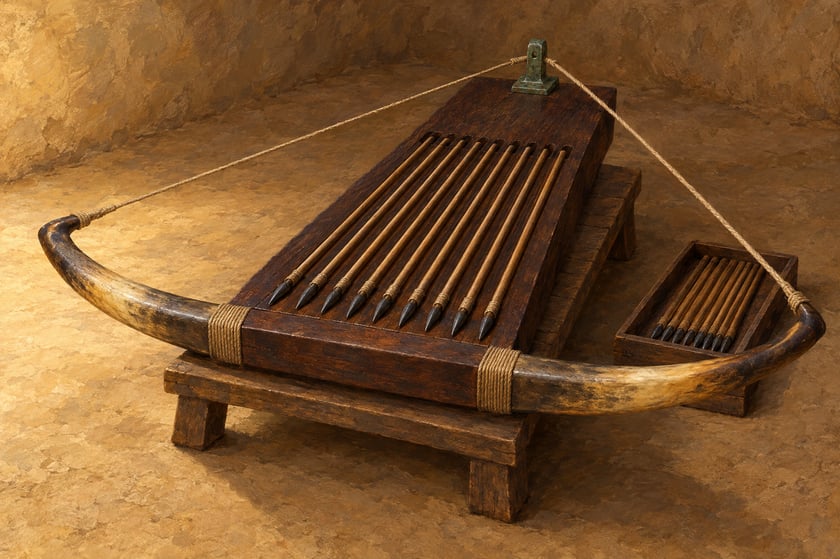
The Zhuge Crossbow was a repeating crossbow improved by Zhuge Liang. The Records of the Three Kingdoms stated that he “modified the repeating crossbow” according to his own ideas. Pei Songzhi's commentary quoted the Weishi chunqiu as saying that this crossbow was called “Yuanrong,” used iron bolts eight cun long, and fired ten bolts simultaneously from a single crossbow. “Zhuge Crossbow” was a later name dating to the Ming dynasty; neither work uses this name.
Origins
According to the biography of Zhuge Liang in the Records of the Three Kingdoms, Zhuge Liang excelled at ingenious designs: he improved the repeating crossbow, devised the Wooden Ox and Flowing Horse, and developed military tactics to create the Stone Sentinel Maze.
Provenance
In chapter 104 of Romance of the Three Kingdoms, Zhuge Liang falls gravely ill during the Battle of Wuzhang Plains. He tells Jiang Wei that he has a design for a repeating crossbow, with bolts eight cun long and the capacity to fire ten bolts from a single crossbow. He has drawn up all the plans but has never used it, and instructs Jiang Wei to manufacture and use it according to the design. Jiang Wei bows and accepts.
Notable Episodes
Pei Songzhi's commentary quoted a preface that Fu Xuan wrote for Ma Jun: after examining Zhuge Liang's repeating crossbow, Ma Jun remarked, “Ingenious it certainly is, but it is not yet perfected,” and said that if he were to make it, he could “increase it fivefold”.
Pei Songzhi's commentary quoted the Shu ji as saying that Liu Hong, the Jin General Who Guards the South, visited Zhuge Liang's former residence at Longzhong to pay his respects and ordered Li Xing to compose a stone inscription. It included the words, “The power of the divine crossbow—how subtle and marvelous!”
At the end of chapter 107 of the Romance, Jiang Wei retreats in defeat to Yangping Pass, and Sima Shi pursues him and attempts to seize the pass. Crossbows concealed on both sides fire together, each discharging ten bolts. The novel says that this is the repeating-crossbow design Zhuge Liang left behind at his death; the episode takes place during Jiang Wei's Later Northern Expeditions. The opening of chapter 108 continues the account: using this design, Jiang Wei conceals more than a hundred repeating crossbows on both sides in front of the pass, all firing poisoned bolts. Countless men and horses in Sima Shi's vanguard are killed or wounded, and Sima Shi escapes through the chaos of his army.
In chapter 116 of the Romance, the Shu general Lu Xun defends Nanzheng, called “Nanzheng Pass” in this chapter. He conceals soldiers on either side of the wooden bridge in front of the pass and sets up the ten-bolt repeating crossbows left behind by Zhuge Liang. The Wei vanguard commander Xu Yi attempts to seize the pass, but several dozen of his horsemen are shot down, and he hastily withdraws his troops; Zhong Hui comes in person to inspect the pass, but he too comes under a volley of arrows and crossbow bolts, turns his horse, and retreats. This battle takes place as the Wei army invades Shu and advances toward Hanzhong; see Conquest of Shu by Wei.
History and the Romance
The two works agree on two points: the bolts were eight cun long, and a single crossbow fired ten bolts. Zhuge Liang's statement in the novel, “The bolts are eight cun long, and a single crossbow can fire ten bolts,” accords with the Weishi chunqiu passage quoted in Pei Songzhi's commentary: “The bolts were eight cun long, and a single crossbow fired ten bolts simultaneously”.
Zhuge Liang passing the repeating-crossbow design to Jiang Wei on his deathbed, Jiang Wei using repeating crossbows at Yangping Pass, and Lu Xun using them at Nanzheng Pass to hold off the Wei army are all episodes from the novel; the Records of the Three Kingdoms does not record them.
Scholarship
According to later research, the Ming-dynasty Zhuge Crossbow was an imagined reconstruction made by Ming craftsmen under Zhuge Liang's name. No images or surviving examples of Zhuge Liang's original crossbow are available, only written descriptions.
One view holds that repeating crossbows had existed long before, with examples excavated from Chu tombs of the Warring States period.