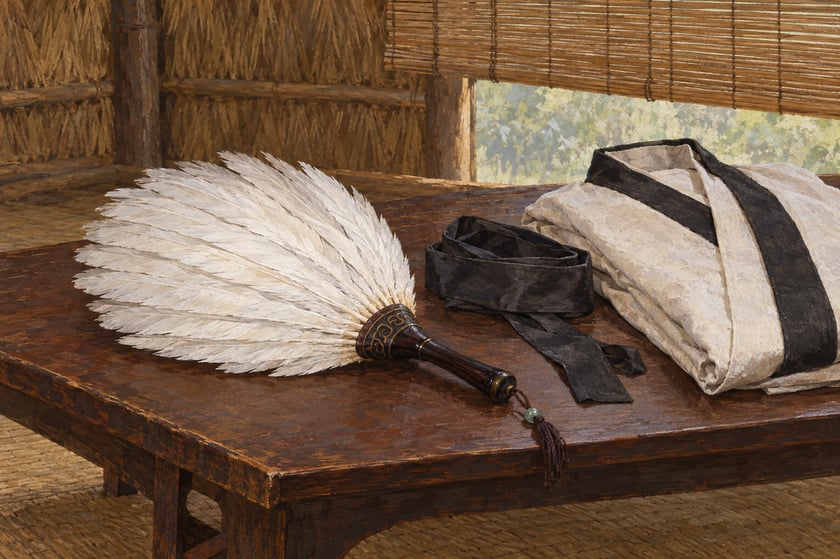
Overview
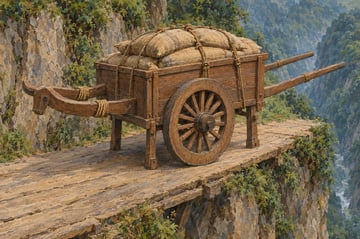
The Feather Fan is the fan held by Zhuge Liang in Romance of the Three Kingdoms. In chapter 52, Zhuge Liang takes the field seated upright in a Four-Wheeled Carriage, wearing a silk headscarf and a crane-feather cloak, with the Feather Fan in hand. The Feather Fan, silk headscarf, crane-feather cloak, and Four-Wheeled Carriage all form part of the description of Zhuge Liang’s attire and equipment; the headscarf and cloak are also covered on this page. In later times, the fan is commonly called a goose-feather fan.
In the novel, the silk headscarf and crane-feather cloak sometimes appear without the fan. In chapter 38, when Liu Bei first meets Zhuge Liang on his third visit, he sees him wearing a silk headscarf and a crane-feather cloak, “with an ethereal air, like an immortal”; this passage does not mention the Feather Fan. In chapter 95, during the Empty Fort Strategy, Zhuge Liang likewise wears a crane-feather cloak and silk headscarf as he burns incense and plays the zither before the defensive tower atop the city wall.
Notable Episodes
All the following episodes are recounted in Romance of the Three Kingdoms.
During Liu Bei's Seizure of the Four Southern Jing Commanderies, Zhuge Liang leads troops to take Lingling. Holding the Feather Fan as he sits in his Four-Wheeled Carriage, he beckons to Xing Daorong with it and urges him to surrender.
During the Seven Captures of Meng Huo, King Mulu chants spells and shakes a bell, raising a fierce wind. Zhuge Liang waves the Feather Fan, and the wind blows back toward the southern tribes’ battle lines.
The Feather Fan also serves as an instrument of command. In chapter 97, Zhuge Liang signals with it, and the two forces led by Ma Dai and Zhang Ni charge out. In chapter 100, during a contest of battle formations with Sima Yi, he enters the ranks and waves the Feather Fan, arranging his troops in the Eight Trigrams Formation.
In chapter 101, Zhuge Liang uses a stratagem of supernatural disguises and decoy troops to harvest wheat. When Sima Yi leaves his camp, he sees “Kongming” in a carriage, wearing a pinned ceremonial cap and crane-feather cloak and waving the Feather Fan. Twenty-four men flank him with loose hair and swords in hand, looking vaguely like heavenly spirits. The figures of “Kongming” in the carriages in this chapter are mostly decoys.
After Zhuge Liang’s death, in chapter 104, Sima Yi pursues the Shu troops and sees “Kongming” in a Four-Wheeled Carriage, with silk headscarf and Feather Fan, crane-feather cloak and black sash. Greatly alarmed, he flees. Two days later, villagers report that the Kongming in the carriage is a wooden figure. This is Zhuge Liang’s stratagem of using a wooden likeness to repel the enemy.
In chapter 116, after Zhong Hui makes offerings at the tomb of Marquis Wu, he dreams that night of a man entering his tent with silk headscarf and Feather Fan, dressed in a crane-feather cloak. Upon waking, he realizes it was the spirit of Marquis Wu. This is an episode of supernatural manifestation in the novel.
In chapter 117, before the battle lines at Mianzhu, a figure sits in a Four-Wheeled Carriage with silk headscarf and Feather Fan, wearing a crane-feather cloak and a square-hemmed robe. Shi Zuan and Deng Zhong believe Kongming is still alive and hastily withdraw their troops. Scouts return to report that the figure seated in the carriage is a carved wooden likeness of the deceased Kongming. This is Zhuge Zhan’s stratagem of using a carved wooden image of Kongming.
History and the Romance
Records of the Three Kingdoms does not record Zhuge Liang holding a Feather Fan.
Scholarship
According to the Shu shu, as quoted in a note in juan 687 of the Taiping yulan, when Marquis Wu, Zhuge Liang, and King Xuan were about to do battle on the banks of the Wei, King Xuan sent someone to observe him. The observer saw Marquis Wu “riding in a plain carriage, wearing a kudzu-cloth headscarf, and directing the armies with a feather fan.” King Xuan exclaimed, “He may truly be called an eminent gentleman.” This is the wording of the Shu shu as quoted in the Taiping yulan, which writes the term as maoshan (毛扇).
In addition, the second stanza of Su Shi’s Niannujiao · Chibi huaigu, recalling Zhou Yu’s achievements with admiration, contains the lines: “With feather fan and silk headscarf, amid talk and laughter, masts and oars turn to flying ash and vanishing smoke.”