In 225, the third year of the Jianxing era, Shu Han chancellor Zhuge Liang led an army on a southern campaign and pacified the four commanderies of Nanzhong. According to the relevant accounts, after capturing Meng Huo, he had him inspect the military camps and formations, capturing and releasing him seven times in succession. Meng Huo ultimately declared that the southerners would no longer rebel. Thereafter, Zhuge Liang appointed local leaders to govern Nanzhong, did not keep troops stationed there for long or transport grain there, and reorganized and prepared the army for the northern campaigns that followed.
The history, in the Han-Jin Annals, only records that when Zhuge Liang heard that Meng Huo “was respected by the Yi and Han peoples,” he recruited men to capture and bring him in; after being captured and released seven times, Meng Huo submitted wholeheartedly, after which they reached Dian Lake and Nanzhong was pacified. The account is extremely brief, focusing on his wholehearted submission rather than specific battles.
Romance
Chapters 87 to 90 of the novel expand this process into a continuous narrative of seven captures and releases, adding numerous invented episodes, including King Mulu driving beasts, Lady Zhurong’s flying knives, the rattan-armored army, and the burning of Panshe Valley. A single line in the historical account is expanded into a full four-chapter fantasy war epic.
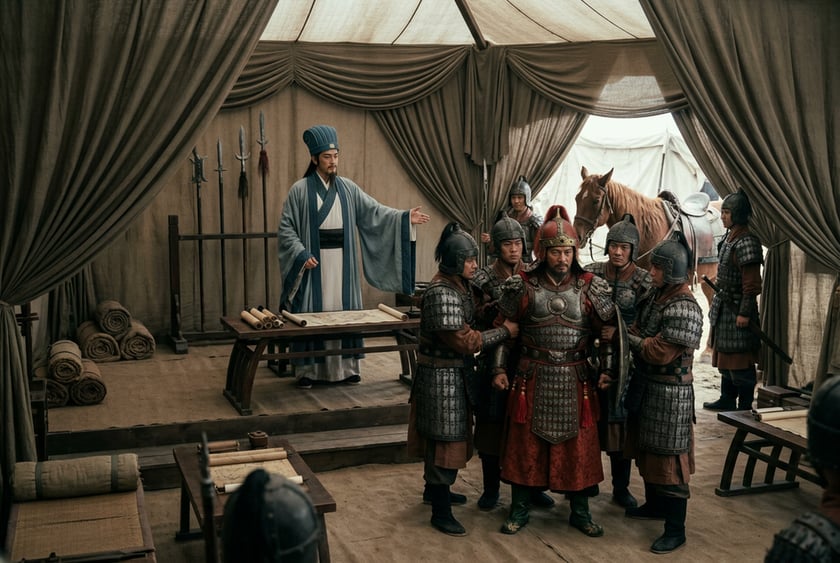
In a military tent, Meng Huo is escorted by soldiers to stand before Zhuge Liang. His expression is unyielding, while Zhuge Liang smiles and gestures for the soldiers to release him.
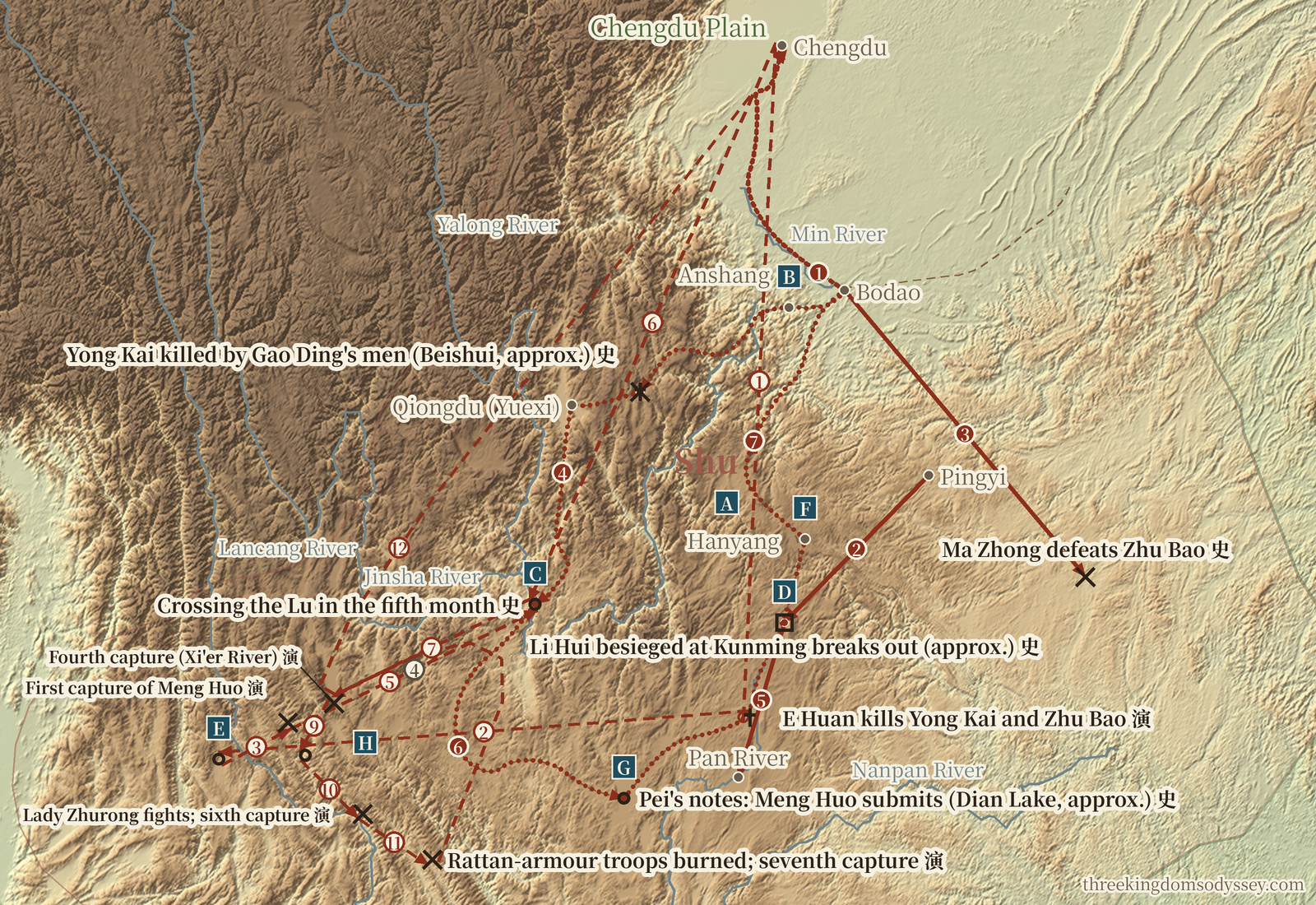
7Zhuge Liang falls back to ChengduRecords of the Three Kingdoms, juan 33Records of the Three Kingdoms, juan 41方国瑜:诸葛亮南征的路线考说(滇史网)
In the Romance
1Zhuge Liang and Zhao Yun and Wei Yan and Wang Ping and Zhang Yi marches on the Nanzhong area500,000 Shu troopsNovelRomance of the Three Kingdoms, ch. 87
2Zhuge Liang marches on Yongchang (Buwei)Romance of the Three Kingdoms, ch. 87
3Zhuge Liang and Zhao Yun and Wei Yan marches on Jindai MountainRomance of the Three Kingdoms, ch. 87
4Meng Huo falls back to Lu River crossingRomance of the Three Kingdoms, ch. 88
5Zhuge Liang marches on Lu River crossingRomance of the Three Kingdoms, ch. 88
6Ma Dai reinforces Lu River crossing3,000 menNovelRomance of the Three Kingdoms, ch. 88
7Zhuge Liang marches on Xi'er RiverRomance of the Three Kingdoms, ch. 88Romance of the Three Kingdoms, ch. 89
8Meng Huo and Meng You falls back to Tulong CaveRomance of the Three Kingdoms, ch. 89
9Zhuge Liang marches on Tulong CaveRomance of the Three Kingdoms, ch. 89
10Zhuge Liang marches on Yinkeng Cave (Sanjiang)Romance of the Three Kingdoms, ch. 90
11Zhuge Liang and Wei Yan marches on Coiled Snake Valley (Taohua Ford)Romance of the Three Kingdoms, ch. 90
12Zhuge Liang falls back to ChengduRomance of the Three Kingdoms, ch. 91
The Sanguozhi's main text does not mention Meng Huo; the seven captures come from the Han Jin Chunqiu in Pei Songzhi's notes, which the novel spins into four chapters.
The books mostly say only where an army set out and arrived: a Records line is solid between the places they name and dotted where it follows a reconstructed road between them; an open ring marks an end the books don't give.
Why these routes
AThree commanderies, three rebels: Gao Ding in Yuexi, Yong Kai in Jianning, Zhu Bao in Zangke. So three columns: Zhuge Liang by Yuexi, Li Hui to Jianning, Ma Zhong to Zangke.Schol.Records of the Three Kingdoms, juan 43Zhuge Liang's Southern Campaign (Wikipedia)
CThe memorial says he 'crossed the Lu in the fifth month'. Where is disputed: Fang Guoyu puts it at Sanjiang (Lixi, Huili); the Historical Atlas of China near Yuanmou.Schol.Records of the Three Kingdoms, juan 35方国瑜:诸葛亮南征的路线考说(滇史网)
DLi Hui's column, alone, was ringed at Kunming by twice his numbers with no word from Zhuge Liang; he pretended to join the rebels and broke out once the siege grew slack.Hist.Records of the Three Kingdoms, juan 43
EYongchang lay west of Yizhou commandery, its roads blocked and cut off from Shu; Lü Kai and Wang Kang still closed its borders to Yong Kai, an island behind the rebels.Hist.Records of the Three Kingdoms, juan 43
FThe army did not go home the way it came: Fei Shi's biography has it return 'to Hanyang', so Fang Guoyu routes it from Dian by Wei and Hanyang (Weining) north to Bodao.Schol.Records of the Three Kingdoms, juan 41方国瑜:诸葛亮南征的路线考说(滇史网)
GThe Sanguozhi's main text says only that he went south in spring and 'by autumn all was pacified'; Meng Huo is not in it. The seven captures come from Pei's notes.Schol.Records of the Three Kingdoms, juan 35Zhuge Liang's Southern Campaign (Wikipedia)诸葛亮南征(维基百科)
HIn the novel Kongming reaches Yongchang before crossing the Lu and the Xi'er; Tulong, Yinkeng and Coiled Snake Valley have no known site and follow the novel's directions.Infer.Romance of the Three Kingdoms, ch. 87Romance of the Three Kingdoms, ch. 88Romance of the Three Kingdoms, ch. 89
Base map: Natural Earth; terrain: AWS Terrain Tiles (SRTM and others). Roads and marches reconstructed from the sources listed; positions approximate.
In 225 (the third year of Jianxing), after Liu Bei’s death, several commanderies in Nanzhong rebelled: Gao Ding, Yong Kai, and Zhu Bao each controlled a separate area, and Yong Kai had also once allied himself with Eastern Wu. Zhuge Liang led a southern campaign, seeking both to restore Shu Han’s control over its outlying commanderies and to avoid weakening its defenses against Wei and Wu through a prolonged expedition. The Records of the Three Kingdoms states that Zhuge Liang set out in spring and pacified Nanzhong by autumn; however, this summary cannot directly prove that every battle in the later “Seven Captures of Meng Huo” narrative occurred as described in the novel.
The record of military events must be distinguished from the dramatized narrative. The Han-Jin Chunqiu, quoted in the Records of the Three Kingdoms, does report that after Meng Huo was captured, he was allowed to fight again, and records that he was “released seven times and captured seven times”; it also says Meng Huo expressed his submission to Zhuge Liang’s virtue and authority. The Romance of the Three Kingdoms, however, expands this into a connected series of captures and releases, efforts to win hearts and minds, and eventual submission. Thus, the “seven captures” are not entirely without a basis in historical sources, but the precise number, dialogue, and tactical details should still be assessed cautiously in light of the different layers of evidence.
Main Figures
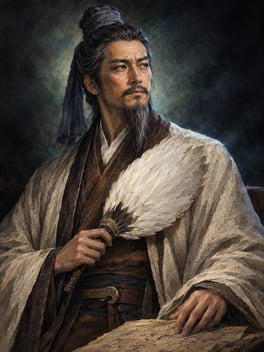
Zhuge Liang was both commander and political strategist. The focus of the historical sources is not simply the destruction of enemy forces, but how to govern after conquest: he appointed local leaders, avoided keeping outside troops stationed there for long periods, and refrained from continuously transporting grain from the interior. He also explained the risks posed by leaving troops behind, supplying them, and the mutual distrust between Han and non-Han peoples. This policy shows that the goal of the southern campaign was not merely military victory, but restoring order at a lower cost of garrisoning the region.
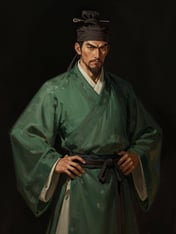
In the surviving accounts, Meng Huo serves to concentrate scattered local resistance in a single political figure with whom negotiations could be conducted. The histories describe him as respected by both non-Han and Han people, so his submission carried significance beyond that of an individual surrender. But the Records of the Three Kingdoms does not provide enough information for us to know what kind of alliance he represented or what stable organizational authority he held. Ma Su’s advice to “win hearts and minds as the first priority” appears mainly in the Romance of the Three Kingdoms and should not be treated as a historical quotation confirmed by the sources cited here.
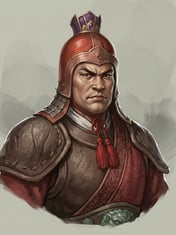
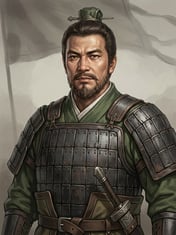
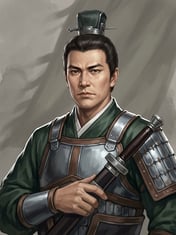
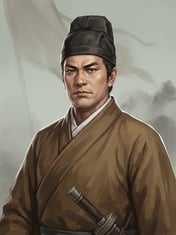
Yong Kai, Gao Ding, and Zhu Bao represented local political networks behind the rebellion, but they should not simply be viewed as a completely unified group. According to the record, before Zhuge Liang reached Nanzhong, Yong Kai had already been killed by men under Gao Ding’s command. The novel goes further, depicting E Huan and Gao Ding cooperating with Zhuge Liang, who undermines the alliance by releasing prisoners and using schemes to sow discord. Wang Ping, Wei Yan, Zhang Yi, and others are given specific military roles in the novel, while E Huan is also portrayed as a key general. These details can be used to analyze how literature depicts a commander’s stratagems, but they should not be conflated with what the histories explicitly record.
Key Issues
The first issue is how military victory can be turned into sustainable rule. The region’s remoteness, difficult transport, and lack of stable trust between local society and the Shu Han government meant that repeated garrisoning was both costly and liable to intensify resistance. Zhuge Liang’s decision to appoint local leaders was a way of turning military control into indirect governance: local authority was retained while being brought within the order of Shu Han. This approach reduced the burden of logistics, but also meant that central power depended on the cooperation of local elites; it was neither unconditional nor risk-free control.
The second issue is whether “leniency” was benevolent rule or a tool. The Seven Captures narrative explains the repeated releases as a way to win Meng Huo’s wholehearted submission, presenting a form of political integration backed by deterrence and achieved through recognition and appeasement. This was not simple tolerance: Zhuge Liang first used his military advantage to force his opponent to the negotiating table, then made surrender appear voluntary and politically meaningful by releasing him. Such a narrative may also compress complex local conflicts into the story of a “barbarian king” being won over, downplaying the independent actions of commandery officials, local communities, and regional alliances.
Political Consequences
As for the immediate outcome, the histories state that all four commanderies were pacified after the southern campaign, that the administrative divisions were subsequently reorganized, and that Zhuge Liang returned to Chengdu in the twelfth month. Another passage also says that local leaders were appointed after Nanzhong was pacified. This shows that the campaign was accompanied by administrative reorganization and governance through local proxies, rather than being merely a punitive expedition. “Pacification” is the histories’ summary of the campaign and the restoration of government; it does not justify inferring that Nanzhong saw no further conflict afterward, or that Shu Han established undisputed direct rule there.
From Shu Han’s strategic perspective, order in Nanzhong was linked to manpower, supplies, and the security of the rear. The sources state that the region provided military supplies, making the state prosperous. Zhuge Liang subsequently reorganized and readied his troops for war, and in the fifth year of Jianxing moved north to Hanzhong. The southern campaign can therefore be understood as part of the preparations for the northern expeditions: eliminating threats to the rear, reducing the costs of long-term garrisoning and transport, and gaining the strategic initiative. But its success still depended on whether local leaders continued to cooperate; short-term gains in resources should not be equated with stable political integration.
Counterfactual Analysis
If Zhuge Liang had opted for long-term garrisons and direct control of each locality by officials from outside the region, the central government might have gained stronger immediate oversight, but it would have had to commit troops and supplies continuously. The prolonged presence of troops might also have made it harder for local society, already damaged by the fighting, to recover. Zhuge Liang himself argued that this approach would be difficult to carry out because troops left behind would be hard to supply, the non-Han people had recently suffered casualties, and the two sides distrusted each other. The counterfactual, then, is not that “a hard line would necessarily have failed,” but that a forceful occupation might have brought more direct control at a higher fiscal cost, without necessarily making that control more secure.
Conversely, if the campaign had relied on clemency alone, without military pressure, local leaders might have taken it as a sign that Shu Han lacked the ability to intervene continuously, potentially leading to renewed rebellion. The Seven Captures story emphasizes a combination of deterrence and incorporation, but the historical sources do not prove that this model could be mechanically replicated, nor do they support the claim that Meng Huo’s submission alone determined Nanzhong’s long-term fate. The most cautious conclusion is that, according to the accounts, Zhuge Liang’s southern campaign achieved a measure of pacification and brought material benefits, while its long-term stability remains uncertain. The “Seven Captures” is both a paradigmatic narrative of political strategy and a historical memory through which later generations personalized and moralized complex problems of governance.