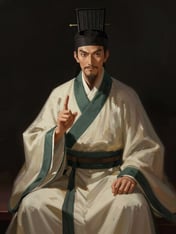
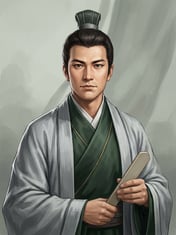
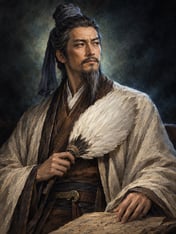
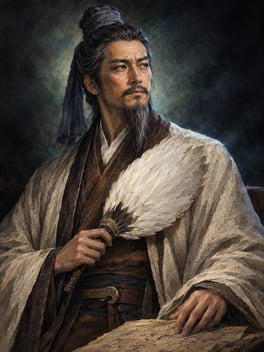
In the second year of Jianxing (224), Eastern Wu dispatched the Colonel-Director Zhang Wen to Shu on a return courtesy visit. Shuhan Chancellor Zhuge Liang selected Qin Mi to serve as Acting Registrar and go out to receive him. Zhang Wen, not seeing Qin Mi already at the farewell banquet, asked "who is that man?", to which Zhuge Liang replied "a scholar of Yizhou." When Qin Mi arrived at the feast, Zhang Wen pressed him repeatedly with questions — "Does Heaven have a head? Does it have ears? Does it have feet? Does it have a surname? Does the sun rise in the east?" — and Qin Mi answered each in turn by citing the Book of Odes: "It turns and looks westward" [for Heaven having a head], "the crane cries in the deep marshes, its voice heard up to Heaven" [for ears], "Heaven's path is steep and difficult" [for feet], and to "Does Heaven have a surname?" he replied "the Son of Heaven's surname is Liu," and to "Does the sun rise in the east?" he replied "though it rises in the east, it sets in the west". Qin Mi's answers drew on the Odes, came effortlessly and with measured poise, and in the end won Zhang Wen's genuine admiration. Chapter eighty-six of San Guo Yanyi moves the scene to a farewell gathering at the postal station south of the city — Qin Mi enters in a state of mild intoxication, Zhang Wen taunts him by asking whether his chest holds any learning at all, and Qin Mi replies that from astronomy to geography, from the Three Teachings and Nine Schools to the Hundred Schools of Thought, there is nothing he does not know, after which the same exchange about Heaven's head, ears, feet, and surname unfolds, ending with Zhang Wen doffing his arrogance and bowing in deference. The episode confirmed the caliber of Shuhan's scholars and reinforced the cultural parity that underpinned the Wu-Shu alliance.
The Biography of Qin Mi in the Shu Book of the Records of the Three Kingdoms recounts this episode in the second year of Jianxing, when officials held a farewell banquet for an envoy from Wu. Qin Mi had not yet arrived, and Zhuge Liang repeatedly sent messengers to hurry him along. When Qin Mi arrived, Zhang Wen challenged him with five questions at the banquet. Qin Mi answered instantly by citing the Book of Songs, and Zhang Wen was “greatly impressed”; the entire account emphasizes Qin Mi’s talent for literary debate and the practical value of his command of the classics.
Romance
Chapter 86 of the novel sets the scene at a farewell gathering the next day at a postal pavilion south of the city. Qin Mi “enters in a drunken state and gives a proud, sweeping salute,” and the novel adds dramatically forceful lines such as “Even three-foot-tall children in Shu all attend school, let alone me.” Qin Mi is thus transformed from the learned diplomat of the historical account into an eloquent speaker with the air of an unrestrained eccentric.
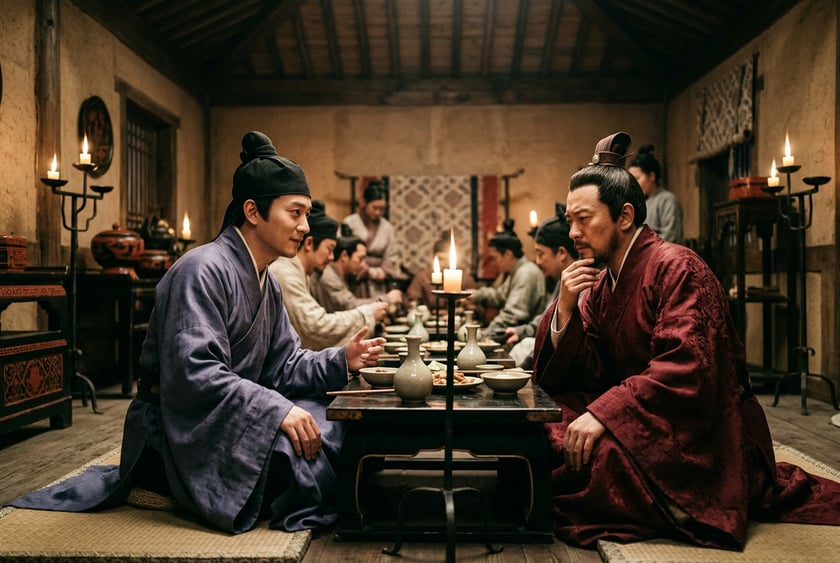
At a banquet, Qin Mi and Zhang Wen sit facing one another. Qin Mi answers Zhang Wen's many questions with a composed expression, while Zhang Wen looks thoughtful.
Qinmiyingduizhangwen — Qin Mi's exchange with Zhang Wen — occurred at an exceptionally critical juncture: the second year of Jianxing (224) fell exactly two years after the defeat at Yiling (222) and one year after Liu Bei died at Baidicheng (223). Shuhan was now governed by Zhuge Liang, and urgently needed to rebuild the Wu-Shu alliance to meet the pressure from Caowei to the north. Before this, Deng Zhi's mission to Eastern Wu had already broken the diplomatic ice. Zhang Wen's entry into Shu as Wu's reciprocal envoy carried a significance far beyond a courtesy return visit — he was an "on-the-ground observer" dispatched by Sun Quan, and his report on the true state of the Shuhan regime (its scholarly culture, governance, and intellectual level) would directly shape Sun Quan's judgment of the alliance's reliability. Zhuge Liang understood this clearly, which is why he carefully designed several "cultural showcase windows" within the ceremonial rhythm of Zhang Wen's visit to Shu: the send-off banquet attended by all officials was one; arranging for Qin Mi to appear was another. Seen from this angle, the meeting that appears on the surface to be an exchange among men of letters was in reality an examination of whether Shuhan possessed the cultural confidence of an independent empire.
The Dialogue
When Zhang Wen took his seat, Qin Mi had not yet arrived, and Zhang Wen asked with a touch of condescension, "Who is that man?" Zhuge Liang replied, "A scholar of Yizhou." This arrangement was itself Zhuge Liang's design of "suppressing first to elevate later" — letting Zhang Wen feel slightly slighted before Qin Mi made his entrance. After Qin Mi arrived, Zhang Wen opened with the first question: "Are you a man of learning?" Qin Mi replied, "Even a child of five feet studies — why should I be any different?" — shifting the subject from the individual to the scholarly culture of all of Shu. Five questions then unfolded: Does Heaven have a head? (Answer: "Yes, in the west — as the Odes say, 'He deigns to look westward.'") Does Heaven have ears? (Answer: "Heaven dwells on high but hears what is below — as the Odes say, 'The crane cries in the marshes of Jiugao, its voice heard in the heavens.'") Does Heaven have feet? (Answer: "As the Odes say, 'Heaven's steps are hard and toilsome.'") Does Heaven have a surname? (Answer: "Its surname is Liu — I know this because the Son of Heaven's surname is Liu.") Does the sun rise in the east? (Answer: "Though it rises in the east, it sets in the west.") Every answer accomplished three things: invoked classical authority through textual citation; brought an abstract question down to a concrete, demonstrable level; and, on the question of Heaven's surname, deftly embedded the political legitimacy of the Han imperial house of Liu Shi into the response. Throughout the exchange, answers came "as fast as echo follows sound," and under the twin pressure of pace and density of citation Zhang Wen was left with "deep admiration and respect". The romance version adds a scene in which Qin Mi enters "flushed with drink" and opens with a self-promotional declaration of mastering "everything from celestial phenomena above to terrestrial matters below," dramatizing the scholarly temperament into something approaching that of an eccentric.
Outcome
The meeting produced no treaty or formal agreement, yet its diplomatic effect was immediate. Zhang Wen returned from Shu with an impression of the regime's cultural level that erred on the side of overestimation rather than underestimation — and that had a decisive influence on Sun Quan's assessment of "whether the Wu-Shu alliance was worth maintaining over the long term." From Sun Quan's vantage, the cost of the alliance was strategic restraint regarding Jingzhou; the benefit was reduced pressure from Caowei to the north. If Shuhan appeared culturally shrunken and talent-depleted, the alliance's "political stock price" would fall in Sun Quan's mind and would over time be replaced by opportunistic wavering. Qin Mi's performance showed Zhang Wen precisely the opposite: that Shuhan, though it had lost Jingzhou and had a young new ruler, retained its scholarly spirit, its talented men, and its cultural confidence intact — the cheapest and most effective form of diplomatic communication. Within Shuhan itself, Zhuge Liang used the occasion to give Qin Mi very high political visibility before the assembled officials; that act of promotion itself strengthened Qin Mi's voice in domestic governance.
Historical Impact
The long-term influence of this event has three layers. The first layer established the paradigm of "conducting diplomacy through scholarly question and answer" in San Guo: after this, Wu and Shu missions traveled back and forth frequently, and similar exchanges (such as Sun Quan with Deng Zhi, and multiple rounds of Shuhan-Wu envoy meetings) became a diplomatic norm — a far more economical form of statecraft than armed conflict. The second layer shaped Qin Mi's dual positioning in history and literature: in the historical sources he is the archetype of "supplementing governance through literary accomplishment" in Zhuge Liang's administration of Shu; in the romance he becomes the representative of the Shuhan scholar who "overawes the envoy with words" — both threads cast him as the spokesman for the "scholarly culture of Yizhou." The third and deepest layer is that it demonstrated a distinctive political rhetorical strategy of "entering the exchange through the Odes." When a nascent regime needed quickly to establish legitimacy, proof through precise citation of canonical classics — demonstrating that it had inherited the orthodox cultural capital — was more effective than demonstrations of military might or material wealth. This strategy was employed repeatedly in the diplomatic interactions of the Northern and Southern Dynasties, the Tang, and the Five Dynasties; Qin Mi's few lines of response may be counted among the earliest and most complete specimens of that tradition. From this angle, the true weight of Qinmiyingduizhangwen lies not in Qin Mi's eloquence per se, but in its demonstration of a political mode that mobilizes scholarly resources to shape diplomatic perception — and that mode was precisely the key instrument by which the post-Yiling Shuhan, punching well above its weight, maintained the alliance.
Done reading?
Walk through The Persuader yourself
Debate the scholars of Wu, hide your ambition from Cao Cao, and more: win with words